Author: peter.j.martinson@gmail.com

  • Burn the Ships: How to Force Yourself to Risk Success

    Burn the Ships: How to Force Yourself to Risk Success

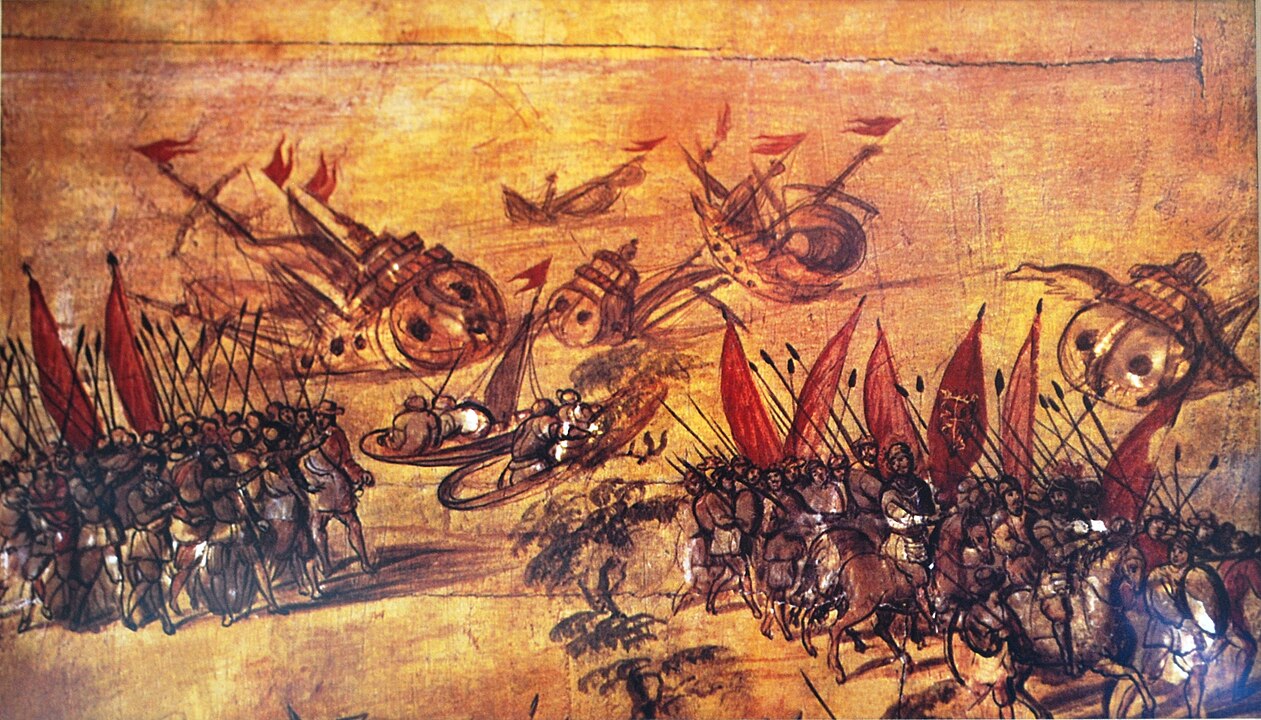
    In 1519, Hernán Cortés faced a crisis. His men, fresh off the boat in Iberoamerica, were terrified of the powerful Aztec death cult and plotting to retreat. His answer? He burned the ships.

    Cortez ensured there was no illusion of retreat. And while few of us are launching expeditions to conquer empires, we face equally paralyzing fears every day. We aren’t afraid of human sacrifice, but we are terrified of rejection, failure, and embarrassment.

    For example, success in business is dependent on building a network of people that will help you grow your enterprise. If you don’t ask someone to buy your thing, then nobody will buy your thing. But what if you suffer from social anxiety, and dying sounds like more fun than networking events?

    This article is about how to remove retreat as an option, and force yourself to risk success.

    Case Study: Phone Calls

    I have a habit of not making phone calls to anybody. Especially my family. I’ve gone years not talking to my parents, siblings, and other relatives, simply because I hate talking on the telephone.

    The phone calls are risky. What if I agree to do something I don’t want to do? What if I say something offensive? My family is pretty liberal, but I’ve turned, and now support Trump. What if they find out, and no longer love me? What if the call eats up my whole day?

    All of those are really empty fears, but they’re fear enough to make me put off a phone call until some future date, every time.

    A few months ago, I noticed that I rarely miss scheduled meetings at work, and it’s easy for me to send out a calendar appointment. I still get hit by anxiety before the actual meeting happens, but I almost always push through and do the meeting. And it usually goes much better than I anticipated.

    Then it hit me – an accepted meeting invite is more powerful than a thousand reminders.

    So, I started doing that with my family. If I wanted to call my Mom, I’d send her a text that says “Mom, I’m going to call you on X day at Y time. OK?” Then, even if I was nervous about making the call, I did it anyhow.

    Sending out that invitation burns the ships. No retreat.

    How it works

    Calling family is not really high stakes. How about making one sales pitch for your new product? Higher risk of failure, so higher risk of not making that pitch.

    In a previous article, I talked about removing friction to get things done. If you have to take two steps instead of one to perform an important action, you’re twice as likely to avoid that action. Removing all intermediate steps, though, makes it far easier to get it done.

    When you burn the ships, though, you’re adding friction. Friction becomes your friend. You’re adding friction in front of the action of avoidance. And, yes, avoidance is an action, sometimes more difficult to carry out than whatever it is you’re avoiding!

    An invitation that gets accepted introduces the friction of tarnished reputation. “If I ditch Ben today, I’ll look like a jerk.” Scheduling a presentation before an audience does the same. Anything that includes an acknowledgment by somebody that you will do something at a given time or place adds enough friction to make it hard to avoid.

    Burn a Ship Today!

    Here are three opportunities you could use today, to get yourself off the couch and into a potentially risky but profitable situation.

    1. Schedule a phone call

    That person you’ve wanted to call every weekend for the past forty weekends? Send him a text and ask if he’s available this Saturday at noon for a 30 minute phone call. Then call him.

    1. Pre-Sell the Ghost Product.

    Stop letting your idea gather dust. Email your 10 best contacts today with a non-refundable, steeply discounted pre-order price and a firm, 30-day delivery date. You don’t have a product yet, but now you have ten paying customers and a cash-backed deadline that makes retreat more expensive than work.

    1. Interview someone

    Email some idol of yours, and ask to set up an interview (phone, in person, whatever). Then, send them a Google calendar invite.

    There are all kinds of ways to leverage this tactic to make ourselves do the things we fear. What ship are you burning this week? Let me know in the comments below.

    If this article got you off the couch, please leave a comment, share it, and get on my email list!

  • Beyond Logic:  How to Listen to your Little Voice

    Beyond Logic: How to Listen to your Little Voice

    My youngest boy has been obsessed with the British band Muse recently, much to our chagrin because we want him to obsess over classical music. But, no, he takes his violin out, and uses it as an air guitar to play Uprising. He used to have a small toy acoustic guitar, which he smashed last week. Now he wants an electric guitar.

    Unplugged, an electric guitar is almost inaudible. Unless you are close by, you can’t hear it. However, plug it into the proper amplification, and the guitar’s sound can fill a large city block.

    Human beings play the part of amplifier as well, to an instrument that I call the Little Voice.

    This article presents what the Little Voice is, what I think its origin is, and how to use it. Once you understand that last part, you will become unstoppable.

    What is the Little Voice?

    When you are talking to a good liar, but you can tell they’re lying, how do you know? A good liar will never come out and say “I’m lying, sucker!”, and won’t give away any obvious clues.

    It’s hard to put your finger on the “tell”, or the unconscious mannerism or combination of facts, that gives away the lie.

    For another example, when viewing an AI generated image, you just can tell it’s not real. What in the image gave it away? Usually, after studying the picture a bit, you can find what actually tipped you off – uniformly unfocused lights, too many knuckles on the hand, face is too symmetrical, etc. But when you felt that tug that says “wait, this isn’t real…”, it wasn’t the result of logical deduction. It was almost an unconscious thought.

    The rule of thumb here is, if you think a person or image is lying, you’re probably right!

    That hunch you feel is the presence of the Little Voice.

    The Little Voice is Quiet

    As we go about our days, conscious thoughts hold reign. “Ugly pants”, “I need to email my boss”, “Pick up some toothpaste before getting home”, “ugh, that stinks”, and so forth.

    That Little Voice is there too, just too drowned out to hear.

    But if you can quiet down the loud voices and listen, you can hear that little guy, giving you all kinds of great ideas.

    Sometimes you might experience this is while reading, or while meditating (if you do that kind of thing), while praying, or while dreaming.

    For example, maybe one day you were pounding on a problem you found hard to solve, like a math problem or where to sit your Mom during Thanksgiving. Upon waking up the next day, you realize that the solution came to you in a dream. That’s your Little Voice too.

    Your Little Voice is what gives you your next great idea, helps you out of tough situations, and comes up with great punchlines to jokes. It’s the true source of your creativity.

    Who is the Little Voice?

    The concepts of the “conscious” and the “subconscious” mind are pretty standard in modern culture. You can think of the Little Voice as messages that get through to your conscious observation from your subconscious mind.

    While you’re going about your day, your subconscious is working out of sight. It takes whatever information you give it, like when you read a book, take a class, or watch a movie, and then it tries to make sense of it. The products of that work pop into your mind, as ideas.

    So, is the Little Voice, your voice?

    I read a great book recently, The Artist’s Way by Julia Cameron, all about how to reawaken your creativity. Reading that book is really what got me all excited about the Little Voice, though I’d had this concept from years ago. In it, Cameron suggests that that Little Voice is actually the voice of God. Then, she waves her hands a bunch to say you don’t have to believe in a great, bearded gentleman in the sky for her methods to work.

    But I think she’s not wrong. I think it’s one way that God expresses His love for His creation – he talks to us, and helps us.

    At the very least, it’s a playful, childlike part of you, that pipes up when you are listening for it.

    Whoever that voice belongs to, when you hear it, you should follow its advice.

    Learn to tune in that Little Voice

    Here are a few techniques that I use to hear my own Little Voice better. Maybe some of them will work for you.

    1. Walking

    A simple ten-minute walk fills that playful side of you with new sensations and helps you quiet the noise.

    1. Praying

    An ancient way to listen to that voice, the ultimate goal of prayer is to listen for the voice of God.

    1. Morning Pages

    This practice helps you squeeze out all the “pus-thoughts” to clear a space for creativity.

    1. Taking Action

    This is the most critical step. Cameron describes the voice like a curious child—you must follow its whims to show that you’re listening and encourage it to keep talking.

    Like the electric guitar, that Little Voice inside you is tiny and quiet. It is only through you that its will can be made manifest. You are the amplifier. Let that Little Voice sing.

    If you liked this article, please leave a comment below, share it with someone you know, and get on my email list!
  • Why Planning Less May Be a Better Plan

    Why Planning Less May Be a Better Plan

    Disclaimer: this post contains affiliate links. If you click on them and buy the products, I’ll get a cut of the profit. I promise they’re good products!

    Story time!

    I embarked on my productivity porn addiction back around 2013, when I discovered David Allen’s Getting Things Done (GTD). After skimming a bootleg version of his book on my tiny iPhone, I reckoned I had found the secret to life!

    In short, the goal of GTD is to offload all chores, plans, and to-do lists to a filing cabinet, to free your mind from the burden of remembering everything. Instead of never getting to large projects, you break all projects down into a series of smaller actions, listed on a piece of paper for you. Each day, you get a bunch of those next-actions in front of you and complete them.

    Instead of using your mind as your to-do list, you can now use your mind to be creative while still getting everything done.

    That’s it. Mind like water.

    (Before you true believers out there pillory me, yes there’s more to it. Like, the machine that prints out labels for all the file folders.)

    I got obsessed, bought two beat up filing cabinets, and filled them with file folders for everything in my life.

    And I just couldn’t keep up.

    I’ve since tried a few ways to approximate Allen’s write-out-all-steps approach, and sometimes have made a bit of progress. But I could never quite make it take off.

    The part that filled me with guilt and failure, was that I just couldn’t bring myself to take every project and break it up into action chunks. While dealing with this guilt, and getting some things done half-assed, I kept wondering if maybe there was another way.

    Then, a few days ago, it hit me. There is another way!

    In this article, I’ll describe this other way, which is more like mathematical induction than exhaustive introspection. And, I think both you and I will become happier and more productive in the end.

    Enjoy Failure

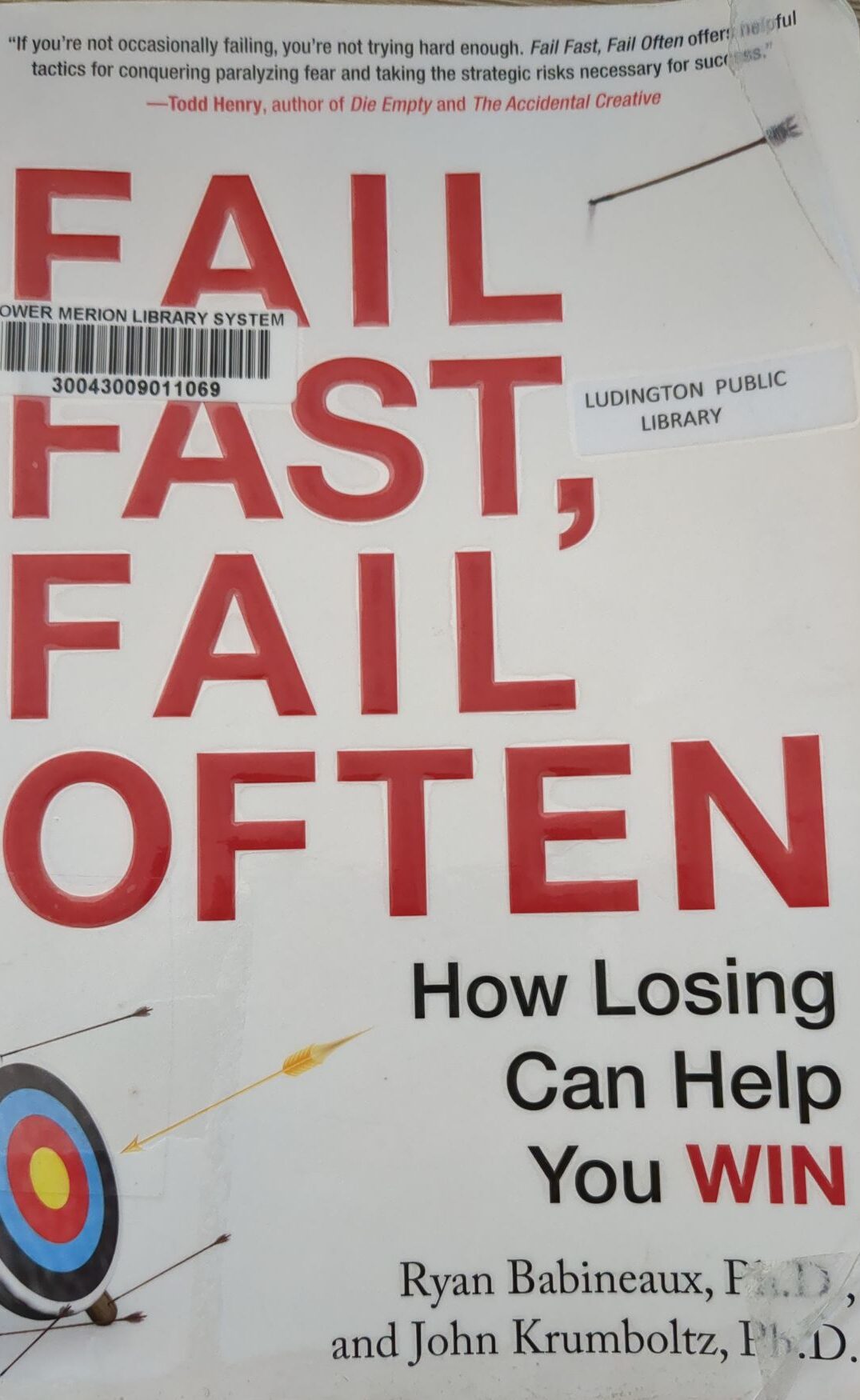
    I’m reading a book called Fail Fast, Fail Often, by John Krumboltz and Ryan Babineaux. Their strategy so far feels a little like a learned faith. They studied the happiness and success of over a bajillion people, and have come to the conclusion that the most successful and happy among us act first, and plan rarely.

    Most of us are the opposite – we plan always, act never. The authors instead found that it’s through trying new things and failing, that people encounter the most opportunities for growth and success. Those of us that plan out all our actions before taking the first step tend to blame everyone for our failures, while the fault really lies in our lack of action.

    It is by fearlessly blasting toward little failures that we learn, and at the same time experience life in a way that the planners could no.

    The behavioral therapy these authors suggest are 1. follow your curiosity, and 2. if you feel like doing something, figure out how to fail at it as soon as possible.

    But how do I know if my curiosity is leading me in the right direction? And, if I fail a bunch of times, won’t I just go broke and lose my house?

    To answer these questions, we need a little bit of mathematics.

    Calculus!

    I know you failed calculus long ago (so did I!), and there’s no way some dry subject like this can help with human psychology.

    But it can. Give it a minute.

    Think about power lines hung from electric poles. They hang in a conspicuous “U” shape called a catenary. It turns out that every chain, rope, bridge, string of lights, whatever, suspended between two points, will hang in that same shape. It’s pretty easy to do experiments to investigate this shape. For example, get a chain necklace, or just a length of chain, and hold it between your hands. That U is the catenary.

    If you get a friend’s help, you can demonstrate something surprising about the catenary. While you hold the chain, have your friend pinch the chain somewhere else gently, so the chain stays pretty still. Now, you let go of the string on that end. The rest of the chain will remain in the identical catenary shape.

    If you follow this experiment all the way down to the smallest bit of chain, the shape continues to remain.

    German mathematician Gottfried Leibniz discovered that the shape goes all the way to the smallest conceivable length of chain, of length zero. He called that smallest length the infinitesimal. That infinitesimal can’t be a straight line, but must be some shape that represents the catenary’s curvature.

    Leibniz showed a surprising relationship between that infinitesimal and the full catenary curve. He invented a new math called integration, where all those infinitesimals can be added together to form the entire, beautiful catenary curve.

    In other words, the smallest bit of action, constructed properly and repeated over and over, is sufficient to recreate the full goal of the curve.

    The challenge Leibniz and his collaborators, like Johann Bernoulli, faced, was to create a new mathematics to both describe this minimum-maximum relationship, but also to discover the relationship for new types of curves. This mathematics is today called “Calculus”, and it is crucial for understanding all areas of physics.

    Tiny Actions, Giant Results

    We can apply the laws of infinitesimal calculus to our own lives. I call this “trust the process”.

    The way this works is by identifying certain behaviors that tend to aim towards success, and then practicing those behaviors even when they lead to failure. And when failure strikes, learn from it.

    In fact, Krumboltz and Babineaux stress that failure, itself, should be a daily behavior!

    The authors pack their short book with examples of people who apparently bumble into wild success. For example, Jack Dorsey, the founder of Twitter (now X). Dorsey got interested in the network problem of dispatch – like, selecting the best cops to get to the scene most efficiently. He got hired to a company to work on their dispatch software, and the company soon went bust at the end of the 1990s. Instead of jumping back into programming, Dorsey went and dabbled at massage therapy, botanical illustration, babysitting, and fashion design. Several years later, while working as a programmer again for a podcasting company that was on the verge of bankruptcy, he pitched the idea that would become Twitter. The rest is history.

    Krumboltz and Babineaux show, from various angles, that trying new things and failing is not only a great path toward success, but an efficient path. Instead of pinning your hopes of success on some future goal that you might never get to, you spend your time doing little experiments and learning from them.

    They suggest a few ground rules for picking an action to take, so you’re not just failing for failure’s sake. Here are the ones I thought most important, found in the chapter called “Think Big, Act Small”:

    1. Keep it specific

    Don’t pick something vague, like “start writing better”. It needs to be something that happens at a point, like “send a sales email to a bunch of my friends and family this afternoon”.

    1. Keep it easy

    Instead of trying to bench press 500 pounds right now, and getting discouraged, try benching 50 pounds instead.

    1. Keep it fun

    Cutting off a finger is not fun, though it’s probably pretty easy and specific. Do something that will make you smile instead.

    1. Keep it immediate

    If the action occurs way in the future, like planning to hit up a networking conference two months from now, you’ll have too much time to talk yourself out of it. And, that’s two months wasted not taking any other risks! Pick something you can do today.

    1. Keep it cheap

    The point here is that the only hurdle should be fear. You don’t want to stick your life savings into something that might pay out in a year. It needs to be something that, if it results in failure, doesn’t set you back at all but rather provides some form of lesson.

    1. Keep it real

    “Think about the good things that happened yesterday” doesn’t count. The action has to be something that will move your life forward, like “show my coworker my productivity side project and get his feedback.” Or, “send my most recent article to ADDitude magazine and see if they’ll publish it”.

    1. Keep it social

    This was the “ah ha” step for me, since I tend to be on the bashful side. A key to success is to be seen and heard by others. Remember, ultimately, other people give you money and other valuables. These things do NOT grow on trees in your own personal garden. Showing your little project to someone else will provide some form of feedback, and may open a door to a new experience or opportunity.

    Trust the Process

    That cycle of “act small – fail – learn” may sound somewhat awful. Like some kind of tedious homework assignment that never ends. But here’s the surprising bit Krumboltz and Babineaux drive home: this process actually builds happiness along the way.

    When you manage to take just one tiny, low-risk step driven by curiosity, you get a little jolt of confidence. That confidence delivers its own ounce of joy. And that little spark of joy? It creates momentum, making you want to try the next small thing. Suddenly, each tiny step you take – even the ones that end in a “teaching failure” – has the power to make you happier right now.

    Sure, trusting that these small, sometimes fumbling steps will eventually lead somewhere worthwhile might feel like a leap of faith. But isn’t it more realistic, more attainable, than rigidly following a complex set of rules towards some vague future state that might contain happiness?

    So, what can you do today that could lead to a teaching failure?

    If you liked this article, please leave a comment below, share it with someone you know, and get on my email list!
  • Slaughter the Friction before Friction kills the Action

    Slaughter the Friction before Friction kills the Action

    So you’re going to take action that will make you awesome, like making cold calls to mining experts to fish for leads. You picked a time, a date, your phone is charged, you got a name and a phone number, nothing will stop you this time!

    The time comes and goes, and you never made the call.

    What happened?

    Something got in the way, and that something is what we call friction.

    Friction is anything that delays the completion of an action. In the case above, maybe it was that you couldn’t come up with a good sales pitch. Maybe you wore yourself out coming up with ways to overcome rejections. Maybe you needed to find a quiet place to make the call, but spent all day wandering around town. (I have done all three of these.)

    Whatever it was, some activity YOU did prevented the action from happening.

    We’re going to look today at how to identify sources of friction, and how to remove them, so there is nothing standing between you and success.

    The Source of Friction

    When you decide to start practicing some periodic action, from brushing your teeth twice a day to writing out your daily morning pages, there is always a force that will prevent you from doing that action.

    I count two main reasons that make it hard to slip a new action into your day.

    1. Fear

    Fear is the biggest factor that keeps me from taking action. For example, I get panic attacks before talking to new people. That’s the main reason I (and others) have yet to make cold calls.

    But the friction doesn’t present itself as fear. It presents itself as extra steps added between now and the target action. When I’m planning to make a call, I tend to think I need a fully worked out script, including responses to objections. I’ll spend an hour fighting with that script, then boom, no calls.

    1. Routine

    Your daily routine comes with inertia. It’s not easy to just throw something else in there.

    I think the daily routine is a human adaptation to living in a world. The daily routine can be done mostly on autopilot. This allows you to think about other things, instead of constantly considering “what do I need to do next?”

    But whatever the origin of the daily routine, your daily activities tend to fill all the available space of that day, like a gas. There’s rarely an hour in there where you’re staring at the wall thinking “wow, I wish I could fill this time with a new activity!”

    More likely, if you’re a grown up like myself, that hour is really only about five minutes long, and taken up by a well-needed break.

    Identifying Friction

    Now that we know whence the friction comes, let’s find all the points of friction in the way.

    For example, exercising every day takes a lot of time out you could be doing other things. It makes you sweaty, so you need to shower afterwards. You don’t want to exercise on a full stomach or you’ll barf, so you need to time your eating an hour before, or maybe get up earlier than usual to do it in the morning. But, that would mean going to bed earlier, which means rearranging the schedule the evening before.

    That’s a heavy lift, and a lot of it is unnecessary. But exactly which parts are the friction?

    Here’s a method for identifying what is friction versus necessary actions.

    First, list out the steps it takes to complete the target action.

    1. Get a gym membership
    2. Design a workout routine
    3. Schedule an hour for the workout
    4. Put on workout clothes
    5. Grab a bottle of water
    6. Hop in the car
    7. Drive to the gym
    8. Go into the gym
    9. Work out
    10. Drive back home
    11. Take a shower

    Second, identify the target action itself. The important step here is number 9 – Work Out!

    Look all those steps before step 9!

    Third, examine the other steps. Friction has a smell. That smell is “this could take forever”. Anything with that smell is friction

    Step one was to get a gym membership. Imagine how long it would take to find a gym, compare membership plans, compare amenities, and so on. You could spend forever on step one.

    Do you really need a gym membership to begin exercising? Maybe you can come up with a different set of exercises you can do at home.

    Notice also, the gym membership actually comprises several steps – 1, 6, 7, 8, and 10. That is a lot of work for a requirement that is not the target action.

    The gym membership is friction.

    How about step 2, coming up with the routine? This could certainly be friction, if a “routine” in your mind is more elaborate than running around the neighborhood and doing some push-ups. You could take a long time trying to develop a routine, and never actually get to the exercising part.

    Step 2 is friction.

    How about step 3, scheduling? Even this could take a while, if your calendar is a mess. This is seems like friction, but it’s not really a step that can be avoided. Maybe it can be reduced.

    Step 3 is also friction.

    Or step 4, workout clothes. Maybe you don’t have any. You need to either drive to the store and find some, or do some online shopping. Personally, any activity I pick that starts with “buy appropriate clothes” is unlikely to happen. I take forever picking clothes unless I’m in a special state of mind. But maybe this isn’t a big deal for you.

    Step 4, friction.

    Even step 5 could be a point of friction. Maybe you don’t have a bottle. Maybe you’re nuts, and think you need special water from the health food store. That’s going to steal time and momentum to solve!

    Whether or not some step can be dragged out ad infinitum depends on you. You may already have those exercise clothes, or a water bottle you’ve been hoping to take out for a run. One person’s friction could be someone else’s fuel.

    Rely on that smell of bad infinity to identify what is truly friction.

    Next, we decide what to do with all these smelly pressure points.

    Kill All Sacred Cows

    If you’re serious about your target action, then you need to be serious about eliminating the friction. You can always add some additional steps back in, but only after that target action itself has been established as part of your routine.

    All points of friction can either be completely eliminated, or shrunk to an almost trivial action.

    In the above example, you need to get down to maybe one or two steps before the exercise step. You don’t need the gym membership. Skip your lunch break tomorrow, wear your jeans and dress shoes, and exercise at home – whatever you absolutely need to do to have zero space left between you and the workout.

    Wait, wear jeans to exercise?

    Yes. If your target action is to exercise, then EVERYTHING that gets in the way can be friction. For example, how stupid would it be for you to die a few years early just because you were stuck picking exercise clothes, and could never get to the actual exercising!

    You need to look at all intervening steps as sacred cows that should be sent to the slaughter. You don’t have a pair of shorts? How bad would it really be to take your oldest pair of pants, the ones you don’t even wear anymore, hack off the legs, and just run in those?

    There used to be a crazy marathon in Australia, where the competitors run from Sidney to Melbourne, a distance of 544 miles. Back in 1983, the world record was beaten by almost two whole days! The new record holder wasn’t a high performer funded by Red Bull and Nike. He was a farmer. He ran the race in his work boots and overalls, beating the other runners by over 10 hours.

    Do not let the sacred cow stand between you and success.

    Do it!

    In summary, if you’re having trouble getting from now to target action, do the following:

    1. List the steps to accomplish the target action.
    2. Identify where that target action is in the list.
    3. Interrogate all the other steps as potential friction.
    4. For each step, ask yourself if it smells like “this could take forever”.
    5. Imagine how to complete the target action if each other step is removed.
    6. If you absolutely can’t remove a step, shrink it to something trivial to complete.

    Next time you find yourself unable to accomplish what you set out to do, interrogate yourself for friction. Assume you’re either scared or battling inertia, and find all those steps in between now and the target action. And gut them.

    You can do it.

    If you liked this article, please leave a comment below, share it with someone you know, and get on my email list!

  • Article Review: Tim Beshara “Inattentive ADHD and Me”

    Article Review: Tim Beshara “Inattentive ADHD and Me”

    Disclaimer: this post contains affiliate links. If you click on them and buy the products, I’ll get a cut of the profit. I promise they’re good products!

    Author Tim Beshara wrote a great article a few months ago on what it’s like to be a high-functioning guy with ADHD-I. I read it first on ADDitude’s website, but it was first published on Medium.

    For review, ADHD-I is also called ADHD (Primarily Inattentive). This means that you have the same executive functioning problems as other people with ADHD, but you don’t have the hyperactivity. The main symptom is that you appear to get distracted easily.

    It reminds me of this legendary character in William Gibson’s book Count Zero named Wilson. The protagonist kid is just learning how to be a hotshot computer hacker, and when he messes up he says he “pulled a Wilson”. His mentor responds, “Wilson, I knew the guy.”

    Protagonist: “Was he dumb?”

    Mentor: “No, he was smart as hell. Just a complete f— up is all.”

    Beshara captures the feeling precisely. Below, I’ll reprint a few quotes that stuck out to me, and say why they did, but I suggest you read the original article. Some issues you, dear reader, face each day may be due to this disorder.

    What Stuck Out

    1. “[E]ven if I’ve reminded myself several times I need to put my lunch in my bag before I walk out the door for work, the thought will simply not enter my mind at all.”

    You don’t even remember that you need to remember something. It’s only since getting on meds that I realized my awful memory may have something to do with ADHD. The need to remember something short term can couple with the fear of forgetting, and drive me into a real panic attack.

    1. “You get judged by your friends, colleagues, teachers, partners and relatives as being weak in character or lazy. And you don’t know if they are right. Eventually you believe them.”

    This is something dangerous to both close relationships as well as job security. I got serious about my ADHD at the prompting of my wife. After the first few years with her, I began to think that maybe I really did want to hurt her by not doing important things, or by doing important things half-assed. Nope. It’s typical ADHD-I.

    1. “People diagnosed with ADHD later on in life, like I was, wear the scars of a lifetime of judgment from failures you could never explain.”

    Beshara begins his journey by visiting a psychiatrist to get diagnosed for a mood disorder, only to find that the mood disorder is a result of his ADHD.

    One good effect I’ve seen in myself since being diagnosed, is my interest in helping others afflicted with this silent knee-capper. For example, I’m very conscious now of building habits to defeat the effects brought on by ADHD. Since I’m so conscious of this, I am eager to help others build the same habits, so they don’t have to go through half their life wondering why they suck so bad.

    As the existence of Beshara’s report demonstrates, he feels the same way.

    Read Beshara’s article!

    Please go read Beshara’s article, and share it with your friends. It’s good for us to know what events and self-conceptions were caused by ADHD-I, and it’s also good for our loved ones to know what we’re going through.

    If you liked this article, please leave a comment below, share it with someone you know, and get on my email list!

  • Don’t Panic! How to Handle a Disappointing Product Sample

    Don’t Panic! How to Handle a Disappointing Product Sample

    Disclaimer: this post contains affiliate links. If you click on them and buy the products, I’ll get a cut of the profit.

    What do you do when your first product sample arrives and it sucks? You either throw the whole idea out as stupid, or you maximize your improvements and try again.

    If you’ve read one of my earlier posts on the Growth Mindset, you know it’s important to use failure as information that fuels improvement.

    It’s easy to take failures and use them as bait for your Inner Critic to come out and punish you. This manifests in product development as the urge to can the whole enterprise.

    The growth mindset says, maybe the evidence suggests an improvement that can be made instead.

    I sold a few math mugs! Three were to myself, of course, as samples. Two were sold to my father in law, and two to an old friend I used to work with. They are math people – my father in law has written several articles about math history, and my friend just published a book on the discovery the principle of least action by mathematician Pierre de Fermat.

    Sure, both sales can be chalked up to sympathy buys, but they helped me complete a few full start-to-finish tests of purchasing. Both my customers also provided valuable feedback – for example, maybe don’t put the whole proof of the Pythagorean Theorem on the mug.

    The real feedback, however, came when I got my samples. They were disappointing. My Quadratic Reciprocity (QR) mug, which is all text, was too small and blurry.

    My Quadratic Reciprocity mug's text is blurry!

    The chart, which should be imposing and thought provoking, was too hard to read that it appears as something you’re not supposed to read.

    The chart on my Quadratic Reciprocity mug is too small!
    Small chart on the mug, looks like it’s not supposed to be read.
    Blurry text on the Quadratic Reciprocity mug
    No, this is not out of focus. The text on the Quadratic Reciprocity mug is blurry and bluish.

    My Trigonometric Functions mug would have been great, except for the bluish ghosting.

    Blue ghosting on the Trigonometric functions mug
    Blue ghosting on the Trigonometric functions mug

    And except for the microscopic image text.

    Microscopic text on the Trigonometric Functions mug
    Microscopic text on the Trigonometric Functions mug

    My first reaction was that this was a dead idea from the beginning. Who will buy crappy mugs where you can’t even read the math? I cheaped out on production by choosing a cheap company – Printful. In general, stop doing this and stop having dreams of big profits.

    Keep Going!

    Then, I remembered my own advice, and decided to instead try to improve the product, and get the best result possible from the producer. Changing course like this feels like steering the ship into the wind – it takes almost physical force, even though it’s just mental work.

    First, I got feedback from my Fermat friend. He said he actually likes the Pythagorean Theorem mug, but is disappointed in the QR one. “Not a good advertisement for your business!” he said. Instead of a refund, though, he wanted a replacement with better quality printing. In other words, he actually likes and wants the mugs!.

    Second, I emailed Printful and asked why the mugs look so bad. Their response was, some crappiness is expected. But my imagery also was too small for the mug – I need to maximize the size of my images on the cups. So, I looked around on their site and found an actual template.

    I used the template to maximize the space used by my QR text, and also added a little branding so my mugs now advertise my site.

    Do Not Quit if You Don’t Know You’ve Lost

    The story of the American Revolutionary War is inspiring. The war was devastating to the patriots who supported the revolution. The economy was broken, leading to widespread poverty. The continental army under Washington faced constant supply shortages, including lack of boots during the punishing Pennsylvania winters, and lack of basic foodstuffs. They suffered major defeats at New York and South Carolina.

    But in the end, Washington defeated the British.

    In a way, starting a business is kind of like fighting a battle against terrible odds. Your first battles might be defeats, but you shouldn’t quit just because you lost a battle.

    Here are some tips to decide whether your shiny new side hustle is worth the effort:

    1. Money Invested

    In general, it should cost you VERY LITTLE to start your business. My mug business really cost me zero dollars. I designed my images using the free vector graphics application Inkscape, the free paint application GIMP, and the free math typesetting software LaTeX. Printful itself costs no money to get started.

    The only thing I spent money on are the samples, which cost about $6 per mug. Now I have three interesting mugs to drink coffee from, and they didn’t cost too much.

    If I had spent $1000 to start, and found myself at the same point, I’d stop.

    • KEEP GOING if you spent what you consider a small amount of money so far.
    • STOP if you have dumped a lot of money into the venture.
    • STOP also if your expenses add up to more than your expected returns.
    1. Time Spent

    If you are studying up on how to start a business, you will have encountered the sentiment that “It takes work. A lot of work.”

    While this is true, it shouldn’t take too much work to perform validation testing of your idea. Your first forays into the wild should be with prototypes, with the goal of getting feedback.

    I dumped a few hours into my images and into actual mug design on Printful. Part of my early work was to post a request for proofreading on the r/math subreddit. The number and quality of people that helped in the comments told me, there was at least some interest in the concept of Cool Math On Mugs.

    When I finally sent out my sales emails, I would say I spent 25% of my time on product development, 15% on setting up the online store, 10% on the sales email, and 50% convincing myself to take action. This added up to maybe 15 hours total.

    If I had spent more time than full-time employment, or even part-time employment, I would probably turn my back and find a different side hustle.

    • KEEP GOING if you sunk what you think is minimal time into the project.
    • STOP if this has already become like a part-time job, with no clear return.
    1. Experimental Evidence

    This is the real measurement. If you actually brought in cash from sales, and the response was favorable, then don’t stop.

    Like I said above, the response on Reddit was encouraging. The responses from my sales emails were as well. A few customers said, while they’re not willing to buy a mug yet, they had ideas they’d like to see on future mugs.

    My Fermat friend gave the most encouraging response, though. After saying he thought the QR mug was just no good, I asked if he wanted a replacement or a refund. He responded, “I want the mug. Send me a new one when you’ve improved the design.”

    • KEEP GOING if you get any feedback that indicates a demand for your product.
    • STOP if you get no response, or responses that “it’s garbage”.

    Pro Tip: Product Modification

    Along with good and bad responses to your sales pitch, you should solicit suggestions for improvement of the product. In my sales email, I include the following line

    “If you have any suggestions on how to improve this idea and make the purchase a no-brainer, or other math that you would like to see, let me know.”

    If nobody buys your product, but you get some suggestions for how to modify the design to make it desirable, then make the modifications and try again!

    I hope you found this article useful, and that it encourages you to try your own sales experiments. If you did try something, and it didn’t quite work, please leave a comment!

    Also, go buy a Math Mug.

    If you liked this article, please leave a comment below, share it with someone you know, and get on my email list!

  • Why You Wait Until the Last Minute, and How to Get Back to Work

    Why You Wait Until the Last Minute, and How to Get Back to Work

    Disclaimer: this post contains affiliate links. If you click on them and buy the products, I’ll get a cut of the profit.

    Do you feel like you’re always late for deadlines? Always “a day late and a dollar short”?

    Well, you’re not alone. Procrastination is the #1 most annoying, and debilitating, symptom of ADHD. Sure, everybody puts things off for another day, but for you and me, procrastination can be just as crippling as losing a leg.

    The constant companion of procrastination is that pernicious creep, the Inner Critic. “You’re so lazy and stupid.”

    In this article, I’ll explain why procrastination is such a problem for ADHD people, and give some tips on how to thwart this enemy for massive fortune.

    The Due Date is Tomorrow!

    Work is a challenge.

    If there is a job with a deadline down the road, it’s too easy to put it off.

    For example, I work as a data engineer for a financial company. We do sensitive investments, which means that it’s pretty important for the analysts to have their data NOW. My job is to deliver that data.

    Sometimes, the vendor (some other company that sends us data) changes the format of their data. Sometimes this isn’t a problem, and sometimes it is.

    When they change the format without telling us, and it breaks something, that’s just fine. My adrenaline’s running high, and I’m working with the analysts as a team against those irresponsible data suppliers. When the problem gets fixed, I’m a hero.

    But if they announce a change they will implement in the future, then there is real danger.

    I’m facing down a project like this right now, which is due in just a few days. I’ve known about the changes for over a month, and they even delayed the changes a few weeks. But I have not yet prepared our system to handle the changes.

    Immediate jobs face me every day, but that deadline is so far away that I can postpone the work for a little longer. And then, all of a sudden, it’s here. And so are all the other immediate problems that face me every day.

    Urgency vs. Importance

    When experts describe ADHD as a problem with executive functioning, it’s both obvious and meaningless to me. Yes, it’s hard to do what I know I should do, and easy to do what’s more interesting in the moment.

    Knowing it has to do with my executive function offers very little to solve the problem.

    One day while following the ADHD subreddit, I came across a description that explained almost everything. (I can’t find it now, so can’t link)

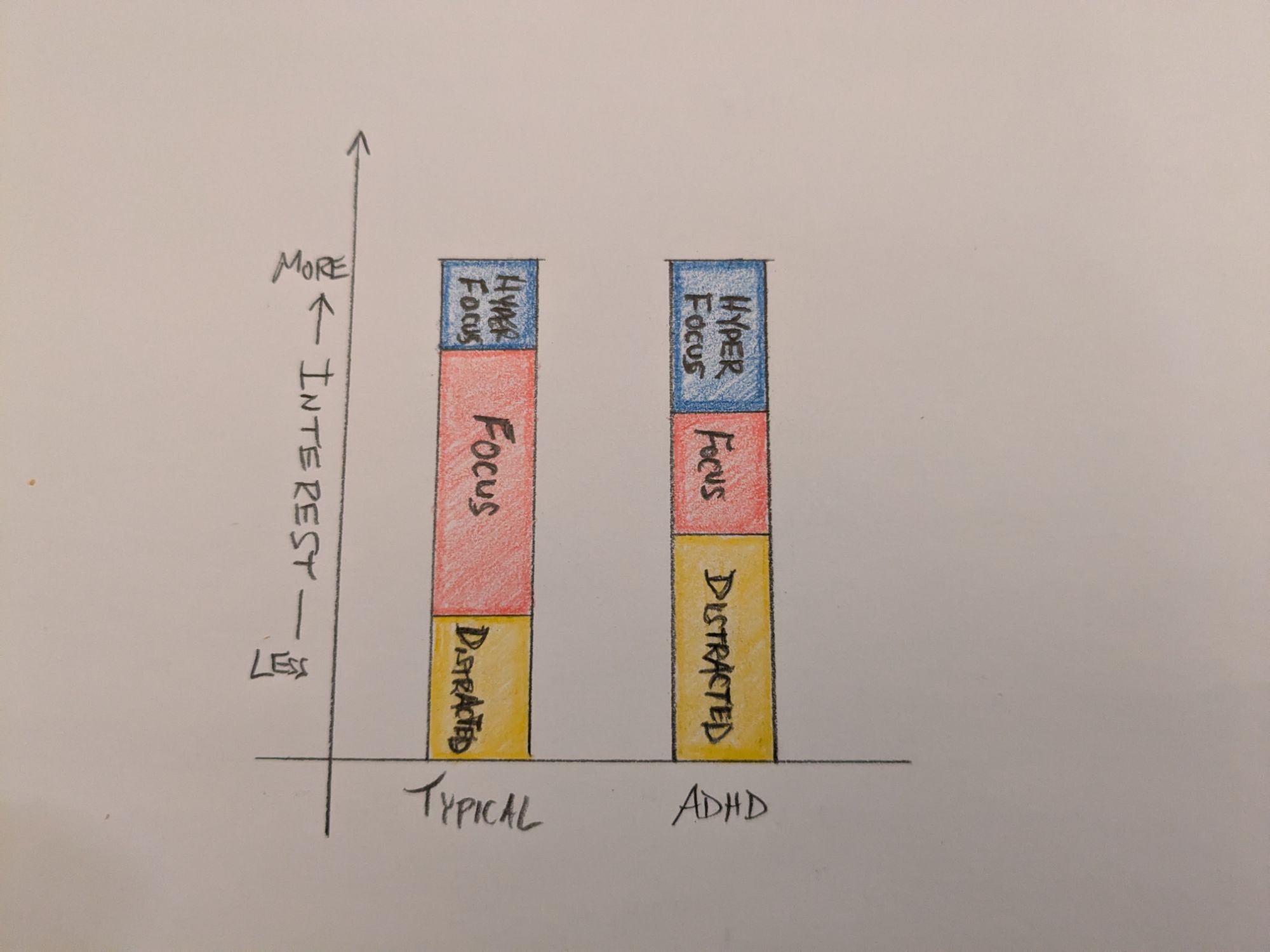
    Imagine a scale from 1 to 10. The scale represents how interesting you find some task. For most people, there’s a division around 3, at which they’re willing to get to work. For ADHD brains, that division is up around 5 or 6.

    This is why things like Adderal or Caffeine help us get to work. Stimulants help us drive that interest level over the threshold, and then we can get down to business even if we’re not really interested in the job.

    It is said that ADHD people have a special third stage normal people don’t, up near 10 on the scale. This stage, called “hyperfocus” allows us to be so obsessed with the object in our attention that the rest of the world can dissolve away, and we can work for hours.

    The problem is, activities rarely make it up to that first threshold for us. Hence, procrastination. If something’s due in a few days, it’s hard to give it the attention it needs. When the deadline is upon us, though, watch out! We get driven straight up to 10 with adrenaline, and perform miracles.

    Or disasters. Usually the end product of these last-minute sprints are mediocre performance at best, and careless accidents and disappointed loved ones at worst.

    Keys to Attention

    Here are a few tricks to subvert the usual doldrums, and get to action.

    Before we get to tricks, though, it’s important to mention that medication could be useful for you, if prescribed by a licensed professional.

    1. Start by doing the minimum

    This trick is sometimes referred to as the “2 minute rule”. The idea is, instead of trying to start a big job, pick a tiny piece of it to tackle. That tiny piece might be enough to get you interested and engrossed.

    For example, I try to get a whole blog post out every week. Sometimes that feels like a really big lift. Big enough that I’d rather check email or look out the window.

    But if instead of writing a whole article, I commit to just writing one sentence, suddenly it doesn’t seem like so much tedious work. Anyone can write one sentence! So I’ll open the laptop, fire up my editor, and take a minute to bang out a sentence.

    Typically, that one sentence turns into more.

    The point here is, anyone can do two minutes of something, even someone with a clinical diagnosis. That two minutes tends to grow to more.

    1. Use a timer

    The classic form of this is called the Pomodoro Technique. “Pomodoro” means Tomato in Italian, which is what the original timer looked like that the inventor of the technique used. Personally, I use a Time Timer at home, and an hourglass at work.

    Set a timer for 15-30 minutes. Commit to doing your work during that time, and after you can go take a break. Some people like 25 minutes, because it doesn’t have the same emotional baggage as 30.

    While working, any thought that comes into your head, just write down a reminder on a piece of paper and get back to work. You’ll be able to take up that thought in just a few more minutes.

    A protip here is to set the timer on top of your phone. That way you’ll be less likely to absent-mindedly pick it up and start scrolling.

    1. Procrastinate with another need-to-do

    If you just can’t get started on the task at hand, pick another task you need to do, and do that one instead. When that one gets unbearable, return to the original task.

    Some people find that “anything but this!” is interesting enough to capture their attention. Maybe you will too.

    1. Put your phone in a different room

    This one is important. Nothing is more interesting than your phone. Even if it doesn’t DING!!!, you will think about checking it if it’s sitting right there in front of you.

    The solution is to put that phone somewhere you can’t see it. If it’s in another room, it won’t distract you as much. Plus, having to get up to go check it might just be enough friction to prevent you from doing so.

    Get to work

    So what are you waiting for? Try one of the techniques above, and complete that task you’ve been putting off!

    Do you have a tip that helps you get work done, when you just can’t find the willpower to move? Put it in the comments below!

    If you liked this article, please leave a comment below, share it with someone you know, and get on my email list!

  • From Selling Drugs to Selling Mugs

    From Selling Drugs to Selling Mugs

    Disclaimer: this post contains affiliate links. If you click on them and buy the products, I’ll get a cut of the profit. They’re good products!

    The lack of updates on my last big make money scheme means it went nowhere. Not for lack of ambition, rather for lack of courage and action.

    It’s time to move onto the next make money quick scheme!

    I drink coffee in the morning, as I’m almost sure you do as well. I drink it as part of my morning routine, which includes writing a few Morning Pages.

    When I drink coffee, it’s important that I pour it into a nice mug. Our mugs consist of a bunch of plain white ones, an old Hillary in 2018 mug (our Trump 47 mug hasn’t arrived yet), a “Nasty Lady” mug (remember those lame post-Trump protests? They’re still lame…), and a big one with an O on it.

    I’ve hunted for mugs with cool math formulas on them for a long time, because I love math. The only ones you can find are plastered with a bunch of random formulas, or have $E=mc^2$ on them. I am not interested in popular science mugs – I want to see the [Law of Quadratic Reciprocity](your reddit comment), or a proof of Gauss’s Theorema Egregium, or a derivation of Riemann’s Zeta Function.

    And I thought the other day, maybe other mathematicians would like to get their hands on coffee mugs with serious math on them. Hence, the Math Mug!

    My plan now is to make and sell a hundred million Math Mugs and get rich. I’ll follow Kagan’s blueprint in Million Dollar Morning, first target people I know, and hunt for suggestions to make these a no-brainer purchase. Maybe I’ll open an Etsy shop as sales start picking up!

    Mug with a picture of the Pythagorean theorem, but this time with some triangles sprinkled around to hint at the proof.

    I am a Drug Dealer!

    About a day after coming up with my new scheme, I had started to think about ways to cut costs hard so I can maximize my profit. And then it hit me – this is exactly what I did when I failed at selling drugs back in high school.

    This was back in the 1990s Wisconsin. I had two classes of friends back then – computer-math wiz kids, and dirtball druggies.

    I was, at the time, pissed off at the former, because someone had stolen an image I made, pixel by pixel, on my TI-85 calculator. It had taken several days to complete. It was supposed to be the splash page for a new calculator game called “Death Run”, and had a pretty good silhouette of Blade Runner’s Rick Deckard chasing someone with his gun drawn.

    The thief used it as a splash page for his own game, which was a text-based game where you tried to get rich selling drugs. Everybody in school was playing this game that used my image without attribution!

    The goal of the game was to buy low and sell high so your cash flow is always positive. That gave me an idea – maybe I could make some extra cash (and get popular) by selling weed!

    Pretty much all my druggie friends helped me get started – sourcing the product, explaining the product sizing (dime bag, nickel bag, etc.), and even finding customers. I still blew it!

    After I bought the largest bag of weed I had ever seen, it was hard to resist not smoking some of it. In fact, it was impossible. After enjoying myself for a few days, I decided to split my stash up into saleable bags. That’s when my heart sunk. I could no longer cover my costs with the remainder.

    So, I did what any good entrepreneur without scruples would do. I made the bags light. I sold maybe one or two to the gullibles. After about a week, my friend who had hooked me up with the supply was flabbergasted that I hadn’t sold the whole thing yet. In order to help, he got one of his friends to buy from me.

    This friend was a year or two older than me, very cool, and very muscular. I did not want to disappoint him. When he came over for a nickel bag, and looked at the bag I gave him, he said “what’s this, a dime bag?” (that’s half a nickel bag). I panicked, got frustrated, and just gave him the rest of my weed, which ended up being a bit more than what he’d asked for, and he left happy.

    I never sold drugs again.

    Mug with a statement of the Law of Quadratic Reciprocity, first proved by Gauss in 1801

    Lessons Learned

    All this came flooding back as I thought about how to maximize my Math Mug gambit a few days ago. And I realized, I will not be that little kid anymore, but rather work to gain the respect of my customers.

    Here are a few things I will and won’t do with my new gambit:

    1. Don’t use from your own inventory

    What my cheap younger self should have done, is maintain a strict separation between my inventory and my own stash. In other words, I should not have smoked the weed I intended to sell, but rather bought another bag for myself. NOTE: I don’t smoke weed anymore 🙂

    This translates to my mug biz like this – I want to drink MY coffee from Math Mugs! So instead of nipping one or two from my stock of sellable mugs, I should buy one when I’ve made enough profit to do so.

    Maybe I can convince my supplier to send me a sample.

    1. Make a high quality product

    My dope biz suffered from poor quality control. My bags were light, so my customers did not get their money’s worth. Not only did this fail to make my business profitable, but it risked destroying my reputation on the day of product launch.

    For a coffee cup design company, this means do NOT find the cheapest possible supplier, or use the cheapest possible printing process. It doesn’t mean find the most expensive, either. It means to find a high-quality supplier, and make sure the mugs are worth the trouble for my customers.

    I look at that old Hillary in 2016 mug I have, and see that it’s barely legible now. After a few runs through the dishwasher, it is clear that this was a cheaply made product, not worth the few dollars I threw at it.

    My mugs will be the kind of mug I want on my own shelf for years to come.

    1. Do not overprice the product

    In my panic to turn a profit, I charged customers more than my skimpy dime bags were worth. If I were one of those customers, I would find a new dealer.

    My goal is to make money. However, I also want to grow a business. You can’t do that if you treat your customer like a quick buck, by swindling them. You do that by building a reputation as a straight dealer who respects the people who choose your product, and send you their hard-earned dollar.

    Growing money is not made by stiffing individuals, but by volume of sales. Tonnage. I want customers to come back to me for more. And I want them to refer customers, who refer groups, who refer departments, who refer entire organizations to me and my products. That doesn’t happen if I’m clearly trying to bilk my customers out of an extra buck or two.

    However, it also doesn’t mean I should lose money. I’ll use some math to figure out my cost of production, do some research on competitor pricing, and use those to make sure my mugs are priced fair.

    Mug with a chart that shows examples of the law of quadratic reciprocity.

    Conclusion

    My two first designs are sprinkled through the article. One mug shows the Pythagorean Theorem, and gives a hint on how to prove it. The other shows Carl Gauss’s statement of the Law of Quadratic Reciprocity, and presents a chart of some examples.

    Ready to elevate your coffee break? Be one of the first to own a Math Mug! The first 25 who order one get a 10% discount.

    Still not convinced? Share your thoughts in the comments below. What other kinds of math-inspired merch would you like to see?

    If you liked this article, please leave a comment below, share it with someone you know, and get on my email list!

  • Let Us Revive the True Spirit of Thanksgiving

    Let Us Revive the True Spirit of Thanksgiving

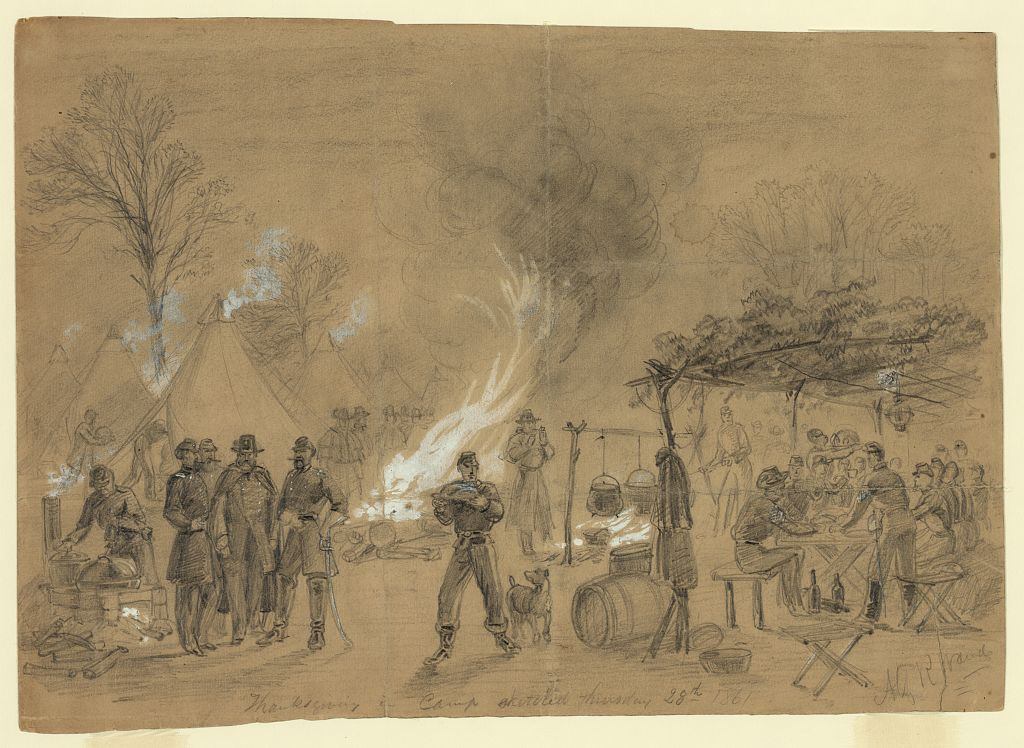
    We’ve been celebrating Thanksgiving in the United States since forever, but 1863 was a special one. It was in this year that President Abraham Lincoln issued his Thanksgiving Proclamation, that set the last Thursday each November aside as a national holiday, for Americans to thank God for our prosperity.

    The full text of that proclamation is below.

    Before getting to that, though, I think it’s appropriate to set a bit of the scene.

    Southern plantation owners and politicians argued that the end of slavery would be the end of their economic prosperity. The argument, as my brilliant wife pointed out to me, is almost identical to the opposition shown against incoming President Trump’s policy to deport illegal aliens from USA. The screeching of the corporations that run most southern farms has only just begun.

    However, by 1863, as noted by Lincoln below, the economy of the Northern, non-slavery states, had grown in both economic output as well as in population. The growth had three components that were directly from Lincoln’s government:

    1. Internal Improvements

    Two major projects were launched by the Lincoln administration that drove economic growth. First, Lincoln supported and initiated the construction of the Transcontinental Railroad, a massive feat of machinery that provided an impetus for developing new technologies. Second, Lincoln launched the Land Grant State College system, which ensured Americans were able to get educated in the latest techniques of agriculture and manufacturing.

    1. Greenbacks

    The USA had been stuck with gold and silver coins for currency up to 1862. This form of “hard money” was impossible to grow, because supply was limited by mining. Some banks had issued their own paper currency, but these notes were always at risk of devaluing by the failure of the source bank.

    This situation made it impossible for the US government to fund both the war and internal improvements.

    As a solution, Lincoln, backed by great American economists Henry C. Carey and Salmon P. Chase, began issuing paper currency directly from the US Treasury. There were three utterances between 1862 and 1863. By expanding the issue of this “fiat money”, Lincoln was able to provide support for a growing national economy under the strain of internal warfare.

    1. Tariffs

    At the time of Lincoln’s election, the USA had the lowest protective tariffs of any nation. During his tenure, he signed the Morrill bill, which had been a cornerstone of Lincoln’s electoral campaign. In fact, a cornerstone of confederate Democrat Stephen Douglas’s campaign was to prevent protectionist measures from being enacted.

    Before the end of the Civil War, protectionist tariffs on foreign goods topped 50%. The revenue generated was used to pay for war expenses as well as the expansion of agriculture and industry across the north.

    The tariffs had the added benefit of enraging the United Kingdom. Prime Minister Lord Palmerston responded, “We do not like slavery, but we want cotton, and we dislike very much your Morrill tariff.”

    In the renewed discussion of protective tariffs by incoming President Trump, which also is greatly distressing British economists, it should be remarked that Lincoln’s monetary and trade policy was combined with vigorous investment into basic economic infrastructure and technological advance. Without this latter investment, tariffs are indeed inflationary.

    Americans do not need more of what we already have, like cars. We need major public works projects, like a new Tennessee Valley Authority to rebuild the American Southeast, which has been repeatedly devastated by natural disasters since the early 2000s. President Trump should declare several new public works projects in this style immediately, to provide a true outlet for renewed American manufacturing might.

    Without further ado, Happy Thanksgiving to you!

    Transcript for President Abraham Lincoln’s Thanksgiving Proclamation from October 3, 1863

    By the President of the United States

    A Proclamation

    The year that is drawing toward its close has been filled with the blessings of fruitful fields and healthful skies. To these bounties, which are so constantly enjoyed that we are prone to forget the source from which they come, others have been added, which are of so extraordinary a nature that they cannot fail to penetrate and even soften the heart which is habitually insensible to the ever-watchful providence of Almighty God.

    In the midst of a civil war of unequaled magnitude and severity, which has sometimes seemed to foreign states to invite and provoke their aggressions, peace has been preserved with all nations, order has been maintained, the laws have been respected and obeyed, and harmony has prevailed everywhere, except in the theater of military conflict; while that theater has been greatly contracted by the advancing armies and navies of the Union.

    Needful diversions of wealth and of strength from the fields of peaceful industry to the national defense have not arrested the plow, the shuttle, or the ship; the ax has enlarged the borders of our settlements, and the mines, as well of iron and coal as of the precious metals, have yielded even more abundantly than heretofore. Population has steadily increased, notwithstanding the waste that has been made in the camp, the siege, and the battlefield, and the country, rejoicing in the consciousness of augmented strength and vigor, is permitted to expect continuance of years with large increase of freedom.

    No human counsel hath devised, nor hath any mortal hand worked out these great things. They are the gracious gifts of the Most High God, who while dealing with us in anger for our sins, hath nevertheless remembered mercy.

    It has seemed to me fit and proper that they should be solemnly, reverently, and gratefully acknowledged as with one heart and one voice by the whole American people. I do, therefore, invite my fellow-citizens in every part of the United States, and also those who are at sea and those who are sojourning in foreign lands, to set apart and observe the last Thursday of November next as a Day of Thanksgiving and Praise to our beneficent Father who dwelleth in the heavens. And I recommend to them that, while offering up the ascriptions justly due to Him for such singular deliverances and blessings, they do also, with humble penitence for our national perverseness and disobedience, commend to His tender care all those who have become widows, orphans, mourners, or sufferers in the lamentable civil strife in which we are unavoidably engaged, and fervently implore the interposition of the Almighty hand to heal the wounds of the nation, and to restore it, as soon as may be consistent with the Divine purposes, to the full enjoyment of peace, harmony, tranquility, and union.

    In testimony whereof, I have hereunto set my hand and caused the seal of the United Stated States to be affixed.

    Done at the city of Washington, this third day of October, in the year of our Lord one thousand eight hundred and sixty-three, and of the Independence of the United States the eighty-eighth.

    Abraham Lincoln

    By the President: William H. Seward. Secretary of State.

  • Beast, Rider, and Marshall:  How to Get Control of Yourself

    Beast, Rider, and Marshall: How to Get Control of Yourself

    Subscribe to continue reading

    Subscribe to get access to the rest of this post and other subscriber-only content.