Category: Self Improvement

  • Slaughter the Friction before Friction kills the Action

    Slaughter the Friction before Friction kills the Action

    So you’re going to take action that will make you awesome, like making cold calls to mining experts to fish for leads. You picked a time, a date, your phone is charged, you got a name and a phone number, nothing will stop you this time!

    The time comes and goes, and you never made the call.

    What happened?

    Something got in the way, and that something is what we call friction.

    Friction is anything that delays the completion of an action. In the case above, maybe it was that you couldn’t come up with a good sales pitch. Maybe you wore yourself out coming up with ways to overcome rejections. Maybe you needed to find a quiet place to make the call, but spent all day wandering around town. (I have done all three of these.)

    Whatever it was, some activity YOU did prevented the action from happening.

    We’re going to look today at how to identify sources of friction, and how to remove them, so there is nothing standing between you and success.

    The Source of Friction

    When you decide to start practicing some periodic action, from brushing your teeth twice a day to writing out your daily morning pages, there is always a force that will prevent you from doing that action.

    I count two main reasons that make it hard to slip a new action into your day.

    1. Fear

    Fear is the biggest factor that keeps me from taking action. For example, I get panic attacks before talking to new people. That’s the main reason I (and others) have yet to make cold calls.

    But the friction doesn’t present itself as fear. It presents itself as extra steps added between now and the target action. When I’m planning to make a call, I tend to think I need a fully worked out script, including responses to objections. I’ll spend an hour fighting with that script, then boom, no calls.

    1. Routine

    Your daily routine comes with inertia. It’s not easy to just throw something else in there.

    I think the daily routine is a human adaptation to living in a world. The daily routine can be done mostly on autopilot. This allows you to think about other things, instead of constantly considering “what do I need to do next?”

    But whatever the origin of the daily routine, your daily activities tend to fill all the available space of that day, like a gas. There’s rarely an hour in there where you’re staring at the wall thinking “wow, I wish I could fill this time with a new activity!”

    More likely, if you’re a grown up like myself, that hour is really only about five minutes long, and taken up by a well-needed break.

    Identifying Friction

    Now that we know whence the friction comes, let’s find all the points of friction in the way.

    For example, exercising every day takes a lot of time out you could be doing other things. It makes you sweaty, so you need to shower afterwards. You don’t want to exercise on a full stomach or you’ll barf, so you need to time your eating an hour before, or maybe get up earlier than usual to do it in the morning. But, that would mean going to bed earlier, which means rearranging the schedule the evening before.

    That’s a heavy lift, and a lot of it is unnecessary. But exactly which parts are the friction?

    Here’s a method for identifying what is friction versus necessary actions.

    First, list out the steps it takes to complete the target action.

    1. Get a gym membership
    2. Design a workout routine
    3. Schedule an hour for the workout
    4. Put on workout clothes
    5. Grab a bottle of water
    6. Hop in the car
    7. Drive to the gym
    8. Go into the gym
    9. Work out
    10. Drive back home
    11. Take a shower

    Second, identify the target action itself. The important step here is number 9 – Work Out!

    Look all those steps before step 9!

    Third, examine the other steps. Friction has a smell. That smell is “this could take forever”. Anything with that smell is friction

    Step one was to get a gym membership. Imagine how long it would take to find a gym, compare membership plans, compare amenities, and so on. You could spend forever on step one.

    Do you really need a gym membership to begin exercising? Maybe you can come up with a different set of exercises you can do at home.

    Notice also, the gym membership actually comprises several steps – 1, 6, 7, 8, and 10. That is a lot of work for a requirement that is not the target action.

    The gym membership is friction.

    How about step 2, coming up with the routine? This could certainly be friction, if a “routine” in your mind is more elaborate than running around the neighborhood and doing some push-ups. You could take a long time trying to develop a routine, and never actually get to the exercising part.

    Step 2 is friction.

    How about step 3, scheduling? Even this could take a while, if your calendar is a mess. This is seems like friction, but it’s not really a step that can be avoided. Maybe it can be reduced.

    Step 3 is also friction.

    Or step 4, workout clothes. Maybe you don’t have any. You need to either drive to the store and find some, or do some online shopping. Personally, any activity I pick that starts with “buy appropriate clothes” is unlikely to happen. I take forever picking clothes unless I’m in a special state of mind. But maybe this isn’t a big deal for you.

    Step 4, friction.

    Even step 5 could be a point of friction. Maybe you don’t have a bottle. Maybe you’re nuts, and think you need special water from the health food store. That’s going to steal time and momentum to solve!

    Whether or not some step can be dragged out ad infinitum depends on you. You may already have those exercise clothes, or a water bottle you’ve been hoping to take out for a run. One person’s friction could be someone else’s fuel.

    Rely on that smell of bad infinity to identify what is truly friction.

    Next, we decide what to do with all these smelly pressure points.

    Kill All Sacred Cows

    If you’re serious about your target action, then you need to be serious about eliminating the friction. You can always add some additional steps back in, but only after that target action itself has been established as part of your routine.

    All points of friction can either be completely eliminated, or shrunk to an almost trivial action.

    In the above example, you need to get down to maybe one or two steps before the exercise step. You don’t need the gym membership. Skip your lunch break tomorrow, wear your jeans and dress shoes, and exercise at home – whatever you absolutely need to do to have zero space left between you and the workout.

    Wait, wear jeans to exercise?

    Yes. If your target action is to exercise, then EVERYTHING that gets in the way can be friction. For example, how stupid would it be for you to die a few years early just because you were stuck picking exercise clothes, and could never get to the actual exercising!

    You need to look at all intervening steps as sacred cows that should be sent to the slaughter. You don’t have a pair of shorts? How bad would it really be to take your oldest pair of pants, the ones you don’t even wear anymore, hack off the legs, and just run in those?

    There used to be a crazy marathon in Australia, where the competitors run from Sidney to Melbourne, a distance of 544 miles. Back in 1983, the world record was beaten by almost two whole days! The new record holder wasn’t a high performer funded by Red Bull and Nike. He was a farmer. He ran the race in his work boots and overalls, beating the other runners by over 10 hours.

    Do not let the sacred cow stand between you and success.

    Do it!

    In summary, if you’re having trouble getting from now to target action, do the following:

    1. List the steps to accomplish the target action.
    2. Identify where that target action is in the list.
    3. Interrogate all the other steps as potential friction.
    4. For each step, ask yourself if it smells like “this could take forever”.
    5. Imagine how to complete the target action if each other step is removed.
    6. If you absolutely can’t remove a step, shrink it to something trivial to complete.

    Next time you find yourself unable to accomplish what you set out to do, interrogate yourself for friction. Assume you’re either scared or battling inertia, and find all those steps in between now and the target action. And gut them.

    You can do it.

    If you liked this article, please leave a comment below, share it with someone you know, and get on my email list!
  • Why You Wait Until the Last Minute, and How to Get Back to Work

    Why You Wait Until the Last Minute, and How to Get Back to Work

    Disclaimer: this post contains affiliate links. If you click on them and buy the products, I’ll get a cut of the profit.

    Do you feel like you’re always late for deadlines? Always “a day late and a dollar short”?

    Well, you’re not alone. Procrastination is the #1 most annoying, and debilitating, symptom of ADHD. Sure, everybody puts things off for another day, but for you and me, procrastination can be just as crippling as losing a leg.

    The constant companion of procrastination is that pernicious creep, the Inner Critic. “You’re so lazy and stupid.”

    In this article, I’ll explain why procrastination is such a problem for ADHD people, and give some tips on how to thwart this enemy for massive fortune.

    The Due Date is Tomorrow!

    Work is a challenge.

    If there is a job with a deadline down the road, it’s too easy to put it off.

    For example, I work as a data engineer for a financial company. We do sensitive investments, which means that it’s pretty important for the analysts to have their data NOW. My job is to deliver that data.

    Sometimes, the vendor (some other company that sends us data) changes the format of their data. Sometimes this isn’t a problem, and sometimes it is.

    When they change the format without telling us, and it breaks something, that’s just fine. My adrenaline’s running high, and I’m working with the analysts as a team against those irresponsible data suppliers. When the problem gets fixed, I’m a hero.

    But if they announce a change they will implement in the future, then there is real danger.

    I’m facing down a project like this right now, which is due in just a few days. I’ve known about the changes for over a month, and they even delayed the changes a few weeks. But I have not yet prepared our system to handle the changes.

    Immediate jobs face me every day, but that deadline is so far away that I can postpone the work for a little longer. And then, all of a sudden, it’s here. And so are all the other immediate problems that face me every day.

    Urgency vs. Importance

    When experts describe ADHD as a problem with executive functioning, it’s both obvious and meaningless to me. Yes, it’s hard to do what I know I should do, and easy to do what’s more interesting in the moment.

    Knowing it has to do with my executive function offers very little to solve the problem.

    One day while following the ADHD subreddit, I came across a description that explained almost everything. (I can’t find it now, so can’t link)

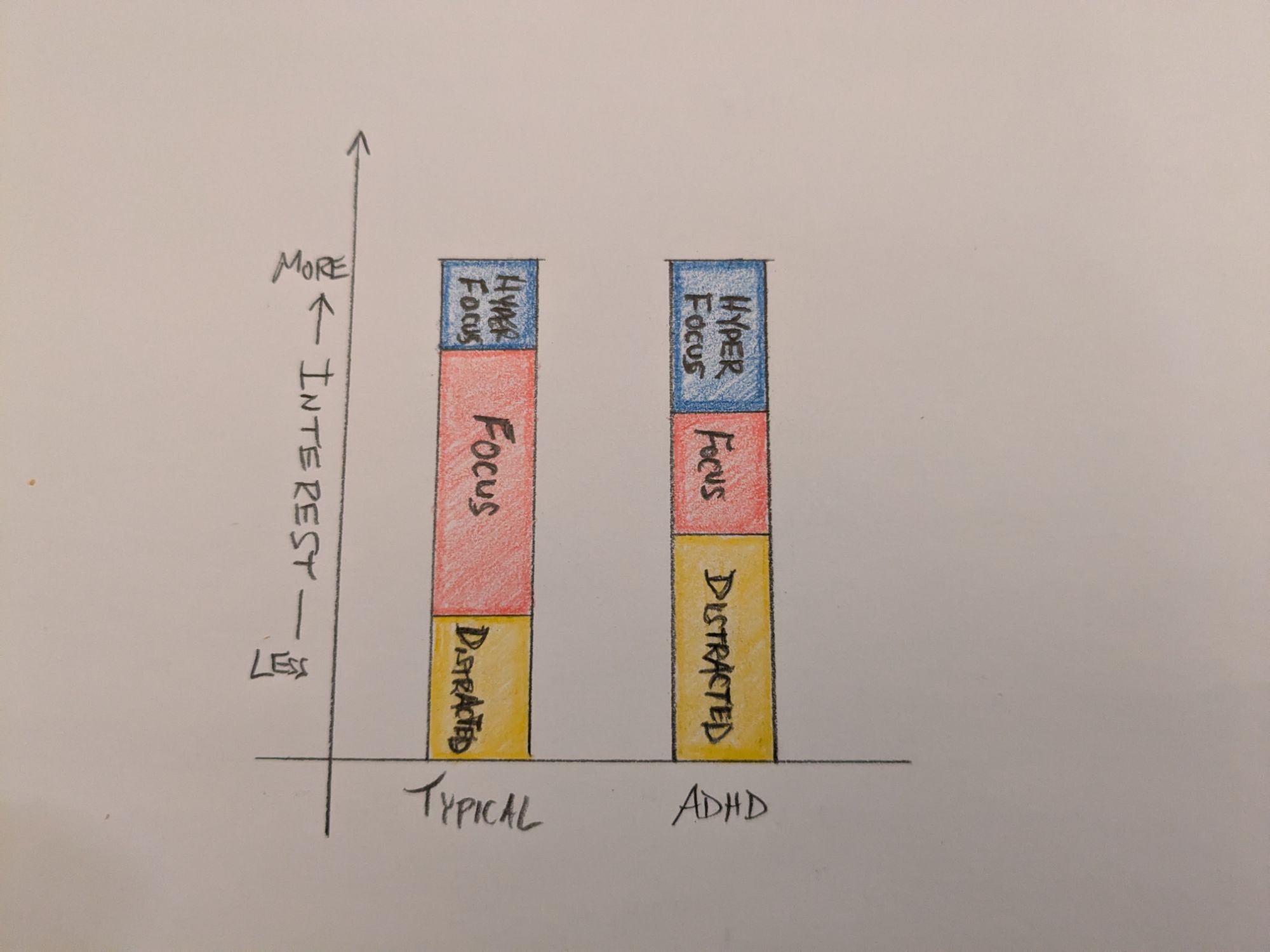
    Imagine a scale from 1 to 10. The scale represents how interesting you find some task. For most people, there’s a division around 3, at which they’re willing to get to work. For ADHD brains, that division is up around 5 or 6.

    This is why things like Adderal or Caffeine help us get to work. Stimulants help us drive that interest level over the threshold, and then we can get down to business even if we’re not really interested in the job.

    It is said that ADHD people have a special third stage normal people don’t, up near 10 on the scale. This stage, called “hyperfocus” allows us to be so obsessed with the object in our attention that the rest of the world can dissolve away, and we can work for hours.

    The problem is, activities rarely make it up to that first threshold for us. Hence, procrastination. If something’s due in a few days, it’s hard to give it the attention it needs. When the deadline is upon us, though, watch out! We get driven straight up to 10 with adrenaline, and perform miracles.

    Or disasters. Usually the end product of these last-minute sprints are mediocre performance at best, and careless accidents and disappointed loved ones at worst.

    Keys to Attention

    Here are a few tricks to subvert the usual doldrums, and get to action.

    Before we get to tricks, though, it’s important to mention that medication could be useful for you, if prescribed by a licensed professional.

    1. Start by doing the minimum

    This trick is sometimes referred to as the “2 minute rule”. The idea is, instead of trying to start a big job, pick a tiny piece of it to tackle. That tiny piece might be enough to get you interested and engrossed.

    For example, I try to get a whole blog post out every week. Sometimes that feels like a really big lift. Big enough that I’d rather check email or look out the window.

    But if instead of writing a whole article, I commit to just writing one sentence, suddenly it doesn’t seem like so much tedious work. Anyone can write one sentence! So I’ll open the laptop, fire up my editor, and take a minute to bang out a sentence.

    Typically, that one sentence turns into more.

    The point here is, anyone can do two minutes of something, even someone with a clinical diagnosis. That two minutes tends to grow to more.

    1. Use a timer

    The classic form of this is called the Pomodoro Technique. “Pomodoro” means Tomato in Italian, which is what the original timer looked like that the inventor of the technique used. Personally, I use a Time Timer at home, and an hourglass at work.

    Set a timer for 15-30 minutes. Commit to doing your work during that time, and after you can go take a break. Some people like 25 minutes, because it doesn’t have the same emotional baggage as 30.

    While working, any thought that comes into your head, just write down a reminder on a piece of paper and get back to work. You’ll be able to take up that thought in just a few more minutes.

    A protip here is to set the timer on top of your phone. That way you’ll be less likely to absent-mindedly pick it up and start scrolling.

    1. Procrastinate with another need-to-do

    If you just can’t get started on the task at hand, pick another task you need to do, and do that one instead. When that one gets unbearable, return to the original task.

    Some people find that “anything but this!” is interesting enough to capture their attention. Maybe you will too.

    1. Put your phone in a different room

    This one is important. Nothing is more interesting than your phone. Even if it doesn’t DING!!!, you will think about checking it if it’s sitting right there in front of you.

    The solution is to put that phone somewhere you can’t see it. If it’s in another room, it won’t distract you as much. Plus, having to get up to go check it might just be enough friction to prevent you from doing so.

    Get to work

    So what are you waiting for? Try one of the techniques above, and complete that task you’ve been putting off!

    Do you have a tip that helps you get work done, when you just can’t find the willpower to move? Put it in the comments below!

    If you liked this article, please leave a comment below, share it with someone you know, and get on my email list!

  • Beast, Rider, and Marshall:  How to Get Control of Yourself

    Beast, Rider, and Marshall: How to Get Control of Yourself

    Subscribe to continue reading

    Subscribe to get access to the rest of this post and other subscriber-only content.

  • Put Another Link on the Chain!

    Put Another Link on the Chain!

    Disclaimer: this post contains affiliate links. If you click on them and buy the products, I’ll get a cut of the profit. But I promise I’ll only link to products I think you’ll like!

    A few weeks ago, I was asked to write an article on the Moon, and to focus on the Chinese sample returns. Day turned into week. Week turned into two weeks. And BOOM! I broke my chain of success.

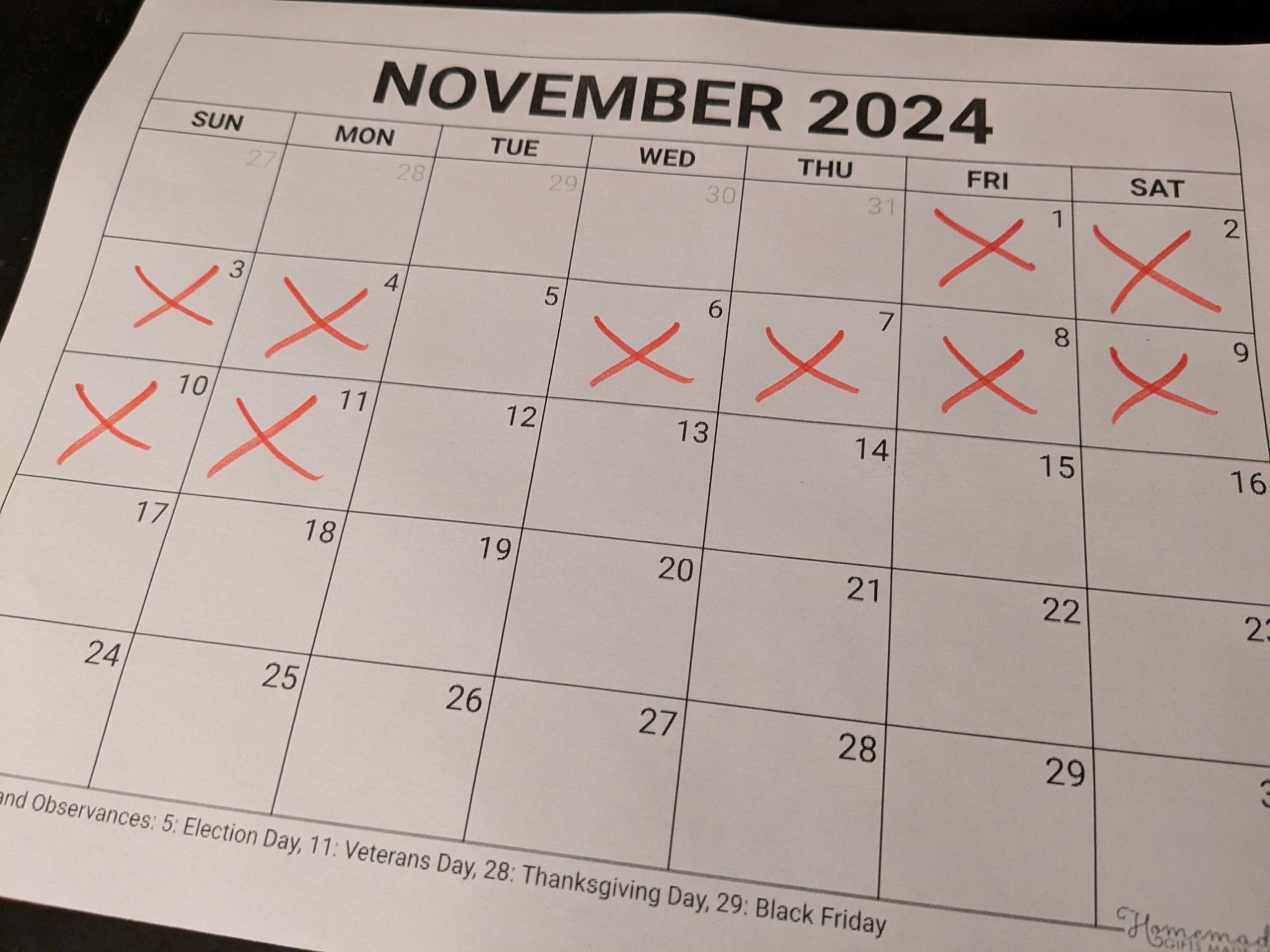
    The Chain is a concept I first heard about from Jerry Seinfeld. I swear I heard him talk about it, but all I can find now is a story, where a young comic asked Jerry what was the secret to great comedy. Jerry said “Tell a lot of jokes. Write at least one joke every day. Draw a big red X every day you write a joke, and don’t miss a day. Don’t break the chain.”

    The idea here is that, after identifying some habit you want, you mark it on a calendar every day you do it. For me, my goal was to write an article for this blog once a week. When you focus on building that chain of successes, you are carving for yourself a consistent habit for long-term personal success.

    Atomic Habits

    Another guy who talks about this is James Clear, of Atomic Habits fame. He looks at these chain links as little micro-encouragements, micro-rewards. Each time you put another link on the chain, you get a little hit of dopamine that reinforces your identity. “This is what people like me do!”

    The other strategy Clear adds is that, if you DO break the chain, get right back on that horse. If you skip a link, don’t skip two.

    Now here is where my problem really lies. Once I miss a link, I miss the next one. And the next one. And, before I know it, my chain is long gone.

    Then comes the guilt and the inner critic. “Of course you broke the chain. It’s because you suck.” I think what actually happens here is that I start a new chain that reinforces my identity as a chump.

    The solution is really easy – just do the habit again and restart the chain. But, that’s easier said then done.

    The Chain and ADHD

    For those of us with ADHD, we tend to spiral and wallow. We constantly listen to that inner critic, and wind up agreeing with it. It’s like when a song gets stuck in your head. That song can play over a thousand times in there, maybe without you noticing it.

    The inner critic does that too, but it’s not just annoying, like that song; the inner critic reinforces an awful identity.

    The only way to end the song, and the inner critic, is to stop what you’re doing and confront that internal parasite. With the song, you can consciously stop the music, or think of a different tune.

    It’s a little more difficult with the inner critic. With the critic, it’s useful to challenge what he’s saying.

    “You’ll never start that habit, you suck!” Not true, I did keep that chain going, just had a little setback.

    “You’re no writer, you suck!” No, a person becomes what he does. If I want to be a writer, I just need to write every day, which I did for a while.

    “You’re a glutton, and you’ll never change. You suck, fat ass!” No, I did slip up and missed my salad yesterday, but I was doing fine for a while.

    “You’re just a fat weakling! Get over it, you suck!” Not true. I just missed a few days at the gym. I can get back on this horse, you imaginary critic parasite.

    After confronting the inner critic with real evidence for a bit, turn him off. Go put another link in your chain.

    Get into the chain business

    The real topic here is, all us distracted people want to get wealthy, but that’s impossible without focus. The chain helps us create a discrete continuity over a long period, of small actions that build toward larger goals.

    In the words of Seinfeld: “No one’s really that great. You know who’s great? The people that just put tremendous amount of hours into it. It’s a game of tonnage.”

    I believe that if you give the Chain a try, it will become a key to your success.

    So how do you start?

    1. Find your focus

    This is the tough part. Pick something you want to do every day, something not too big. “I’ll read for 2 hours every day” probably won’t happen. But “I’ll read for 10 minutes every day” has a chance.

    For another example, “I’ll go to the gym every day” is probably not going to happen. You’ll stop after like two days. But, “I’ll put on my running shoes every day” takes less than a minute. With those shoes on, you’re much more likely to actually go for the run.

    And if you don’t go for the run, you can still put an X in your calendar.

    1. Get a calendar

    This can be a big wall calendar, or something DIY like a row of boxes drawn on a piece of paper, with dates written over them. The main thing is, you need something that can bear a visual record of your successes, something you can mark up.

    If you just have to have an app on your phone, try Habitica. It has pretty good reviews, and can do more than just track the chain.

    1. Be compassionate

    If you miss a day, don’t be too hard on yourself. Even if you miss a week, don’t let that boring, poor inner critic take over. Just try to put another X on the calendar today. The more you do it, the more enjoyable it gets.

    Remember, consistency is the key. Give the Chain a try, and watch yourself blow past your goals.

    This article is evidence that I put an X on my calendar today.

    If you liked this article, please leave a comment below, share it with someone you know, and get on my email list!
  • Focus on Your Fears: A Strategy for Action

    Focus on Your Fears: A Strategy for Action

    Once upon a time – OK, fine. All the time, I’m faced with fears, and risk being a coward. I’m afraid I can’t cover the bills, I’m afraid my wife will think my latest get-rich-scheme will be nuts, I’m afraid the shoes I want will look stupid on my feet. When there is something I need to do, the biggest impediment to taking action is ALWAYS my fear.

    All men have fears, but real men are not governed by them.

    Recently, I stumbled on a way to make my fears an advantage, both at work and in my personal life. If you follow the advice below, you too can make your fears a source of power, and start crushing life.

    The Problem

    Here’s the pattern; see if any of this pertains to you.

    Let’s say I’m facing a problem I don’t know how to solve, like a big bill I can’t afford to pay by the deadline. A great plan here would be to call the biller and work out a payment program, or defer the bill to a later date, or take some money earmarked for another more lenient bill. Maybe none of these are the right strategy, but they’re at least trying to solve the problem.

    Instead of taking action, I tend to think to myself, “I’ll just deal with this later today.” Later today turns into tomorrow. Tomorrow turns into the next day. Before you know it, the deadline’s here and I need to panic and do something now! It doesn’t help things that I also need to tell my wife what’s wrong, and pretty much force her to go along with my panic plan.

    It’s usually some variation of this.

    1. Get confronted with a situation that inspires fear
    2. Plan to come up with a plan to deal with it at a later time
    3. Keep planning to think about it
    4. Slam into the situation with no plan or preparation, and cause a cascade of other problems.

    Sometimes, I’ll even forget about the problem I fear, until it’s too late.

    The deep issue here is clear – I’m trying to protect myself from getting hurt in the near term, by putting that hurt into the future and trying to wish it away.

    Imagine if this was how the US Congress worked when considering the national deficit! Oh, wait, that is how the Congress deals with things like this.

    There must be a better way.

    If you watch Instagram, you’ll know that the only way to deal with fears like this is to feel your feelings and stare your fears down and come into yourself and not be a victim of trauma and whatever.

    Instead of that, I’ll present here a realistic, concrete way to deal with fears, by hunting for them and making them work for you instead of against you.

    The Clue, from Work

    I stumbled on this technique while worrying about something at work.

    I’m a data engineer for a pretty successful hedge fund. One of the situations I get faced with often is data quality. In other words, for a given data set, do we have all the data? Are we missing any data? Is there any overlap or double counting? What should I even expect to see?

    One day, I was given a data set that had been manually loaded by someone else months ago. My job was to automate the loading, but make sure everything got loaded properly.

    A gnawing fear started to grow in the pit of my stomach. How do I determine what “properly loaded” even means in this case? I don’t even know what the data is supposed to represent! Maybe the existing data set isn’t even loaded properly!

    While dealing with this mounting pile of fears for a specific project, it struck me: a document that laid out how to know if the data was right, complete, and nothing more, would quickly help me get peace of mind. Well, why shouldn’t I be the one to write the document? It could help someone else who was faced with a similar problem down the line; it could even help future me.

    The problem here was not that I didn’t know how to validate data. The problem was that the fear was causing paralysis.

    The solution, therefore, wasn’t a series of steps to ensure data quality in a messy data set. The solution was rather a strategy to face down a specific fear that stops me from acting.

    For this specific case, I’ve adopted a habit now of starting every project – whether new or hand-me-down – with the documentation. If there is no existing document, I’ll create one; if there is documentation, I’ll add to it. Besides standard boilerplate information (owner’s email, source and target locations, etc.), I’ll address any question about the project that give me the least bit of worry or uncertainty.

    Three steps to courage and universal acclaim

    I’m still in the process of distilling the strategy; here is the current working version.

    1. Identify your fears

    Right after lunch each day (or at 1:00 pm if I miss lunch), I spend about 2 minutes brainstorming about things that are giving me the willies. These get scrawled out on whatever scrap of paper is near me – usually a catchall notepad on my work desk. After doing this, I’ll eat a small, tasty dessert to reinforce the habit.

    Sometimes I have a hard time getting started, even though I know those fucking fears are in there. In this case, it helps to have a few categories to interrogate. Maybe you will have a different list, but here’s mine:

    • Relationship with Wife
    • Kids and school
    • Upcoming social events
    • Bills
    • Upcoming trips
    • Work
    • Communications (emails, texts, phone calls that need to happen)
    1. Pick one and dress it down

    Trying to take on all the fears will just overwhelm you, so for now just pick one. Schedule fifteen minutes later that day to interrogate this fear. Right now, open your calendar app (get one if you don’t have one – Google, Microsoft, Apple, whatever), and block out fifteen minutes.

    Now, when that time comes, dig into that fear and figure out why it gives you the heebie-jeebies, or at least why you’re avoiding action.

    For example, say your utility bill is way over budget – isn’t it always? Maybe the gateway fear is, “I don’t know where I’m going to get the money for this.” What happens if you don’t pay the bill? More fears – “what if they shut off the electricity?”, “What if they charge a late fee?”, “What if Wife finds out?” Tear the fear into pieces so you know exactly what you’re dealing with.

    1. Identify a core fear that prevents action

    Your core fear identifies one uncertainty that prevents you from taking action. That uncertainty then points to a new habit you can build, so the fear can get effectively neutralized.

    Take our bill example from above. The core fear is “I don’t know if I’ll screw myself later by paying for this bill now.” In other words, it’s fear of an unknown money situation.

    1. Create a habit to address the fear

    Now that you have shined a light on a specific fear, build one habit to start handling the cause of the fear.

    The habit to build in in our bills example is, start tracking your money. Granted, easier said than done. But, a relatively quick first solution here is to start using some kind of budgeting software to track your income and expenses. These programs usually do a mildly good job of forecasting where you will be a short time in the future, like a few months. Some good apps are Simplifi, You Need A Budget, or EveryDollar.

    Your habit can be to open that app every day during your first coffee break. Spend 5 minutes to look at your current balance and review bills coming down the line.

    The path to integrity

    Notice, this is NOT a strategy to help deal with that one particular problem. It’s a strategy for hunting down weak spots in your life, so these areas can be strengthened. It’s a strategy for becoming a more powerful person overall, which will in turn make these small problems far easier to handle in the future.

    Right now, grab the nearest piece of paper and a writing instrument, and take two minutes to write down the tasks that worry you. Afterwards, pick one and use its underlying fears to guide you towards stronger behaviors.

    If you liked this article, please leave a comment below, share it with someone you know, and get on my email list!
  • Unlock Your Subconscious: The Power of Morning Pages

    Unlock Your Subconscious: The Power of Morning Pages

    Your most powerful tool is your creative mind. It’s what separates us from the animals, and contains the power to change the world. Getting that creativity to kick in, however, is not always easy to do.

    Or, isn’t it?

    I’ll show you the most important trick to getting my creativity locked in, and it’s the first thing I do every morning. After pouring coffee, of course.

    Getting to the first page

    A couple years ago, when I told my wife about a podcast I’d listened to by psychologist Jordan Peterson, she suggested I listen to his talks on the Bible. I knew Peterson as the guy who took a lot of heat in Canada for speaking out against the pronoun regulations imposed on some of the universities up there. It turns out, he also did a bunch of work on how the Bible and other ancient stories can inform our behavior and psychology of today.

    So I started with the earliest Bible talk in his podcast series, on Genesis. To put it gently, it blew me away.

    I won’t try to summarize it here – you should listen to it. The concept that stuck out to me was that we go through life in a dreamlike state, where reality mixes with our imagination in a way that creates a special world for each of us. We interact with the real world through this half-dream state. Our dreams, in turn, can help us to solve certain problems in real life.

    Everybody dreams, though not everybody remembers every dream. Some people remember none of their dreams, some people not only remember their dreams but can act with agency inside their dream (“lucid dreaming”). Most of us remembers a few dreams now and then. And sometimes, those dreams give us ideas that are actually useful in real life.

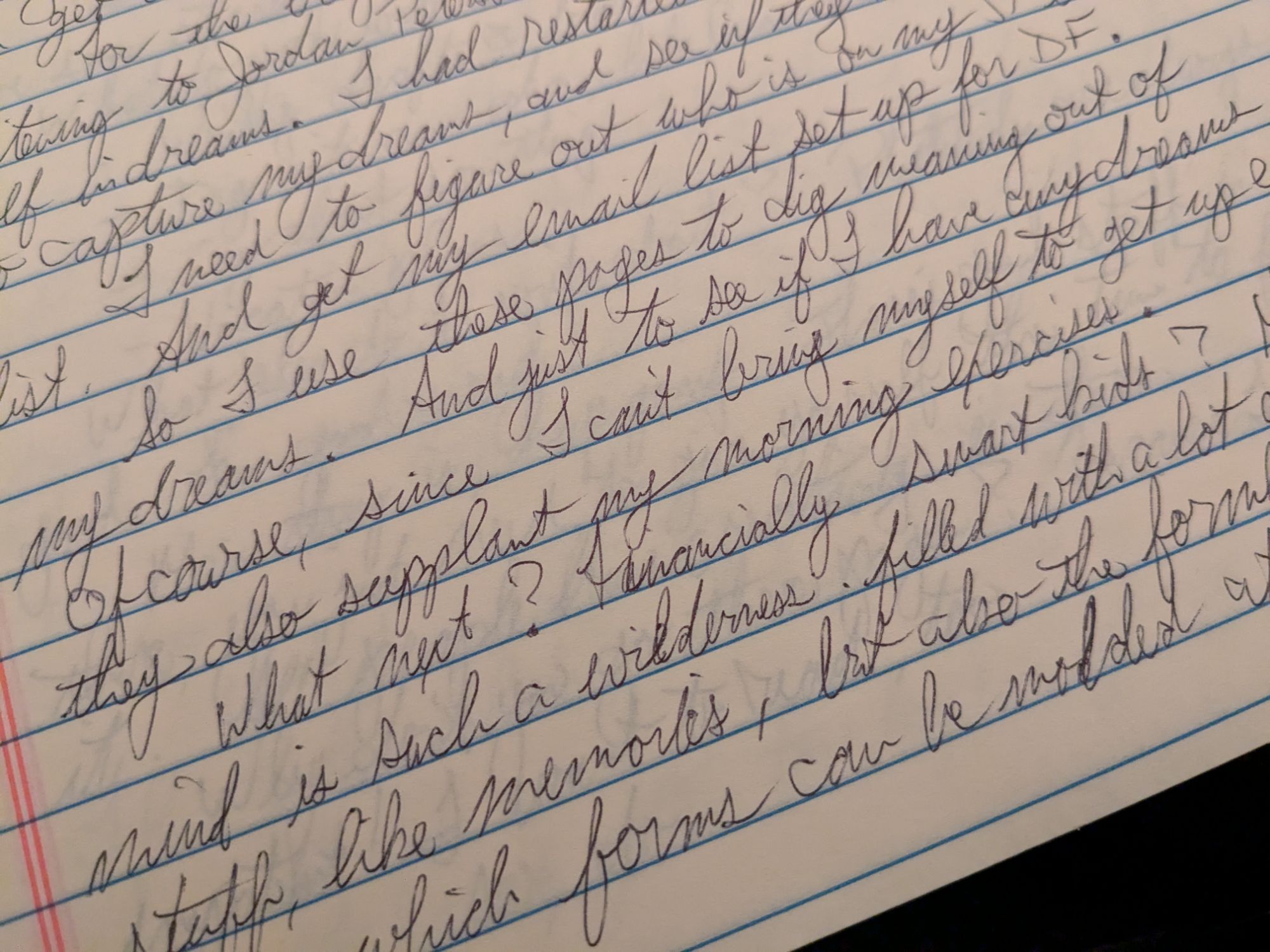
    Putting this all together, I decided to resume a practice I’d started back before my first boy was born – Morning Pages. I did morning pages for a few months, then fell off. After listening to Peterson on the Bible, I started anew, with the goal of at least writing down any dream fragments I could remember, each morning, as soon as I woke up.

    What are morning pages?

    Morning Pages are not a completely new idea, but they were popularized by Julia Cameron in her book The Artist’s Way. Cameron is known as, not a productivity guru, but creativity guru. I may or may not have heard the idea from her (I don’t remember), but here is what she says about them:

    Morning Pages are three pages of longhand, stream of consciousness writing, done first thing in the morning. Source

    The goal here is to get all the mess out of your head, and get to the good stuff right at the beginning of the day. Think of using a honing steel to prep a kitchen knife – you’re straightening out the blade, getting rid of a few kinks, getting ready to cut. Or, letting the sink run on hot for a little bit to push the lingering cold water out, until the hot water starts flowing.

    You’re prepping your mind to take hold of the day.

    The rules are laid out in Cameron’s instructions above:

    1. Use a pen or pencil
    2. Start writing on a piece of paper as soon as you wake
    3. Keep writing until you’ve filled three sheets of paper

    Since this takes about a half hour to 45 minutes, you might be thinking “why not just bang it out on a computer in half the time?” Nope. You write too fast on a computer. The goal is NOT to go fast, but rather to go slow.

    When I wake up in the morning, more often than not I start thinking about all the things I need to do in the day. Rapidly. My morning pages don’t stop the train of thoughts, but rather they force me to think more deeply.

    It forces you to think through your ideas.

    It’s not just going slow that’s important. Writing on a piece of paper is far less inhibiting than on a computer. While you’re writing, you can jot a little note at the top or in the margin. You can draw a little picture or circle some words for emphasis. You can make a paper airplane when you’re done.

    The pen and paper help kick start your creativity.

    The benefits of morning pages

    For those of us who find ourselves easily distracted from the goal of raking in riches, these pages offer an immediate warm up for concentration and a focus on being our best.

    If you get up early enough, the morning is really peaceful. Grab a cup of coffee, open the window, and smell the fresh morning air. Nobody is there to distract you. Your partner isn’t texting reminders to you. The kids are still asleep (maybe).

    The morning tends to be devoid of distraction, so you can get to know how your mind works in a controlled environment.

    The pages you write in the morning give you a chance to think through things you have to do, or ideas you didn’t have time to explore the day before.

    For example, I’m supposed to be writing an article on the discoveries made about the Moon since the Chinese started bringing back fresh samples with their Chang’e-5 and Chang’e-6 missions. I haven’t had time to think much about this article recently, beyond doing keyword searches and grabbing links to articles. This morning, I took the time to write down some ideas and questions I want answered. Did we find out more about the nature of water on the Moon? Do we know more about why the lunar far side is so different than the near side? How has the “giant impact” hypothesis of the Moon’s origin been challenged by the samples?

    Morning pages can help soothe a troubled mind. If you wake up stressed about a fight you had the day previous, or something important coming up today, just the act of writing on a piece of paper helps to calm you down.

    It’s a moment of mindfulness. It engages your senses of vision, hearing (the crinkle of the paper, the pen on paper), touch (roughness of the paper, motion of the hand). Even taste and smell if you like coffee or tea in the morning. Engaging these sensed perceptions helps to ground us and get control over our feelings.

    How to start

    So, now that you have a burning desire to start, it’s time to buy a fancy Clairefontaine notebook and grab your most expensive fountain pen, with some Iroshizuku Tsuki-Yo ink, and set that alarm for 5:00am.

    Wrong.

    I tried doing something like that at first, and it just didn’t hold. Here are some tips that helped me both do the habit, and keep the habit.

    1. Get cheap supplies

    I use a Bic clic stick pen with a pad of yellow paper. The paper is the cheapest I could find, and the Bic is my favorite cheap pen.

    When you write, you can’t be concerned with wasting paper, or making sure everything is perfect. You need an abundance of supplies.

    If you stress about supplies, you’ll never get past a day or two of this.

    1. Just keep writing

    You’re sitting there, staring at the page, not sure what to write next. Just write “I don’t know what to write next.” Then write it again.

    You’ll find that eventually, you’ll want to write something else. These mornings are almost magical. You have good ideas in your mind, you just need to squeeze the crap out of the way.

    Keep going!

    1. Try to write all three pages

    If you don’t see a benefit to writing these pages, you won’t stick to it. Try to keep writing all the way to the end of the third page. That’s long enough that eventually, you’ll get to the good stuff. Often, I find that the last paragraph I write contains the real gold, that leads to either a great article or a great idea for my family.

    1. Do not censor yourself

    Nobody’s going to read these pages. Maybe you will later on, but nobody else will.

    So, write the garbage! Write out your most embarrassing thoughts. Write out your guilty secrets. Write about how you secretly think the guy at the store smells like cow shit. It doesn’t matter.

    What does matter is that, by writing out what is really on your mind, you get to know who you really are.

    1. Put it in an easy spot

    Tonight, pick out where you will write tomorrow morning. Put your pen and notepad on that spot so it’s all ready for you to go. You want to be able to start no matter what state of mind you’re in.

    Wake up, get some coffee, and go sit. There is nothing in your way to writing your morning pages.

    So tomorrow morning, grab a pen, some paper, and start writing. Remember, there’s no right or wrong way to do morning pages. It’s about your journey, your thoughts, and your growth. Give it a try for a week, and see how it transforms your mornings, and perhaps, your life.

    I hope you liked this article. Thank you for taking the time to read it! Please leave a comment below with your thoughts, sign up to receive regular updates, and share this article with your friends.

  • Lost in Likes? Seize Your Own Attention!

    Lost in Likes? Seize Your Own Attention!

    Recently, my kid’s school held a little book club meeting for the parents. The topic was Jonathan Haidt’s new book, The Anxious Generation: How the Great Rewiring of Childhood Is Causing an Epidemic of Mental Illness. The meeting was what you’d expect from a classical, closet conservative primary school – lots of PhDs singing choir to the melody scored within the book. The main thesis is that kids who hit adolescence after about 2012 have had what’s needed for developing strong character removed from their lives, and replaced by intense addiction to the social draws of the online world, primarily represented by smartphones and online gaming.

    A ton of the book resonated strongly with me. For example, I do remember riding my bike around town with my friends around 10 years old, and getting into truly risky situations. I still hark back to lessons learned during those times, while navigating the adult professional world. Parents in my social circles today in 2024 would never let their kids get into risky situations, outside parental supervision. Where should kids learn those kinds of lessons today?

    But the big topic that grabbed me, and is absolutely pertinent to my blog here, is the subject of attention fragmentation. It’s been kind of an undercurrent subject over the past decade or two that attention spans are shortening dramatically, and that it’s due to the prevalence of smartphones. However, the synopsis of how our attention has been intentionally broken up over the past decades is downright spooky.

    Before we get into the tinfoil hat stuff, let’s start with what’s so important about attention.

    What is, and why develop, your attention?

    Human beings have landed on the Moon. We proved the Earth and other planets orbit the Sun, and proved it from the Earth. We split the atom, and put it back together. We feed far more people than the Earth’s habitable land could support naturally. And we tend to live two to three times longer than the average person lived 200 years ago, because we discovered and learned to fight invisible entities called germs.

    How are these things possible? One word – OK, a few more than one word: Man was created with the ability to discover principles that govern actions in the universe, and then develop technologies that leverage those principles to increase our power to survive in this universe. To make those discoveries, you need to sustain attention.

    According to William James, attention is “the taking possession by the mind, in clear and vivid form, of one out of what see several simultaneously possible objects or trains of thought… It implies withdrawal from some things in order to deal effectively with others.” Losing attention is when that train of thought jumps the track. It takes effort to keep that train on the right track, sometimes almost physical effort.

    For example, you’re probably one of 90% of schooled adults who had to analyze a poem in primary or secondary school. You are also probably one of the 90% of people whose eyes just glazed over at the mention of poetry! It takes a LOT of attention to sit still and think long enough about a poem to dig the meat out of it. Take this one – a famous sonnet from Shakespeare, pretty short at 14 lines:

    For shame deny that thou bear’st love to any,
    Who for thyself art so unprovident.
    Grant, if thou wilt, thou art beloved of many,
    But that thou none lov’st is most evident.
    For thou art so possessed with murd’rous hate
    That ’gainst thyself thou stick’st not to conspire,
    Seeking that beauteous roof to ruinate
    Which to repair should be thy chief desire.
    O, change thy thought, that I may change my mind.
    Shall hate be fairer lodged than gentle love?
    Be as thy presence is, gracious and kind,
    Or to thyself at least kind-hearted prove.
    Make thee another self for love of me,
    That beauty still may live in thine or thee.

    You probably didn’t even pay attention long enough to read to the last line!

    But that’s OK, because the point here is that training your attention on some task that doesn’t have an immediate feel-good effect, for an extended time, is hard work. For all of us. If you are one of the readers who have actually analyzed a poem or two in the past, you know that the reward is worth it. The effect can be seen when you finally get it, and a smile pops on your face.

    Go give that poem above another try now. Give it about 15 minutes, the next sentence can wait.

    How your attention is being usurped

    Your attention span is extremely valuable. So valuable, that it is the primary commodity of several of the largest companies in the world.

    The way platforms like Facebook, Instagram, Twitter, and Google make money, is by feeding your attention to advertisers. When you’re scrolling your feed, see an ad for something like the new Acme toilet plungers, and then can’t last one more minute without flipping open Amazon to buy an Acme plunger before your toilet explodes, Google just got paid for your purchase. These platforms expend billions of dollars a year to refine their algorithms for tailoring ads to fit exactly your desires, because other companies will pay them to place those ads for your attention.

    If the Googles and Metas couldn’t steal your attention, then nobody would pay them for ad space. Your attention is their product.

    So let’s look at what companies do to keep your attention on their platforms. Haidt cites a book by Nir Eyal called Hooked: How to Build Habit-Forming Products for the general pattern. Eyal says the model for making something addictive has four components:

    1. Trigger – this is the something that first catches your attention. The vibration of your phone, the ding of a notification, the picture of cheesecake on the restaurant table.
    2. Action – The trigger causes you to want you to do something. Check your phone, eat the second doughnut, put one more coin in the slot machine.
    3. Variable Reward – This is the kicker, which I’ll talk about more below. Not every action causes a shot of pleasure, but enough that you know there’s one in there somewhere.
    4. Investment – This is the secret sauce of social media platforms. You put a little of yourself into the program, so you need to see how your investment is doing. “Did someone like my post? Why do I suddenly want a plunger?”

    Components 1 through 3 are how lottery tickets work. I got into scratch off tickets when I was in my early teens, because my mom wanted me to see how it works, and there was a gas station kiddie corner to the house. You pay a buck and get a ticket, which you then scratch off to reveal the prize. You win a couple dollars every once in a while. Each time you scratch off and lose, you think “maybe the next one,” and you buy another.

    This is called the variable-ratio schedule, which behavioral psychologists found drives the strongest and post persistent behavior.

    When you put a rat into a cage where it has learned to get food by pressing a bar, it gets a surge of dopamine in anticipation of the reward. It runs to the bar and starts pressing. But if the first few presses yield no reward, that does not dampen the rat’s enthusiasm. Rather, as the rat continues to press, dopamine levels will go up in anticipation of the reward, which must be coming at any moment!. When the reward finally comes, it feels great, but the heightened levels of dopamine make the rat continue to press, in anticipation of the next reward, which will come…after some unknown number of presses, so just keep pressing! (Haidt, p. 132)

    Social media platforms have mastered this principle with two specific innovations.

    1. Pull to refresh – Your feed loads at the top. Pulling down with your thumb is the natural motion to see what’s new. When you do, the little “working” circle spins at the top. Sometimes it refreshes with a new post, sometimes it doesn’t. Never mind the fact that the new post will appear at the top regardless of whether you pull to refresh! Each time you pull, you get a little jolt of anticipation, a little dose of dopamine.

    2. Bottomless scroll – Sometimes your internet connection sucks, and you can see this in action. When you get to the bottom, it takes a while for the feed to show more. But generally, more posts get added to the bottom of the webpage without you noticing, so you can just keep scrolling forever. “Doom Scrolling”. You can scroll for a while before there’s anything really interesting. But there might be something just below, so you keep scrolling, in anticipation of the incredible.

    The phantom vibration

    When you were working on that poem up above, how many times did your phone notify you with some new update? If you’re like the average American, at least two or three times.

    With each ding or vibration, your attention flits to the feed.

    “Maybe someone liked my post!”

    “I bet that’s that one email!”

    “Did Biden just drop out of the race?!”

    Each time your attention flits, it takes effort to bring that attention back to what you were doing. Even if you phone isn’t dinging and buzzing, it builds a habituated pattern of thought, where every couple minutes, you think about checking your phone for a notification. Once upon a time, I would even start feeling the periodic vibrations on my hip when I didn’t have my phone with me.

    So you end up only spending about half the allotted time paying attention to your work, and that attention is fragmented into little spurts. There’s no way to get deep into the material at all. Some people like to lie to themselves by saying they’re multitasking, but there is no such thing as multitasking, only context switching.

    The glimmer of hope

    People used to read poetry, and watch long stage productions. People used to read the Bible – the whole thing. Each of the debates between Abraham Lincoln and Stephen Douglas lasted several hours, not the barely one hour presidential debates of today. People used to learn to direct their attention, and keep it there.

    After doom scrolling for an hour, we don’t feel exuberant with joy, but rather deflated. That’s the feeling of maybe having gotten some things done, but those things didn’t move the needle of your life.

    Your mind is thirsting for the kind of deep concentration needed to really find things out! So, here are some practices I’ve found to help train my attention to stick on a topic for more than a minute or two:

    1. Pomodoro technique

    The Pomodoro Technique is a practice where you set two timers, one for 25 minutes, and one for 5 minutes. First, start the 25 minute timer, and use that time to focus on one task. When it goes off, start the 5 minute timer, stand up, walk away from your work, and take a break. After five minutes, go back, sit down, and start the 25 minute timer again. Each cycle of 25 minute work, 5 minute break, is called one Pomodoro.

    The reason this works is because, when your mind starts drifting, you can remind yourself that a break is not far away, and bring your attention back to the task at hand. It helps to keep a pen and piece of paper nearby to write down anything that grabs your attention, so you can attend to it during the 5 minute break.

    1. Morning pages

    For this, you need three pieces of paper, and something to write with. As soon as you get up in the morning, start writing down whatever is in your head. Don’t stop until you’ve filled those three pages. It doesn’t matter what you write, even if it’s “I hate this, I hate this, I hate this”. I write down my dreams if I remember them, or write down ideas for new blog posts, or hash out whatever has me worried.

    The trick here is that you MUST write on a physical piece of paper. The goal is to slow your mind, not get ideas down as fast as you can. I’ll write more about this in a future post, but for now suffice it to say that it sets the pace of the day, with a half hour of unbroken attention.

    1. Study a piece of classical music

    Pick something by one of the traditionally classical composers – Bach, Mozart, Beethoven, Brahms. You can sit and just listen to it, but I find it’s more effective if you print out the score, and follow the music while listening. You can get pretty much any score from the Petrucci Music Library.

    This is similar to working on poems, in that your eyes might be watering at the thought of spending a half hour listening to such boring stuff. But, pop music is far too easy to just have in the background. With one of the great compositions, things you hear later in the piece relate to things you heard earlier. If you can hold your attention on the music, you’ll start hearing these recapitulations.

    For example, the clearest, if not longest, example of this is Beethoven’s 9th symphony. The fourth movement quotes from each of the first three right at the beginning, and then develops a whole new theme out of them that can’t be completed without bringing in a chorus of human voices singing about the Creator’s incredible universe.

    If you set yourself just five minutes to concentrate on a piece of music, you’ll find yourself getting sucked in. This in itself trains your concentration.

    1. Dumb down your phone, or get a dumb phone

    This is probably the most drastic measure you can take, outside of moving to the hills. That smartphone in your pocket is like having a little gremlin on your shoulder, hollering in your ear every few minutes. Get rid of it!

    The best option here is to replace it with a so-called dumb phone. These are the candy bar or flip phones of yore that can’t do much except call and send texts.

    In the United States, our selection is a little limited because the FCC wiped out all the 2G and 3G cellular technology. You can’t just buy a well cared for Motorola Razr off eBay and throw a SIM card in it anymore; you’ll need to buy one of the newer phones with 4G or 5G antennas. In other countries, you might be able to get away with one of the classics, though.

    “But what about my maps app, or WhatsApp, or [some other app I can’t live without]?” Modern dumb phones usually run a modified version of Android, and can run a few of these apps on which we’ve become dependent. Nokia makes a few of these newer 4G dumb phones, as well as a few other companies. If you go on the r/dumbphones subreddit, you can get some suggestions, or try out the dumbphone finder built by the moderator, Jose Briones.

    Maybe you just can’t go whole hog yet. In that case, you can start by stripping the most distracting apps off your smartphone. Get rid of Instagram, X, and whatever else pings you incessantly. Turn off all the notifications except for calls and texts. There are even apps you can install that will dumb down your phone for you.

    Reclaim your attention, reclaim your future

    We’ve explored how our attention spans are under assault and fragmented by the very tools and companies that had promised us connection. The resulting fragmentation hinders us from achieving the accomplishments of humanity’s past, and future.

    But there is hope!

    1. Be Aware: Recognize the tactics that huge tech companies use to keep eyes glued to the screen, and that those tactics work on your eyes too.
    2. Train your Attention: Use some of the tips above, such as studying classical music and switching to a dumber phone, and consciously expand control over your own attention.
    3. Tell others: Progress is a collaborative endeavor among powerful individuals. Get your friends and family to see the importance of training their own attention, and build a team.

    By taking control of your attention span, you can go deeper into complex ideas, develop more meaningful connections, and help you achieve your dreams.

    As usual, thank you for taking the time to read this! Please leave a comment below with your thoughts, and sign up to receive regular updates.

  • Growth Mindset versus Influencer: Defeat the Beast to Succeed

    Growth Mindset versus Influencer: Defeat the Beast to Succeed

    A couple years ago, some Instagram influencer explained to me the difference between the Growth mindset and the Scarcity mindset. “The Growth mindset,” she said, “is one of abundance. This mindset is always optimistic and brings energy.” In contrast, the Scarcity mindset is one of lack. “This mindset is always pessimistic, and sucks energy out of everything around him.”

    Naturally (as implied by the influencer), I suffered from the Scarcity mindset. Because why would I get my psychological advice from an Instagram influencer otherwise? And, I do tend to stress out about lack of money.

    Fast forward a few years, to when I forgot to invite my wife on some outing with the kids and deeply hurt her feelings. My inner critic yelled, “You did it again! You stupid idiot!” My outward response was to grow quiet, and go sit on the porch. There, I punched the ground hard, twice, and broke my hand.

    A day or two later, while reading The Science of Selling by David Hoffeld (yes, I do read other books), I ran into a different viewpoint of this dichotomy. Stanford psychologist Carol Dweck had studied a gazillion people, specifically why some succeed while others don’t. In her studies, she identified two responses to failure that distinguish the two.

    • Fixed Mindset

      • When this person encounters failure, he or she blames an unchangeable quality within themselves. “I just suck” they say to themselves.
    • Growth Mindset

      • In contrast, when this person fails, he or she finds something to learn from the failure, and then acts according to that lesson. They don’t blame themselves.

    Since then, my hand has healed, but remains perceptibly disfigured. Each time I fail and get driven into the despair spiral, I look at my hand, and remember to learn instead of punish.

    Failure Friday

    Chris Guillebeau’s daily Side Hustle School podcast is never more than 10 minutes long, and always worth the listen. One of his weekly categories is “Failure Friday”, where he reviews a person’s failed attempt at building a side hustle. These episodes are usually better than expected.

    This week’s episode featured a lady who helped schools revamp their curricula. However, though she began each project with insatiable enthusiasm, she found that she had to scramble more and more the closer to the finish line she got. Finally, she blew herself out after having failed to deliver on a huge, important curriculum redesign.

    She later got diagnosed with ADHD, which typically manifests with intense focus when something is interesting, and insurmountable procrastination if something is not. She got on medication and started learning behaviors to cope with her disability.

    Now, she’s back on the horse, and finding healthy success. This is the Growth mindset. Instead of careening off the cliff of self-doubt, she reflected on why she failed. In response, she figured out ways to change her behavior, and started rebuilding a sustainable success story.

    Five tips to get better at learning from failure

    Here are five things you can start working on today, to build yourself into a resilient, growing success story.

    1. Focus on the method, not the result

    One thing I’ve learned studying entrepreneurs, is that they’re always starting new companies. When you finally achieve a success, you want that success to be repeatable. Instead of staring down your failures and mistakes, focus on what you did leading up to the result. What was good, and what didn’t help?

    In other words, focus on developing habits that trend toward your goal, not on whether you actually hit that goal or not.

    I’ve found it helps to start journaling. Using a pen-and-paper journal to reflect on my behavior has made it easier to identify problems, and develop constructive ways to change poor habits.

    1. Recognize and challenge the inner critic – you do not deserve to be punished

    I think there’s really three people inside everyone. There’s the little you just trying to be a good man. There’s the coach, which is who talks when you’re talking to yourself. Then there’s the higher you, which is more difficult to observe, because he is watching the interaction between little you and the coach.

    Inside someone with a fixed mindset, that coach is really a terrifying inner critic, who is always poised to punish little you. Instead of just taking the punishment, present evidence to that critic that challenges the critique. “Ugh, you always forget to take out the trash,” he says. Really? Didn’t I take out the trash last week just fine? Yeah, that’s right. Back off, critic.

    1. Celebrate small victories

    It’s easy to run right past small achievements, because that first $1,000,000 is the real goal. But, if you stop for a moment and take a pride in those small accomplishments, it helps puff a little more wind under your wings. It gives you a dose of optimism that could be what you need to get a bit closer to your big goal.

    1. Read about others’ failures

    There’s a great book called Think and Grow Rich by Napoleon Hill. In the book, Hill tells a good story about a gold digger named Darby who tried to strike it rich back in the great California gold rush. After losing a rich vein of gold, he ran out of money and decided to pack up and go home. He sold his machinery to some junk dealer, and went off to sell life insurance.

    That junk dealer hired a consultant to look at Darby’s dig site, and found that vein of gold. He ended up digging out millions of dollars of gold using Darby’s equipment.

    Darby himself ended up quite rich in the insurance business, because he had learned a hard lesson – “I stopped three feet from gold, but I will never stop because someone says ‘no’ when I ask them to buy insurance.”

    1. Practice gratitude

    Last but not least, thank God for what you do have. I thank the Creator each night for giving me one more day with my wife and boys, and for being placed in such a fascinating and weird world that I can comprehend even a little bit. Just saying thank you each day for for the gifts I’ve received, gives me a moment of calm and optimism for the future. It’s that sliver of optimism that helps change my reaction to failure.

    Practicing gratitude, even if it’s not directed toward the Creator, is one way to train yourself to be present in the moment. Mindfulness in this way is an important habit especially for those of us with ADHD, and helps bring us out of the clouds back into reality.

    As usual, thank you for taking the time to read this! Please leave a comment below with your thoughts, and sign up to receive regular updates.

  • Neglect Medications at Your Own Peril!

    Neglect Medications at Your Own Peril!

    Once upon a time, I was with my wife and two boys at another kid's birthday party.  The party was at an outdoor tree house playground, with zip lines and obstacle courses.  A boy's dreamland.

    My job was to keep an eye on the younger boy, who tends to be more fearless than the older one. My anxiety was high, because I had just lost him a few days before. So, I followed him around, making sure there was always a line of sight to his position.

    But the birthday boy's dad is an old friend, and we started talking about real estate. You see, I work for a hedge fund that specializes in distressed properties, so that's usually where I start when someone asks me "How's work?" My friend had done his homework, and briefed me on how a lot of rental homes were getting bought up by hedge funds, like Blackrock, and then rented out at rather high rates that tend to screw the little guy.

    And I lost view of my boy. Trying to be calm, I kept the conversation going while scanning the area for the little rascal. After a few minutes of this futile act, I broke conversation, and hunted the park for him. I couldn't find him anywhere.

    I started to panic. Maybe he was at the bungee trampoline! Nope. Maybe he was at the obstacle course! Nope. I wasn't really afraid that the boy had been abducted (that's actually a very low probability situation), but his risk of injury was very real, and worse, his mom might find out I lost him again. A wife needs to be able to trust her husband will keep the family safe.

    Then she called me.

    "Peter, are you watching number two?"

    "Yep, I'm just running to keep up."

    "Where is he?"

    I was caught. I had no idea. "I, um, think he's at the zip line? I'm looking for him now."

    "He's standing right here Peter. You had one job. What the hell?"

    My Meds


    I first started taking atomoxetine (Strattera) around age 45, when I got my ADHD-Inattentive diagnosis. Soon after, I added buproprion (Wellbutrin). Strattera is a selective norepinephrine reuptake inhibitor (SNRI), and nobody knows why it helps people with ADHD. It made me feel like my feet were on the ground, and I no longer felt panic when I needed to remember something. Wellbutrin is an antidepressant, which made me feel more like taking action than sitting back and planning forever.

    For the first time in a looong time, I felt like I could start functioning at the top of my abilities, and actually stay there.

    One month, I didn't get my Strattera prescription refilled on time, and I was stuck just taking the Wellbutrin. I figured I'd see how it goes -- maybe I had figured out enough coping skills while on Strattera to handle the vacation. And maybe the Wellbutrin was the real workhorse anyhow.

    That's when I started losing my boy, and generally feeling like I was always about to forget something unless I tried REALLY HARD to remember. Since then, I've taken my Strattera every day.

    Don't Skip!


    I'm not an expert on ADHD, so talk to your psychiatrist before taking my advice. However, medication has really changed my life. I did the experiment to prove it.

    There are several arguments against taking medications for mental illnesses.

    1. It does not address the underlying problem

    ADHD is a disease that inhibits executive function in the afflicted. This results in various effects like lost keys, forgotten appointments, low achievement, and poor quality of life. Aren't these really problems that everyone needs to learn how to deal with, and most already have dealt with?

    Yes and no. ADHD is real, and it can be crippling to the sufferer. Taking medication helps you overcome the barrier to focus, and finally get things done. It's not a miracle cure - you still need to learn various skills like keeping a calendar and being mindful. But it does give you the space you need to actually learn and practice those skills

    After a month or two of taking my medications, I cried real tears of joy when I realized I could now plan to do something, and then have the confidence I might actually do it in the future. I could finally set goals I had the hope of meeting.

    2. Dependence (addiction)

    Don't you get addicted to Adderall and start taking more and more to get that feel-good effect? Like cocaine?

    Adderall and other ADHD medications are amphetamine based drugs. And, yes, when abused, they can form dependency. However, remember that ADHD is not an illness that can be cured. You're going to be on the drug for the rest of your life anyway.

    Also, if you get prescribed a non-amphetamine drug like Strattera, you're probably not going to get addicted. For the following reason.

    3. The side effects

    All drugs have side effects. I found no real side effects with Wellbutrin, but did with Strattera. I started taking it in the morning with breakfast. Soon after dropping a pill, I would feel an incredible urge to go take a nap. Also, I found it to create a very bad acid reflux every once in awhile.

    To mitigate these effects, I now take my pills before bed, and eat a little snack at the same time. Sometimes I still get reflux, but I also go right to sleep, which is good for me anyhow!

    Talk to your psychiatrist about possible side effects. There are a variety of medications available to us now. But, remember that the effect of CONTROLLABLE FOCUS tends to far outweigh other physical side effects.

    4. It dulls your creativity

    There are some who think that taking drugs that mess with your mind is a bad idea. I used to associate with an organization that taught ADHD was an imaginary illness, made up to provide an excuse to administer creativity-killing drugs to abnormally bright kids.

    Now that I'm actually taking said drugs, I don't think that. I have no problem coming up with ideas that are just as creative as I did years ago, and I also have the concentration span to follow my dreams, and take care of my family. In other words, the ability to concentrate and maintain focus is needed to get things done. You can be the most creative guy in the world, but if you can't follow that creativity through to production, it doesn't matter.

    To wrap up this post, if you have ADHD, are having a hard time, and haven't attempted medication prescribed by a professional, then please give it a try. It may change your life.