Tag: economics

  • And The Least Worst Accounting Software Is…

    And The Least Worst Accounting Software Is…

    All electronic systems of accounting suck, unless you make more than enough money to cover the bills.

    My first major attempt at keeping the books was with a vast spreadsheet system. You know, like Mister Money Mustache.

    I broke a wide sheet into 52 chunks to represent fiscal weeks – they start when I get paid. Each chunk had a balance rolled over from the previous week, and sections for upcoming income, regular bills, expected costs (like upcoming car repairs), and some other categories.

    Each week, I would download all the line items from my bank website, and distribute them among all these categories. Then, I’d work it until the balance on my spreadsheet was equal to the actual bank balance.

    Rarely did it add up. And rarely did the process take less than 2 hours. And rarely did the result line up with my predictions.

    I tried to speed the process up a few times with functions to automatically categorize things, but still, it was a tedious mess that only kind of worked, and absolutely stressed me out.

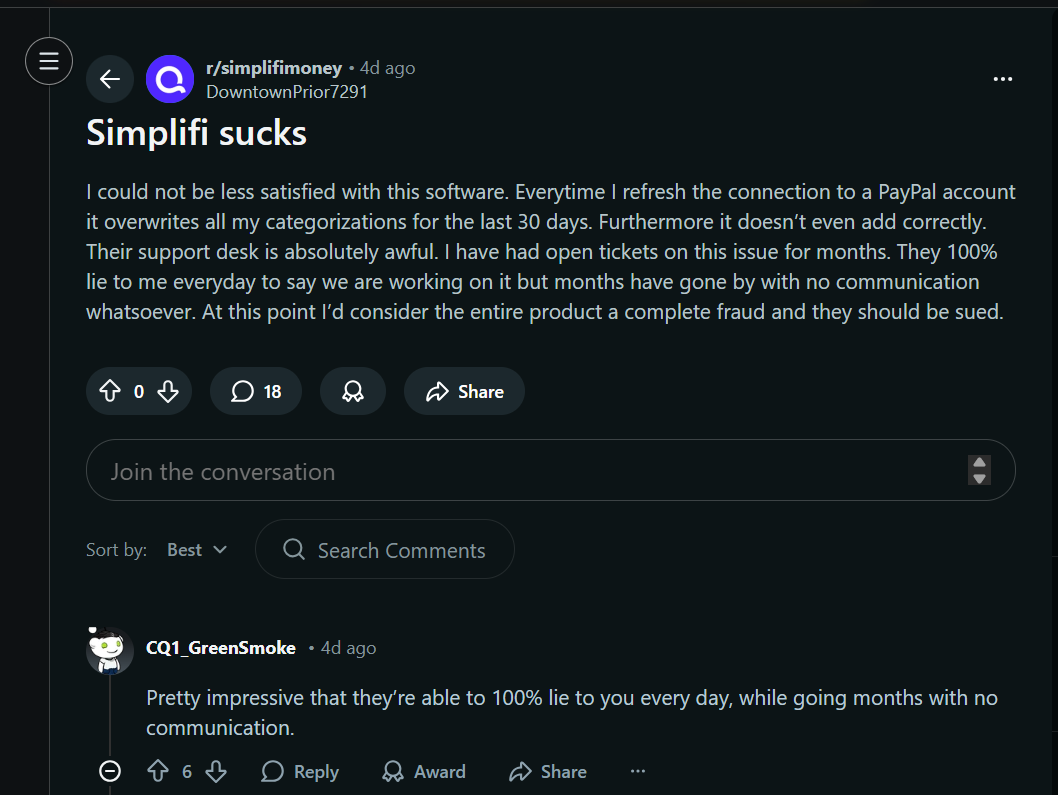
    Wishing there were an easier system, I remembered an earlier experiment with Mint back in the day, which did everything I wanted. Mint went bust, so I found the next best thing – Simplifi.

    The Gap

    Back when I was an elite member of the prestigious Lyndon LaRouche gang, I studied a lot of math. We all did. Half of every paper LaRouche wrote was about math. Really, about how math is an inherently flawed model of the world, and dependence on (or “worship of”) math had led to major economic problems. And war. And sexual impotence. And a bunch of other bad stuff.

    I think, in essence, he’s not wrong.

    Here’s how it works. In math, you have a bunch of statements of bulletproof truths. Those truths are derived logically according to the Rules of Math, from other more fundamental truths. Those more fundamental truths are likewise derived from yet more fundamental truths, and so on, all the way down to a set of truths that can’t be derived from anything else – the axioms, postulates, and definitions.

    But whence this Triumvirate of Truth?

    Well, that’s debatable. We hope the come straight from The Book. That they’re the rules God used when He separated the Light from the Darkness. That they’re the true building blocks of nature.

    However, they are NOT handed down from the Creator. They’re invented by people, usually in order to make the later derived proofs work out. And, in the history of math, we’ve identified a few that are just wrong. For example, Euclid’s parallel postulate.

    So what do you get with a set of theorems proved true, according to an invented set of axioms, postulates, and definitions? You get Star Wars. Or Star Trek.

    You get an approximation to a real world, but not the real world itself.

    There’s a gap. It’s our job not to keep doing proofs on a system that’s inherently an approximation, but rather to find the places where the Real World gives a result that contradicts one of those proved “truths”.

    It’s at that spot, where a new discovery lies in wait. Like Einstein’s theories of Relativity, which incidentally came directly out of the recognition that Euclid was wrong on parallel lines.

    So this brings us back to Simplifi.

    Simplifi, or whatever, is the least worst

    None of these big accounting apps can map the real world exactly. They MUST go off the rails at some point, and require human intervention.

    The least worst accounting software is whatever sounds good to you in about 15 minutes of searching on the web. I like Simplifi, so you can start there if you want.

    You have to be ready to think it sucks after a few weeks of using it, learn how to spot what’s not working, and then figure out how to hack it into something that works better for you. In the end, it’s going to be something of a kludge built off of whatever you first downloaded and installed. But, it will be your kludge.

    The software will not bridge the Gap for you – you will have to build that bridge yourself.

    Here are some hacks I’ve learned with Simplifi, to make it more my own:

    1. Rules, Rules, Rules

    In order for the Reports to work the way you need, you need to set up rules. In the beginning, for every transaction that isn’t some one-off ATM stop, create a rule.

    To do so, click on a transaction, then click on “Create Rule”.

    Your list of transactions
    Your list of transactions

    Information about a single transaction
    Information about a single transaction

    Here, you generalize the keywords Simplifi uses to identify the transaction in the future, give it a nice name you like, and configure all the things you want Simplifi to do when it sees one. For example, maybe you guys get pizza every Friday, and you want that categorized as “Entertainment”.

    Creating a new rule. Get rid of a bunch of the suggested keywords, or it will be too specific to be useful
    Creating a new rule. Get rid of a bunch of the suggested keywords, or it will be too specific to be useful

    After you hit “Continue to Review”, you have the option of running the rule on all past transactions that fit the pattern. Do it!

    Review the rule, and make sure to run rule on all previous transactions
    Review the rule, and make sure to run rule on all previous transactions

    In this way, you are training Simplifi how to read your transactions properly.

    1. Set Recurring Bills and Income

    If a transaction happens more than once, consider it a bill. Click on the transaction (see the pattern?), and hit “Mark as Recurring”.

    Another transaction - Mark as Recurring is in upper right corner
    Another transaction – Mark as Recurring is in upper right corner

    Tell Simplifi how often this one happens, and when it usually happens, and how much it usually is.

    Settings for a recurring bill, or income
    Settings for a recurring bill, or income

    When you mark regular bills (like your weekly pizza night), you can see how these hit your future cash flow. To see your projected cash flow, either click on one of your accounts in the Dashboard, or click on Bills & Income, and then Cash Flow. Pretty neat huh?

    Oh, make sure to also mark any paychecks as Recurring.

    1. Use Categories and Tags for Reporting

    Each transaction can have one Category, but multiple Tags. For the past couple weeks, I’ve been going in and manually marking each transaction with one of two tags: Want and Need.

    When you go to Reports, now you can see the breakdown of what you spent last month based on category, or tags. For example, last month, I found out we spend a quarter of our income on Wants!

    Reports are awesome. This one looks at my custom tags.
    Reports are awesome. This one looks at my custom tags.

    The point is, you need to think about these apps like they are pets. Computer programs are inherently not models of the real world. But, by training them, you can make them a little more useful for you.

    If you liked this article, please leave a comment below, share it with someone you know, and get on my email list!

  • Let Us Revive the True Spirit of Thanksgiving

    Let Us Revive the True Spirit of Thanksgiving

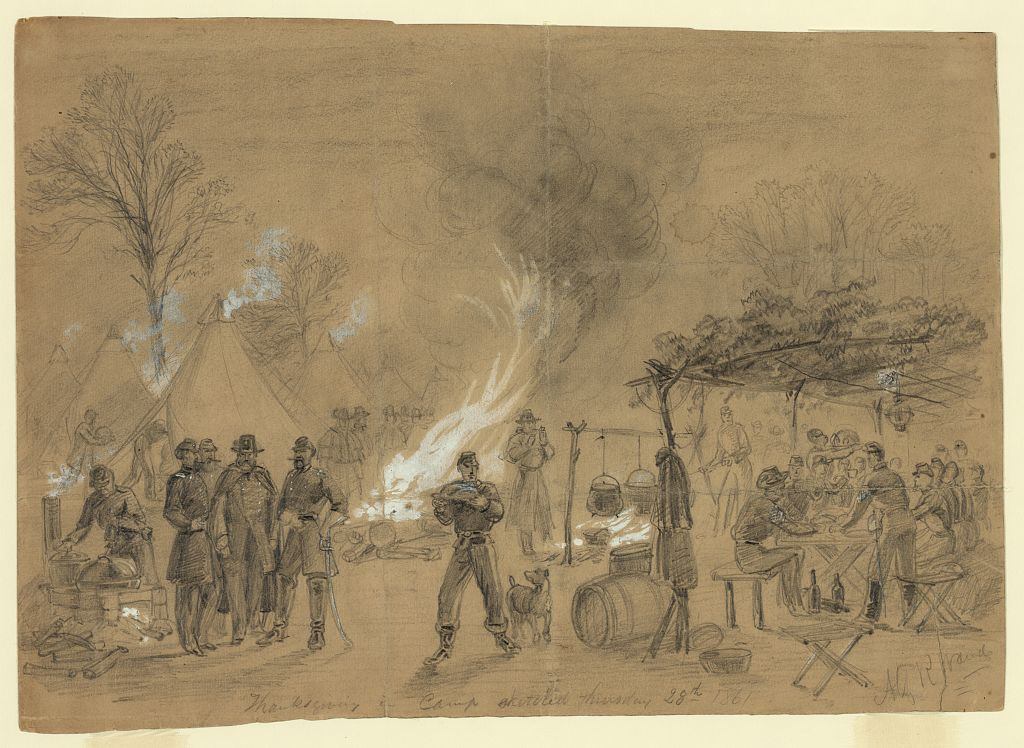
    We’ve been celebrating Thanksgiving in the United States since forever, but 1863 was a special one. It was in this year that President Abraham Lincoln issued his Thanksgiving Proclamation, that set the last Thursday each November aside as a national holiday, for Americans to thank God for our prosperity.

    The full text of that proclamation is below.

    Before getting to that, though, I think it’s appropriate to set a bit of the scene.

    Southern plantation owners and politicians argued that the end of slavery would be the end of their economic prosperity. The argument, as my brilliant wife pointed out to me, is almost identical to the opposition shown against incoming President Trump’s policy to deport illegal aliens from USA. The screeching of the corporations that run most southern farms has only just begun.

    However, by 1863, as noted by Lincoln below, the economy of the Northern, non-slavery states, had grown in both economic output as well as in population. The growth had three components that were directly from Lincoln’s government:

    1. Internal Improvements

    Two major projects were launched by the Lincoln administration that drove economic growth. First, Lincoln supported and initiated the construction of the Transcontinental Railroad, a massive feat of machinery that provided an impetus for developing new technologies. Second, Lincoln launched the Land Grant State College system, which ensured Americans were able to get educated in the latest techniques of agriculture and manufacturing.

    1. Greenbacks

    The USA had been stuck with gold and silver coins for currency up to 1862. This form of “hard money” was impossible to grow, because supply was limited by mining. Some banks had issued their own paper currency, but these notes were always at risk of devaluing by the failure of the source bank.

    This situation made it impossible for the US government to fund both the war and internal improvements.

    As a solution, Lincoln, backed by great American economists Henry C. Carey and Salmon P. Chase, began issuing paper currency directly from the US Treasury. There were three utterances between 1862 and 1863. By expanding the issue of this “fiat money”, Lincoln was able to provide support for a growing national economy under the strain of internal warfare.

    1. Tariffs

    At the time of Lincoln’s election, the USA had the lowest protective tariffs of any nation. During his tenure, he signed the Morrill bill, which had been a cornerstone of Lincoln’s electoral campaign. In fact, a cornerstone of confederate Democrat Stephen Douglas’s campaign was to prevent protectionist measures from being enacted.

    Before the end of the Civil War, protectionist tariffs on foreign goods topped 50%. The revenue generated was used to pay for war expenses as well as the expansion of agriculture and industry across the north.

    The tariffs had the added benefit of enraging the United Kingdom. Prime Minister Lord Palmerston responded, “We do not like slavery, but we want cotton, and we dislike very much your Morrill tariff.”

    In the renewed discussion of protective tariffs by incoming President Trump, which also is greatly distressing British economists, it should be remarked that Lincoln’s monetary and trade policy was combined with vigorous investment into basic economic infrastructure and technological advance. Without this latter investment, tariffs are indeed inflationary.

    Americans do not need more of what we already have, like cars. We need major public works projects, like a new Tennessee Valley Authority to rebuild the American Southeast, which has been repeatedly devastated by natural disasters since the early 2000s. President Trump should declare several new public works projects in this style immediately, to provide a true outlet for renewed American manufacturing might.

    Without further ado, Happy Thanksgiving to you!

    Transcript for President Abraham Lincoln’s Thanksgiving Proclamation from October 3, 1863

    By the President of the United States

    A Proclamation

    The year that is drawing toward its close has been filled with the blessings of fruitful fields and healthful skies. To these bounties, which are so constantly enjoyed that we are prone to forget the source from which they come, others have been added, which are of so extraordinary a nature that they cannot fail to penetrate and even soften the heart which is habitually insensible to the ever-watchful providence of Almighty God.

    In the midst of a civil war of unequaled magnitude and severity, which has sometimes seemed to foreign states to invite and provoke their aggressions, peace has been preserved with all nations, order has been maintained, the laws have been respected and obeyed, and harmony has prevailed everywhere, except in the theater of military conflict; while that theater has been greatly contracted by the advancing armies and navies of the Union.

    Needful diversions of wealth and of strength from the fields of peaceful industry to the national defense have not arrested the plow, the shuttle, or the ship; the ax has enlarged the borders of our settlements, and the mines, as well of iron and coal as of the precious metals, have yielded even more abundantly than heretofore. Population has steadily increased, notwithstanding the waste that has been made in the camp, the siege, and the battlefield, and the country, rejoicing in the consciousness of augmented strength and vigor, is permitted to expect continuance of years with large increase of freedom.

    No human counsel hath devised, nor hath any mortal hand worked out these great things. They are the gracious gifts of the Most High God, who while dealing with us in anger for our sins, hath nevertheless remembered mercy.

    It has seemed to me fit and proper that they should be solemnly, reverently, and gratefully acknowledged as with one heart and one voice by the whole American people. I do, therefore, invite my fellow-citizens in every part of the United States, and also those who are at sea and those who are sojourning in foreign lands, to set apart and observe the last Thursday of November next as a Day of Thanksgiving and Praise to our beneficent Father who dwelleth in the heavens. And I recommend to them that, while offering up the ascriptions justly due to Him for such singular deliverances and blessings, they do also, with humble penitence for our national perverseness and disobedience, commend to His tender care all those who have become widows, orphans, mourners, or sufferers in the lamentable civil strife in which we are unavoidably engaged, and fervently implore the interposition of the Almighty hand to heal the wounds of the nation, and to restore it, as soon as may be consistent with the Divine purposes, to the full enjoyment of peace, harmony, tranquility, and union.

    In testimony whereof, I have hereunto set my hand and caused the seal of the United Stated States to be affixed.

    Done at the city of Washington, this third day of October, in the year of our Lord one thousand eight hundred and sixty-three, and of the Independence of the United States the eighty-eighth.

    Abraham Lincoln

    By the President: William H. Seward. Secretary of State.