Tag: habits

  • Why Planning Less May Be a Better Plan

    Why Planning Less May Be a Better Plan

    Disclaimer: this post contains affiliate links. If you click on them and buy the products, I’ll get a cut of the profit. I promise they’re good products!

    Story time!

    I embarked on my productivity porn addiction back around 2013, when I discovered David Allen’s Getting Things Done (GTD). After skimming a bootleg version of his book on my tiny iPhone, I reckoned I had found the secret to life!

    In short, the goal of GTD is to offload all chores, plans, and to-do lists to a filing cabinet, to free your mind from the burden of remembering everything. Instead of never getting to large projects, you break all projects down into a series of smaller actions, listed on a piece of paper for you. Each day, you get a bunch of those next-actions in front of you and complete them.

    Instead of using your mind as your to-do list, you can now use your mind to be creative while still getting everything done.

    That’s it. Mind like water.

    (Before you true believers out there pillory me, yes there’s more to it. Like, the machine that prints out labels for all the file folders.)

    I got obsessed, bought two beat up filing cabinets, and filled them with file folders for everything in my life.

    And I just couldn’t keep up.

    I’ve since tried a few ways to approximate Allen’s write-out-all-steps approach, and sometimes have made a bit of progress. But I could never quite make it take off.

    The part that filled me with guilt and failure, was that I just couldn’t bring myself to take every project and break it up into action chunks. While dealing with this guilt, and getting some things done half-assed, I kept wondering if maybe there was another way.

    Then, a few days ago, it hit me. There is another way!

    In this article, I’ll describe this other way, which is more like mathematical induction than exhaustive introspection. And, I think both you and I will become happier and more productive in the end.

    Enjoy Failure

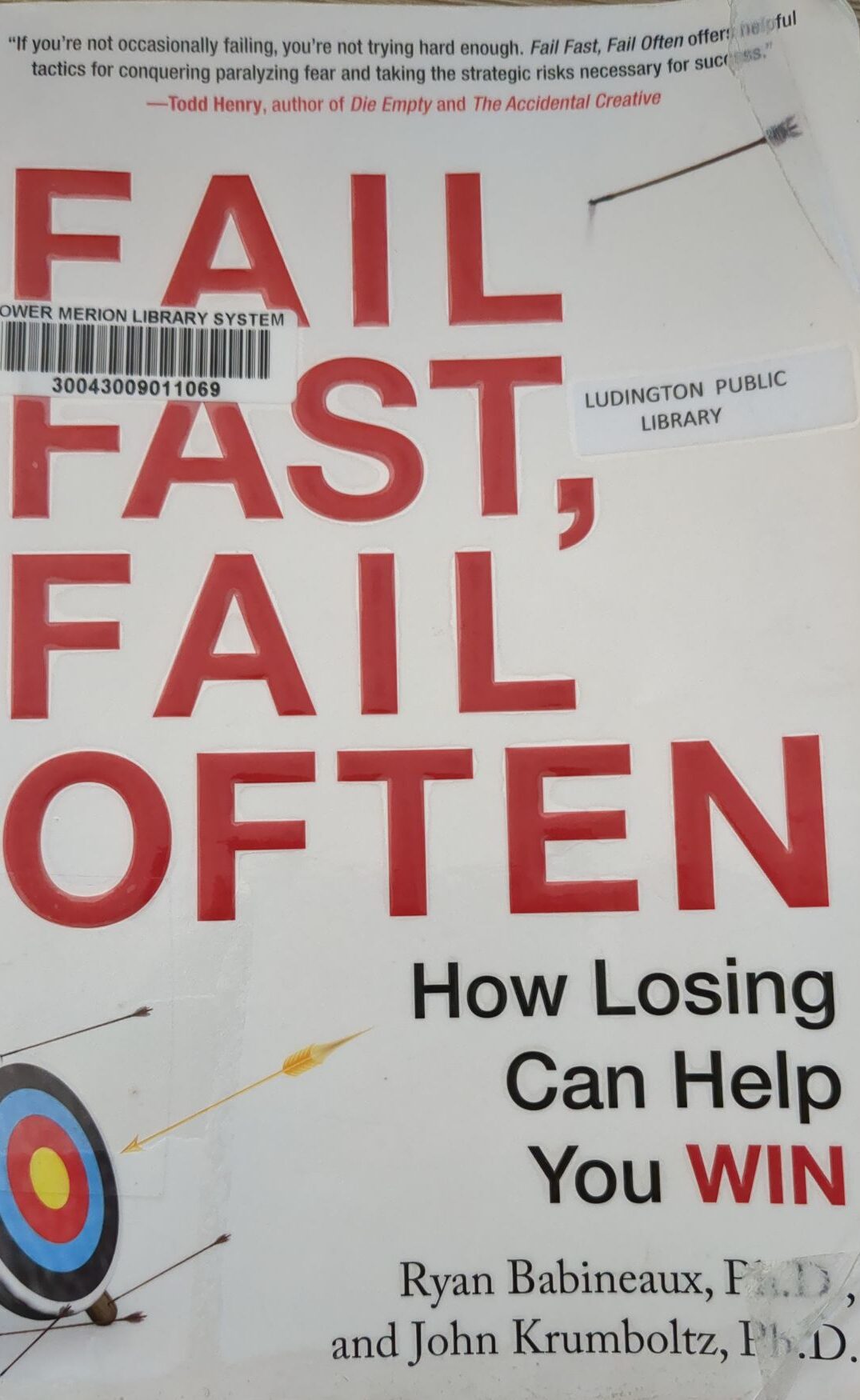
    I’m reading a book called Fail Fast, Fail Often, by John Krumboltz and Ryan Babineaux. Their strategy so far feels a little like a learned faith. They studied the happiness and success of over a bajillion people, and have come to the conclusion that the most successful and happy among us act first, and plan rarely.

    Most of us are the opposite – we plan always, act never. The authors instead found that it’s through trying new things and failing, that people encounter the most opportunities for growth and success. Those of us that plan out all our actions before taking the first step tend to blame everyone for our failures, while the fault really lies in our lack of action.

    It is by fearlessly blasting toward little failures that we learn, and at the same time experience life in a way that the planners could no.

    The behavioral therapy these authors suggest are 1. follow your curiosity, and 2. if you feel like doing something, figure out how to fail at it as soon as possible.

    But how do I know if my curiosity is leading me in the right direction? And, if I fail a bunch of times, won’t I just go broke and lose my house?

    To answer these questions, we need a little bit of mathematics.

    Calculus!

    I know you failed calculus long ago (so did I!), and there’s no way some dry subject like this can help with human psychology.

    But it can. Give it a minute.

    Think about power lines hung from electric poles. They hang in a conspicuous “U” shape called a catenary. It turns out that every chain, rope, bridge, string of lights, whatever, suspended between two points, will hang in that same shape. It’s pretty easy to do experiments to investigate this shape. For example, get a chain necklace, or just a length of chain, and hold it between your hands. That U is the catenary.

    If you get a friend’s help, you can demonstrate something surprising about the catenary. While you hold the chain, have your friend pinch the chain somewhere else gently, so the chain stays pretty still. Now, you let go of the string on that end. The rest of the chain will remain in the identical catenary shape.

    If you follow this experiment all the way down to the smallest bit of chain, the shape continues to remain.

    German mathematician Gottfried Leibniz discovered that the shape goes all the way to the smallest conceivable length of chain, of length zero. He called that smallest length the infinitesimal. That infinitesimal can’t be a straight line, but must be some shape that represents the catenary’s curvature.

    Leibniz showed a surprising relationship between that infinitesimal and the full catenary curve. He invented a new math called integration, where all those infinitesimals can be added together to form the entire, beautiful catenary curve.

    In other words, the smallest bit of action, constructed properly and repeated over and over, is sufficient to recreate the full goal of the curve.

    The challenge Leibniz and his collaborators, like Johann Bernoulli, faced, was to create a new mathematics to both describe this minimum-maximum relationship, but also to discover the relationship for new types of curves. This mathematics is today called “Calculus”, and it is crucial for understanding all areas of physics.

    Tiny Actions, Giant Results

    We can apply the laws of infinitesimal calculus to our own lives. I call this “trust the process”.

    The way this works is by identifying certain behaviors that tend to aim towards success, and then practicing those behaviors even when they lead to failure. And when failure strikes, learn from it.

    In fact, Krumboltz and Babineaux stress that failure, itself, should be a daily behavior!

    The authors pack their short book with examples of people who apparently bumble into wild success. For example, Jack Dorsey, the founder of Twitter (now X). Dorsey got interested in the network problem of dispatch – like, selecting the best cops to get to the scene most efficiently. He got hired to a company to work on their dispatch software, and the company soon went bust at the end of the 1990s. Instead of jumping back into programming, Dorsey went and dabbled at massage therapy, botanical illustration, babysitting, and fashion design. Several years later, while working as a programmer again for a podcasting company that was on the verge of bankruptcy, he pitched the idea that would become Twitter. The rest is history.

    Krumboltz and Babineaux show, from various angles, that trying new things and failing is not only a great path toward success, but an efficient path. Instead of pinning your hopes of success on some future goal that you might never get to, you spend your time doing little experiments and learning from them.

    They suggest a few ground rules for picking an action to take, so you’re not just failing for failure’s sake. Here are the ones I thought most important, found in the chapter called “Think Big, Act Small”:

    1. Keep it specific

    Don’t pick something vague, like “start writing better”. It needs to be something that happens at a point, like “send a sales email to a bunch of my friends and family this afternoon”.

    1. Keep it easy

    Instead of trying to bench press 500 pounds right now, and getting discouraged, try benching 50 pounds instead.

    1. Keep it fun

    Cutting off a finger is not fun, though it’s probably pretty easy and specific. Do something that will make you smile instead.

    1. Keep it immediate

    If the action occurs way in the future, like planning to hit up a networking conference two months from now, you’ll have too much time to talk yourself out of it. And, that’s two months wasted not taking any other risks! Pick something you can do today.

    1. Keep it cheap

    The point here is that the only hurdle should be fear. You don’t want to stick your life savings into something that might pay out in a year. It needs to be something that, if it results in failure, doesn’t set you back at all but rather provides some form of lesson.

    1. Keep it real

    “Think about the good things that happened yesterday” doesn’t count. The action has to be something that will move your life forward, like “show my coworker my productivity side project and get his feedback.” Or, “send my most recent article to ADDitude magazine and see if they’ll publish it”.

    1. Keep it social

    This was the “ah ha” step for me, since I tend to be on the bashful side. A key to success is to be seen and heard by others. Remember, ultimately, other people give you money and other valuables. These things do NOT grow on trees in your own personal garden. Showing your little project to someone else will provide some form of feedback, and may open a door to a new experience or opportunity.

    Trust the Process

    That cycle of “act small – fail – learn” may sound somewhat awful. Like some kind of tedious homework assignment that never ends. But here’s the surprising bit Krumboltz and Babineaux drive home: this process actually builds happiness along the way.

    When you manage to take just one tiny, low-risk step driven by curiosity, you get a little jolt of confidence. That confidence delivers its own ounce of joy. And that little spark of joy? It creates momentum, making you want to try the next small thing. Suddenly, each tiny step you take – even the ones that end in a “teaching failure” – has the power to make you happier right now.

    Sure, trusting that these small, sometimes fumbling steps will eventually lead somewhere worthwhile might feel like a leap of faith. But isn’t it more realistic, more attainable, than rigidly following a complex set of rules towards some vague future state that might contain happiness?

    So, what can you do today that could lead to a teaching failure?

    If you liked this article, please leave a comment below, share it with someone you know, and get on my email list!

  • Beast, Rider, and Marshall:  How to Get Control of Yourself

    Beast, Rider, and Marshall: How to Get Control of Yourself

    Subscribe to continue reading

    Subscribe to get access to the rest of this post and other subscriber-only content.

  • Put Another Link on the Chain!

    Put Another Link on the Chain!

    Disclaimer: this post contains affiliate links. If you click on them and buy the products, I’ll get a cut of the profit. But I promise I’ll only link to products I think you’ll like!

    A few weeks ago, I was asked to write an article on the Moon, and to focus on the Chinese sample returns. Day turned into week. Week turned into two weeks. And BOOM! I broke my chain of success.

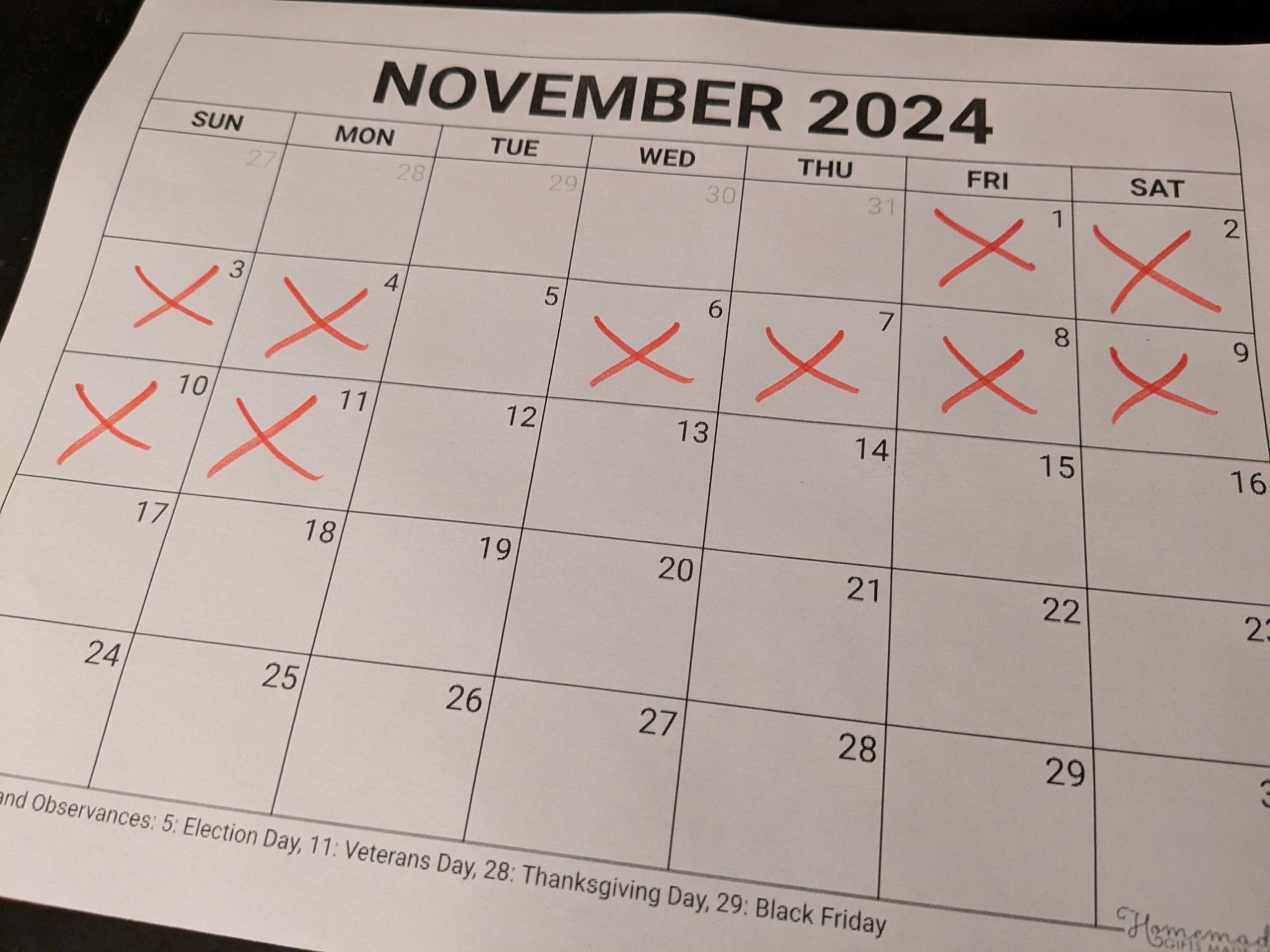
    The Chain is a concept I first heard about from Jerry Seinfeld. I swear I heard him talk about it, but all I can find now is a story, where a young comic asked Jerry what was the secret to great comedy. Jerry said “Tell a lot of jokes. Write at least one joke every day. Draw a big red X every day you write a joke, and don’t miss a day. Don’t break the chain.”

    The idea here is that, after identifying some habit you want, you mark it on a calendar every day you do it. For me, my goal was to write an article for this blog once a week. When you focus on building that chain of successes, you are carving for yourself a consistent habit for long-term personal success.

    Atomic Habits

    Another guy who talks about this is James Clear, of Atomic Habits fame. He looks at these chain links as little micro-encouragements, micro-rewards. Each time you put another link on the chain, you get a little hit of dopamine that reinforces your identity. “This is what people like me do!”

    The other strategy Clear adds is that, if you DO break the chain, get right back on that horse. If you skip a link, don’t skip two.

    Now here is where my problem really lies. Once I miss a link, I miss the next one. And the next one. And, before I know it, my chain is long gone.

    Then comes the guilt and the inner critic. “Of course you broke the chain. It’s because you suck.” I think what actually happens here is that I start a new chain that reinforces my identity as a chump.

    The solution is really easy – just do the habit again and restart the chain. But, that’s easier said then done.

    The Chain and ADHD

    For those of us with ADHD, we tend to spiral and wallow. We constantly listen to that inner critic, and wind up agreeing with it. It’s like when a song gets stuck in your head. That song can play over a thousand times in there, maybe without you noticing it.

    The inner critic does that too, but it’s not just annoying, like that song; the inner critic reinforces an awful identity.

    The only way to end the song, and the inner critic, is to stop what you’re doing and confront that internal parasite. With the song, you can consciously stop the music, or think of a different tune.

    It’s a little more difficult with the inner critic. With the critic, it’s useful to challenge what he’s saying.

    “You’ll never start that habit, you suck!” Not true, I did keep that chain going, just had a little setback.

    “You’re no writer, you suck!” No, a person becomes what he does. If I want to be a writer, I just need to write every day, which I did for a while.

    “You’re a glutton, and you’ll never change. You suck, fat ass!” No, I did slip up and missed my salad yesterday, but I was doing fine for a while.

    “You’re just a fat weakling! Get over it, you suck!” Not true. I just missed a few days at the gym. I can get back on this horse, you imaginary critic parasite.

    After confronting the inner critic with real evidence for a bit, turn him off. Go put another link in your chain.

    Get into the chain business

    The real topic here is, all us distracted people want to get wealthy, but that’s impossible without focus. The chain helps us create a discrete continuity over a long period, of small actions that build toward larger goals.

    In the words of Seinfeld: “No one’s really that great. You know who’s great? The people that just put tremendous amount of hours into it. It’s a game of tonnage.”

    I believe that if you give the Chain a try, it will become a key to your success.

    So how do you start?

    1. Find your focus

    This is the tough part. Pick something you want to do every day, something not too big. “I’ll read for 2 hours every day” probably won’t happen. But “I’ll read for 10 minutes every day” has a chance.

    For another example, “I’ll go to the gym every day” is probably not going to happen. You’ll stop after like two days. But, “I’ll put on my running shoes every day” takes less than a minute. With those shoes on, you’re much more likely to actually go for the run.

    And if you don’t go for the run, you can still put an X in your calendar.

    1. Get a calendar

    This can be a big wall calendar, or something DIY like a row of boxes drawn on a piece of paper, with dates written over them. The main thing is, you need something that can bear a visual record of your successes, something you can mark up.

    If you just have to have an app on your phone, try Habitica. It has pretty good reviews, and can do more than just track the chain.

    1. Be compassionate

    If you miss a day, don’t be too hard on yourself. Even if you miss a week, don’t let that boring, poor inner critic take over. Just try to put another X on the calendar today. The more you do it, the more enjoyable it gets.

    Remember, consistency is the key. Give the Chain a try, and watch yourself blow past your goals.

    This article is evidence that I put an X on my calendar today.

    If you liked this article, please leave a comment below, share it with someone you know, and get on my email list!
  • Focus on Your Fears: A Strategy for Action

    Focus on Your Fears: A Strategy for Action

    Once upon a time – OK, fine. All the time, I’m faced with fears, and risk being a coward. I’m afraid I can’t cover the bills, I’m afraid my wife will think my latest get-rich-scheme will be nuts, I’m afraid the shoes I want will look stupid on my feet. When there is something I need to do, the biggest impediment to taking action is ALWAYS my fear.

    All men have fears, but real men are not governed by them.

    Recently, I stumbled on a way to make my fears an advantage, both at work and in my personal life. If you follow the advice below, you too can make your fears a source of power, and start crushing life.

    The Problem

    Here’s the pattern; see if any of this pertains to you.

    Let’s say I’m facing a problem I don’t know how to solve, like a big bill I can’t afford to pay by the deadline. A great plan here would be to call the biller and work out a payment program, or defer the bill to a later date, or take some money earmarked for another more lenient bill. Maybe none of these are the right strategy, but they’re at least trying to solve the problem.

    Instead of taking action, I tend to think to myself, “I’ll just deal with this later today.” Later today turns into tomorrow. Tomorrow turns into the next day. Before you know it, the deadline’s here and I need to panic and do something now! It doesn’t help things that I also need to tell my wife what’s wrong, and pretty much force her to go along with my panic plan.

    It’s usually some variation of this.

    1. Get confronted with a situation that inspires fear
    2. Plan to come up with a plan to deal with it at a later time
    3. Keep planning to think about it
    4. Slam into the situation with no plan or preparation, and cause a cascade of other problems.

    Sometimes, I’ll even forget about the problem I fear, until it’s too late.

    The deep issue here is clear – I’m trying to protect myself from getting hurt in the near term, by putting that hurt into the future and trying to wish it away.

    Imagine if this was how the US Congress worked when considering the national deficit! Oh, wait, that is how the Congress deals with things like this.

    There must be a better way.

    If you watch Instagram, you’ll know that the only way to deal with fears like this is to feel your feelings and stare your fears down and come into yourself and not be a victim of trauma and whatever.

    Instead of that, I’ll present here a realistic, concrete way to deal with fears, by hunting for them and making them work for you instead of against you.

    The Clue, from Work

    I stumbled on this technique while worrying about something at work.

    I’m a data engineer for a pretty successful hedge fund. One of the situations I get faced with often is data quality. In other words, for a given data set, do we have all the data? Are we missing any data? Is there any overlap or double counting? What should I even expect to see?

    One day, I was given a data set that had been manually loaded by someone else months ago. My job was to automate the loading, but make sure everything got loaded properly.

    A gnawing fear started to grow in the pit of my stomach. How do I determine what “properly loaded” even means in this case? I don’t even know what the data is supposed to represent! Maybe the existing data set isn’t even loaded properly!

    While dealing with this mounting pile of fears for a specific project, it struck me: a document that laid out how to know if the data was right, complete, and nothing more, would quickly help me get peace of mind. Well, why shouldn’t I be the one to write the document? It could help someone else who was faced with a similar problem down the line; it could even help future me.

    The problem here was not that I didn’t know how to validate data. The problem was that the fear was causing paralysis.

    The solution, therefore, wasn’t a series of steps to ensure data quality in a messy data set. The solution was rather a strategy to face down a specific fear that stops me from acting.

    For this specific case, I’ve adopted a habit now of starting every project – whether new or hand-me-down – with the documentation. If there is no existing document, I’ll create one; if there is documentation, I’ll add to it. Besides standard boilerplate information (owner’s email, source and target locations, etc.), I’ll address any question about the project that give me the least bit of worry or uncertainty.

    Three steps to courage and universal acclaim

    I’m still in the process of distilling the strategy; here is the current working version.

    1. Identify your fears

    Right after lunch each day (or at 1:00 pm if I miss lunch), I spend about 2 minutes brainstorming about things that are giving me the willies. These get scrawled out on whatever scrap of paper is near me – usually a catchall notepad on my work desk. After doing this, I’ll eat a small, tasty dessert to reinforce the habit.

    Sometimes I have a hard time getting started, even though I know those fucking fears are in there. In this case, it helps to have a few categories to interrogate. Maybe you will have a different list, but here’s mine:

    • Relationship with Wife
    • Kids and school
    • Upcoming social events
    • Bills
    • Upcoming trips
    • Work
    • Communications (emails, texts, phone calls that need to happen)
    1. Pick one and dress it down

    Trying to take on all the fears will just overwhelm you, so for now just pick one. Schedule fifteen minutes later that day to interrogate this fear. Right now, open your calendar app (get one if you don’t have one – Google, Microsoft, Apple, whatever), and block out fifteen minutes.

    Now, when that time comes, dig into that fear and figure out why it gives you the heebie-jeebies, or at least why you’re avoiding action.

    For example, say your utility bill is way over budget – isn’t it always? Maybe the gateway fear is, “I don’t know where I’m going to get the money for this.” What happens if you don’t pay the bill? More fears – “what if they shut off the electricity?”, “What if they charge a late fee?”, “What if Wife finds out?” Tear the fear into pieces so you know exactly what you’re dealing with.

    1. Identify a core fear that prevents action

    Your core fear identifies one uncertainty that prevents you from taking action. That uncertainty then points to a new habit you can build, so the fear can get effectively neutralized.

    Take our bill example from above. The core fear is “I don’t know if I’ll screw myself later by paying for this bill now.” In other words, it’s fear of an unknown money situation.

    1. Create a habit to address the fear

    Now that you have shined a light on a specific fear, build one habit to start handling the cause of the fear.

    The habit to build in in our bills example is, start tracking your money. Granted, easier said than done. But, a relatively quick first solution here is to start using some kind of budgeting software to track your income and expenses. These programs usually do a mildly good job of forecasting where you will be a short time in the future, like a few months. Some good apps are Simplifi, You Need A Budget, or EveryDollar.

    Your habit can be to open that app every day during your first coffee break. Spend 5 minutes to look at your current balance and review bills coming down the line.

    The path to integrity

    Notice, this is NOT a strategy to help deal with that one particular problem. It’s a strategy for hunting down weak spots in your life, so these areas can be strengthened. It’s a strategy for becoming a more powerful person overall, which will in turn make these small problems far easier to handle in the future.

    Right now, grab the nearest piece of paper and a writing instrument, and take two minutes to write down the tasks that worry you. Afterwards, pick one and use its underlying fears to guide you towards stronger behaviors.

    If you liked this article, please leave a comment below, share it with someone you know, and get on my email list!