Tag: side hustle

  • Don’t Panic! How to Handle a Disappointing Product Sample

    Don’t Panic! How to Handle a Disappointing Product Sample

    Disclaimer: this post contains affiliate links. If you click on them and buy the products, I’ll get a cut of the profit.

    What do you do when your first product sample arrives and it sucks? You either throw the whole idea out as stupid, or you maximize your improvements and try again.

    If you’ve read one of my earlier posts on the Growth Mindset, you know it’s important to use failure as information that fuels improvement.

    It’s easy to take failures and use them as bait for your Inner Critic to come out and punish you. This manifests in product development as the urge to can the whole enterprise.

    The growth mindset says, maybe the evidence suggests an improvement that can be made instead.

    I sold a few math mugs! Three were to myself, of course, as samples. Two were sold to my father in law, and two to an old friend I used to work with. They are math people – my father in law has written several articles about math history, and my friend just published a book on the discovery the principle of least action by mathematician Pierre de Fermat.

    Sure, both sales can be chalked up to sympathy buys, but they helped me complete a few full start-to-finish tests of purchasing. Both my customers also provided valuable feedback – for example, maybe don’t put the whole proof of the Pythagorean Theorem on the mug.

    The real feedback, however, came when I got my samples. They were disappointing. My Quadratic Reciprocity (QR) mug, which is all text, was too small and blurry.

    My Quadratic Reciprocity mug's text is blurry!

    The chart, which should be imposing and thought provoking, was too hard to read that it appears as something you’re not supposed to read.

    The chart on my Quadratic Reciprocity mug is too small!
    Small chart on the mug, looks like it’s not supposed to be read.
    Blurry text on the Quadratic Reciprocity mug
    No, this is not out of focus. The text on the Quadratic Reciprocity mug is blurry and bluish.

    My Trigonometric Functions mug would have been great, except for the bluish ghosting.

    Blue ghosting on the Trigonometric functions mug
    Blue ghosting on the Trigonometric functions mug

    And except for the microscopic image text.

    Microscopic text on the Trigonometric Functions mug
    Microscopic text on the Trigonometric Functions mug

    My first reaction was that this was a dead idea from the beginning. Who will buy crappy mugs where you can’t even read the math? I cheaped out on production by choosing a cheap company – Printful. In general, stop doing this and stop having dreams of big profits.

    Keep Going!

    Then, I remembered my own advice, and decided to instead try to improve the product, and get the best result possible from the producer. Changing course like this feels like steering the ship into the wind – it takes almost physical force, even though it’s just mental work.

    First, I got feedback from my Fermat friend. He said he actually likes the Pythagorean Theorem mug, but is disappointed in the QR one. “Not a good advertisement for your business!” he said. Instead of a refund, though, he wanted a replacement with better quality printing. In other words, he actually likes and wants the mugs!.

    Second, I emailed Printful and asked why the mugs look so bad. Their response was, some crappiness is expected. But my imagery also was too small for the mug – I need to maximize the size of my images on the cups. So, I looked around on their site and found an actual template.

    I used the template to maximize the space used by my QR text, and also added a little branding so my mugs now advertise my site.

    Do Not Quit if You Don’t Know You’ve Lost

    The story of the American Revolutionary War is inspiring. The war was devastating to the patriots who supported the revolution. The economy was broken, leading to widespread poverty. The continental army under Washington faced constant supply shortages, including lack of boots during the punishing Pennsylvania winters, and lack of basic foodstuffs. They suffered major defeats at New York and South Carolina.

    But in the end, Washington defeated the British.

    In a way, starting a business is kind of like fighting a battle against terrible odds. Your first battles might be defeats, but you shouldn’t quit just because you lost a battle.

    Here are some tips to decide whether your shiny new side hustle is worth the effort:

    1. Money Invested

    In general, it should cost you VERY LITTLE to start your business. My mug business really cost me zero dollars. I designed my images using the free vector graphics application Inkscape, the free paint application GIMP, and the free math typesetting software LaTeX. Printful itself costs no money to get started.

    The only thing I spent money on are the samples, which cost about $6 per mug. Now I have three interesting mugs to drink coffee from, and they didn’t cost too much.

    If I had spent $1000 to start, and found myself at the same point, I’d stop.

    • KEEP GOING if you spent what you consider a small amount of money so far.
    • STOP if you have dumped a lot of money into the venture.
    • STOP also if your expenses add up to more than your expected returns.
    1. Time Spent

    If you are studying up on how to start a business, you will have encountered the sentiment that “It takes work. A lot of work.”

    While this is true, it shouldn’t take too much work to perform validation testing of your idea. Your first forays into the wild should be with prototypes, with the goal of getting feedback.

    I dumped a few hours into my images and into actual mug design on Printful. Part of my early work was to post a request for proofreading on the r/math subreddit. The number and quality of people that helped in the comments told me, there was at least some interest in the concept of Cool Math On Mugs.

    When I finally sent out my sales emails, I would say I spent 25% of my time on product development, 15% on setting up the online store, 10% on the sales email, and 50% convincing myself to take action. This added up to maybe 15 hours total.

    If I had spent more time than full-time employment, or even part-time employment, I would probably turn my back and find a different side hustle.

    • KEEP GOING if you sunk what you think is minimal time into the project.
    • STOP if this has already become like a part-time job, with no clear return.
    1. Experimental Evidence

    This is the real measurement. If you actually brought in cash from sales, and the response was favorable, then don’t stop.

    Like I said above, the response on Reddit was encouraging. The responses from my sales emails were as well. A few customers said, while they’re not willing to buy a mug yet, they had ideas they’d like to see on future mugs.

    My Fermat friend gave the most encouraging response, though. After saying he thought the QR mug was just no good, I asked if he wanted a replacement or a refund. He responded, “I want the mug. Send me a new one when you’ve improved the design.”

    • KEEP GOING if you get any feedback that indicates a demand for your product.
    • STOP if you get no response, or responses that “it’s garbage”.

    Pro Tip: Product Modification

    Along with good and bad responses to your sales pitch, you should solicit suggestions for improvement of the product. In my sales email, I include the following line

    “If you have any suggestions on how to improve this idea and make the purchase a no-brainer, or other math that you would like to see, let me know.”

    If nobody buys your product, but you get some suggestions for how to modify the design to make it desirable, then make the modifications and try again!

    I hope you found this article useful, and that it encourages you to try your own sales experiments. If you did try something, and it didn’t quite work, please leave a comment!

    Also, go buy a Math Mug.

    If you liked this article, please leave a comment below, share it with someone you know, and get on my email list!

  • From Selling Drugs to Selling Mugs

    From Selling Drugs to Selling Mugs

    Disclaimer: this post contains affiliate links. If you click on them and buy the products, I’ll get a cut of the profit. They’re good products!

    The lack of updates on my last big make money scheme means it went nowhere. Not for lack of ambition, rather for lack of courage and action.

    It’s time to move onto the next make money quick scheme!

    I drink coffee in the morning, as I’m almost sure you do as well. I drink it as part of my morning routine, which includes writing a few Morning Pages.

    When I drink coffee, it’s important that I pour it into a nice mug. Our mugs consist of a bunch of plain white ones, an old Hillary in 2018 mug (our Trump 47 mug hasn’t arrived yet), a “Nasty Lady” mug (remember those lame post-Trump protests? They’re still lame…), and a big one with an O on it.

    I’ve hunted for mugs with cool math formulas on them for a long time, because I love math. The only ones you can find are plastered with a bunch of random formulas, or have $E=mc^2$ on them. I am not interested in popular science mugs – I want to see the [Law of Quadratic Reciprocity](your reddit comment), or a proof of Gauss’s Theorema Egregium, or a derivation of Riemann’s Zeta Function.

    And I thought the other day, maybe other mathematicians would like to get their hands on coffee mugs with serious math on them. Hence, the Math Mug!

    My plan now is to make and sell a hundred million Math Mugs and get rich. I’ll follow Kagan’s blueprint in Million Dollar Morning, first target people I know, and hunt for suggestions to make these a no-brainer purchase. Maybe I’ll open an Etsy shop as sales start picking up!

    Mug with a picture of the Pythagorean theorem, but this time with some triangles sprinkled around to hint at the proof.

    I am a Drug Dealer!

    About a day after coming up with my new scheme, I had started to think about ways to cut costs hard so I can maximize my profit. And then it hit me – this is exactly what I did when I failed at selling drugs back in high school.

    This was back in the 1990s Wisconsin. I had two classes of friends back then – computer-math wiz kids, and dirtball druggies.

    I was, at the time, pissed off at the former, because someone had stolen an image I made, pixel by pixel, on my TI-85 calculator. It had taken several days to complete. It was supposed to be the splash page for a new calculator game called “Death Run”, and had a pretty good silhouette of Blade Runner’s Rick Deckard chasing someone with his gun drawn.

    The thief used it as a splash page for his own game, which was a text-based game where you tried to get rich selling drugs. Everybody in school was playing this game that used my image without attribution!

    The goal of the game was to buy low and sell high so your cash flow is always positive. That gave me an idea – maybe I could make some extra cash (and get popular) by selling weed!

    Pretty much all my druggie friends helped me get started – sourcing the product, explaining the product sizing (dime bag, nickel bag, etc.), and even finding customers. I still blew it!

    After I bought the largest bag of weed I had ever seen, it was hard to resist not smoking some of it. In fact, it was impossible. After enjoying myself for a few days, I decided to split my stash up into saleable bags. That’s when my heart sunk. I could no longer cover my costs with the remainder.

    So, I did what any good entrepreneur without scruples would do. I made the bags light. I sold maybe one or two to the gullibles. After about a week, my friend who had hooked me up with the supply was flabbergasted that I hadn’t sold the whole thing yet. In order to help, he got one of his friends to buy from me.

    This friend was a year or two older than me, very cool, and very muscular. I did not want to disappoint him. When he came over for a nickel bag, and looked at the bag I gave him, he said “what’s this, a dime bag?” (that’s half a nickel bag). I panicked, got frustrated, and just gave him the rest of my weed, which ended up being a bit more than what he’d asked for, and he left happy.

    I never sold drugs again.

    Mug with a statement of the Law of Quadratic Reciprocity, first proved by Gauss in 1801

    Lessons Learned

    All this came flooding back as I thought about how to maximize my Math Mug gambit a few days ago. And I realized, I will not be that little kid anymore, but rather work to gain the respect of my customers.

    Here are a few things I will and won’t do with my new gambit:

    1. Don’t use from your own inventory

    What my cheap younger self should have done, is maintain a strict separation between my inventory and my own stash. In other words, I should not have smoked the weed I intended to sell, but rather bought another bag for myself. NOTE: I don’t smoke weed anymore 🙂

    This translates to my mug biz like this – I want to drink MY coffee from Math Mugs! So instead of nipping one or two from my stock of sellable mugs, I should buy one when I’ve made enough profit to do so.

    Maybe I can convince my supplier to send me a sample.

    1. Make a high quality product

    My dope biz suffered from poor quality control. My bags were light, so my customers did not get their money’s worth. Not only did this fail to make my business profitable, but it risked destroying my reputation on the day of product launch.

    For a coffee cup design company, this means do NOT find the cheapest possible supplier, or use the cheapest possible printing process. It doesn’t mean find the most expensive, either. It means to find a high-quality supplier, and make sure the mugs are worth the trouble for my customers.

    I look at that old Hillary in 2016 mug I have, and see that it’s barely legible now. After a few runs through the dishwasher, it is clear that this was a cheaply made product, not worth the few dollars I threw at it.

    My mugs will be the kind of mug I want on my own shelf for years to come.

    1. Do not overprice the product

    In my panic to turn a profit, I charged customers more than my skimpy dime bags were worth. If I were one of those customers, I would find a new dealer.

    My goal is to make money. However, I also want to grow a business. You can’t do that if you treat your customer like a quick buck, by swindling them. You do that by building a reputation as a straight dealer who respects the people who choose your product, and send you their hard-earned dollar.

    Growing money is not made by stiffing individuals, but by volume of sales. Tonnage. I want customers to come back to me for more. And I want them to refer customers, who refer groups, who refer departments, who refer entire organizations to me and my products. That doesn’t happen if I’m clearly trying to bilk my customers out of an extra buck or two.

    However, it also doesn’t mean I should lose money. I’ll use some math to figure out my cost of production, do some research on competitor pricing, and use those to make sure my mugs are priced fair.

    Mug with a chart that shows examples of the law of quadratic reciprocity.

    Conclusion

    My two first designs are sprinkled through the article. One mug shows the Pythagorean Theorem, and gives a hint on how to prove it. The other shows Carl Gauss’s statement of the Law of Quadratic Reciprocity, and presents a chart of some examples.

    Ready to elevate your coffee break? Be one of the first to own a Math Mug! The first 25 who order one get a 10% discount.

    Still not convinced? Share your thoughts in the comments below. What other kinds of math-inspired merch would you like to see?

    If you liked this article, please leave a comment below, share it with someone you know, and get on my email list!

  • Million Dollar Weekend: The world inside, and the world outside

    Million Dollar Weekend: The world inside, and the world outside

    Disclaimer: this post contains affiliate links. If you click on them and buy the products, I’ll get a cut of the profit.

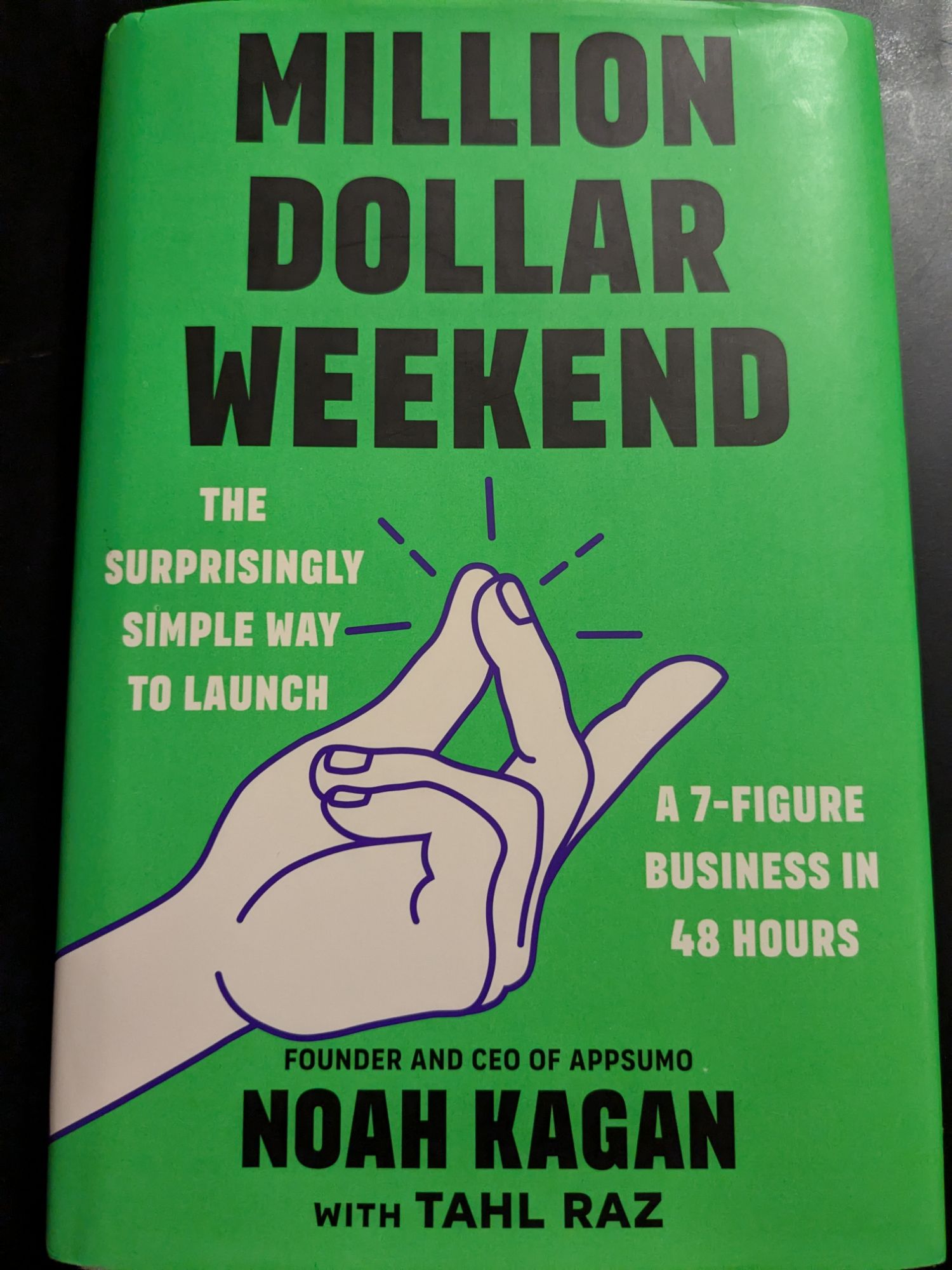
    I had been listening to podcasts on building side hustles for years. But it wasn’t until I read Noah Kagan’s book, Million Dollar Weekend, that I had a strategy to START RIGHT NOW.

    This post is a review of Kagan’s awesome book. The book is a quick read, but not because it’s lacking in content. It will light your mind on fire, and you won’t want to stop

    The three main ideas I’ll pull from this book here are as follows: 1) You must start NOW, or at least really soon, 2) Spend no money on your startup, take in prepayments instead, 3) Experiment, experiment, experiment.

    Let’s start with the first one first, because it’s the easiest to describe without getting too philosophical. But don’t worry, we will get philosophical below!

    1. Start NOW

    Though this is Kagan’s first step, it is probably the hardest part of the book to follow. It’s surprisingly scary to go ask someone to give you something for your crackpot invention, and so much easier to sit back and plan. For years.

    Kagan tells the story of when he was slinging internships at a college campus.

        Then one day my intern Kenny suggested we do a student discount card.
    
        Conventional wisdom said don't bother trying, and most people would have just accepted that reality, but growing up with my crazy salesman dad had toaught me never to take conventional wisdom at face value.  My dad taught me to always test things out for myself.
    
        Basically, I figured it wouldn't cost me a penny or much time to see whether local businesses would be interested, so right then and there I told Kenny, "Come on, let's go to town and ask a few shopkeepers if they'd be willing to participate and offer discounts."
    
        Kenny paused.  "You mean, like, right now?  Just walk the streets and ask whoever we find?"
    
        In my head a thought balloon popped up:  "NOW, Not How!"
    
        "Yes, NOW!" I responded.
    

    This is the core philosophy of the book. True entrepreneurs start first, and plan later.

    The point is that, if you sit on the couch planning how your new startup will take over the world, you will be sitting for a long time, and end up talking yourself out of it.

    If you shoot from the hip, you will get feedback on your idea very quickly, and be able to learn how to make the next pitch better.

    “Overthinking seems like the ‘smart’ way to launch,” says Kagan, “but it’s far less effective. Super-successful people do the opposite – they take action first, get real feedback, and learn from that, which is a million times more valuable than any book or course. And quicker!”

    2. Spend No Money

    This is truly a novel strategy from Kagan. The essence is that, before you decide that online lifestyle coaching will be your next side hustle, and spend $20,000 for a course, you need to validate your plan first.

    In computer programming, sometimes we call this “fail fast”. You don’t want to spend your resources building something that the customer doesn’t want, because you will waste a lot of effort. If your plan is shown to fail fast – like, in the span of one weekend – then you know that it’s a stinker! It won’t bring in a million dollars!

    According to Kagan,

        *The Golden Rule of Validation*
    
        Find three customers in forty-eight hours who will give you money for your idea.
        Success means moving quickly and spending no money.  And that's what makes the Golden Rule of Validation so effective.  Here's why it works so well:
    
        - *You'reallowed only forty-eight hours.*  Limitiations breed creativity.  Having a tight time limit will cut off the doubting wantrepreneur inside you and force you to iterate fast and be creative until you find something that works.
    
        - *Get your first three customers.*
    
        - *Collect money up front.* The _promise_ of payment is not valdation.  That's polite rejection.  Getting customers to hand over their dollars makes it real.
    
        The point is, if you can get someone to give you money quickly just by describing a product or solution, you're good!
    

    When you come up with an idea, quickly sketch out how much it should cost per person. Then, reach out to 3 people, and ask them to give you money NOW for the product. A family member, a friend, and someone else. You will deliver the product by a set future date.

    If they pony up, not only do you know that people are willing to pay for your idea without even seeing it, but you also have a bit of operating capital with which to fund the initial product offering.

    If you’re nervous that you might not be able to deliver, you can always add a caveat in the sales pitch that you’ll give the money back if something goes wrong.

    This is a special advantage we have in the 21st Century. Most people in the Western world are now comfortable giving some online outlet, like Amazon, a bunch of money up front, and then waiting up to a few weeks to receive the product. The “spend no money” strategy leverages this new cultural habit to your advantage. And, with services like Venmo and PayPal, you can do the whole thing without leaving your home.

    You might even get money rolling in! And you might get a bunch of NOs! That’s good too, because of the third important strategy: Experiment often.

    3. Experiment, Experiment, Experiment

    Kagan notes that one trait entrepreneurs tend to have, is the willingness to fail over and over in pursuit of a venture that sells. In that sense, the concept here is not new. But Kagan’s emphasis on this practice brings it to light for those of us who grew up in a cave.

    Kagan says it best here:

        Any analysis ahead of action is purely speculation.  You really do not understand something until you've done it.  Rather than trying to plan your way into the confidence to act, just start acting.
    

    To find a business idea that will bring in cash, you need to try things to see what will sell. You can’t come up with an idea, believe with all your heart it will work, then go all in with that belief. Maybe this works for one in a thousand people, but it is absolutely not guaranteed to work.

    What is guaranteed, is that your idea of what’s great is probably not identical to what others think is great. You need to prod people, and cause them to cough their true feelings up to you.

    The experiment gets your prospective customer to tell you what they want. It also informs you of what they don’t want.

    According to Kagan, the mental barrier, Fear of Rejection, gets easier to overcome the more times you do experiments. And, he says it won’t take a thousand rejections – probably only around half a dozen until you strike gold.

    Philosophical tangent

    First of all, reading this book almost makes me feel very stupid, because the path to success seems so clear and obvious.

    But second, Kagan’s ideas resonated with some ideas about the world that I keep coming back to.

    I used to work for Lyndon LaRouche. Yep, the same. The core of all his writings, at least those since around 1980, revolve around a model he developed about how human minds interact with the rest of the universe.

    LaRouche presents the concept of the “Theorem Lattice”.

    In Euclid’s presentation of his Elements, you start with a set of axioms, postulates, and definitions. Basically, assumptions taken for granted, from which all future theorems are derived. For example, one of the postulates is that if two lines (A and B) cross a third ©, and the interior angles on one side of that third line add up to 180 degrees (= two right angles), then those two lines A and B will never meet. In other words, they’re parallel. Later on in Book 1, Euclid uses this postulate to prove that the angles in a triangle will always add up to 180 degrees.

    In this way, Euclid combines his axioms, postulates, definitions, and derived theorems into a self-consistent architecture – the Theorem Lattice. All modern math textbooks do the same thing, by the way.

    LaRouche says that a person’s concept of the universe, or “world view”, has the form of such a theorem lattice. However, a person’s world view is never an exact representation of the real universe. For example, right now my youngest kid thinks that any plastic card he finds is able to buy a new toy. Oh, were that the case…

    So, in the case of an experiment, a person is comparing one theorem in his world view’s lattice (a hypothesis), with what really happens in the universe. If the result of the experiment doesn’t equal the hypothesis, well then that person has to change his axioms! LaRouche goes further, and says that you technically get a brand new theorem lattice, with new theorems that can’t be mapped exactly onto the old theorems.

    Two Parallel Lines, at right angles to a third line
    Two Parallel Lines, at right angles to a third line
    These two lines are also parallel, since they cross the third at the same angles
    These two lines are also parallel, since they cross the third at the same angles
    These two lines are NOT parallel, because they cross the third at different angles
    These two lines are NOT parallel, because they cross the third at different angles

    For a geometry example, it was shown around the time of Karl Gauss that there are surfaces on which you can draw triangles whose angles don’t add up to 180 degrees. If you try to draw a big triangle on the Earth, with one corner at the North pole, and the other two on the equator, the sum of your angles will always be greater than 180 degrees. So, that means the parallel postulate can’t be true, at least on Earth. Later, Einstein and others proved that it is not true in the real physical universe.

    On a sphere, triangles do NOT have angles that add up to 180 degrees
    On a sphere, triangles do NOT have angles that add up to 180 degrees

    When you come up with a hot sales idea, and then act like that baby will sell like hotcakes, you’re relying on a theorem derived from the basic assumptions of your world view. When you ask someone to give you money for that product, you’re challenging the real universe to either agree or disagree with your world view. If you can’t sell that product to anyone to save your soul, you’ve just proved you have some wrong axioms in your theorem lattice.

    The special thing that we humans are equipped to do is to change our minds! We can ditch the product idea and try something else!

    Whether Kagan’s system is underpinned by such deep philosophical/theological beliefs is not covered in his book. But, the idea that you need to run repeated experiments, and use the feedback you get to design the followup experiments, implies this kind of world.

    Conclusion

    If you have any inclination to become a rich person, I’d recommend you buy and read Kagan’s book. Every time I open my copy, I can hear Rabbi Noah yelling at me whatever words I read. “This is the fear in you worrying about too many things. Momentum is your friend, and we can sweat the details later.” and other such gems.

    The one book that moved me from desiring to acting is this one. Million Dollar Weekend. Please go buy it now.

    If you found this post interesting, please leave a comment below, share the article with friends, and add your email to my list for updates and other inspiring messages.

  • Cold Calls: Your Secret Weapon for Growth

    Cold Calls: Your Secret Weapon for Growth

    Once upon a time, I worked with an organization that had to raise funds. The two biggest parts of the job were talking to people at street corners to gather contact information by selling literature, and then calling those people back afterward. The point was to either get them to donate money, or come to meetings, or both.

    But, oh, those calls. I could sit and stare at that phone for hours and not make a single call. I would play procrastination games like organizing my contact sheets in the perfect order in which to make the calls. Or, spend hours scripting out the perfect briefing. Or, go take a two hour dump while reading a book.

    You may be asking, who cares about cold calls? Here’s the problem – I want to launch a successful business. This means I need a product to sell, and a market in which to sell it. In order to come up with a product, I need to know what problems need to be solved.

    So, for a given customer base, how do you find the problems that your creative genius can solve?

    That’s where cold calls come in.

    In this post, I’m going to describe how cold calls fit into my current business plan. Let’s call this the “reconnaissance phase” of entrepreneurship. I’ll also give some practical advice on how to carry out this phase of research.

    The goal here is twofold: 1. By telling you my plan, I will burden myself with the social pressure to carry it out, and 2. Maybe you will find some of these ideas useful, and use them to go make yourself a fortune.

    Solutions Need Problems!

    I don’t right now have a product, or any idea of a clear market demand. So, where do I find a pool of customers, and a product that solves a problem for those customers?

    Like you, I listen to a bunch of podcasts. Recently, I’ve been spending some time with two podcasts on side hustles: Side Hustle School and Side Hustle Nation. One podcast on Side Hustle Nation caught my eye. It’s about this Australian guy named John Logar who makes cold calls to company bigwigs, and sells them software that he doesn’t make. He hunts down companies in markets experiencing growth, and calls decision makers in those companies. When he gets one on the horn, he sweet talks them into divulging areas of friction facing the company. When he finds one that could be solved with software, he hires out a few freelancers to build the software, and boom, he’s sold a product!

    It’s probably more difficult than that. But the main idea is actionable – to find a real problem, talk to people to find their problems.

    One industry I found that is growing in the USA, is mining and resource development. It turns out, I have a master’s in Geology, which means I don’t know anything about mining or resource development, but I think I do! So, my reconnaissance phase involves finding companies taking part in the boom, finding the decision makers at those companies, and then hustling them to cough up their problems, so I can sell them the solutions.

    It couldn’t fail!

    Now, what if I actually get some dude on the horn willing to talk to a random for 60 seconds. What do I say? For the record, I’m the exact opposite of a crisp salesman who can talk to anyone about anything. My most comfortable state of being is holed up in my house talking to nobody.

    But, progress is not made without taking personal risks.

    The Questions

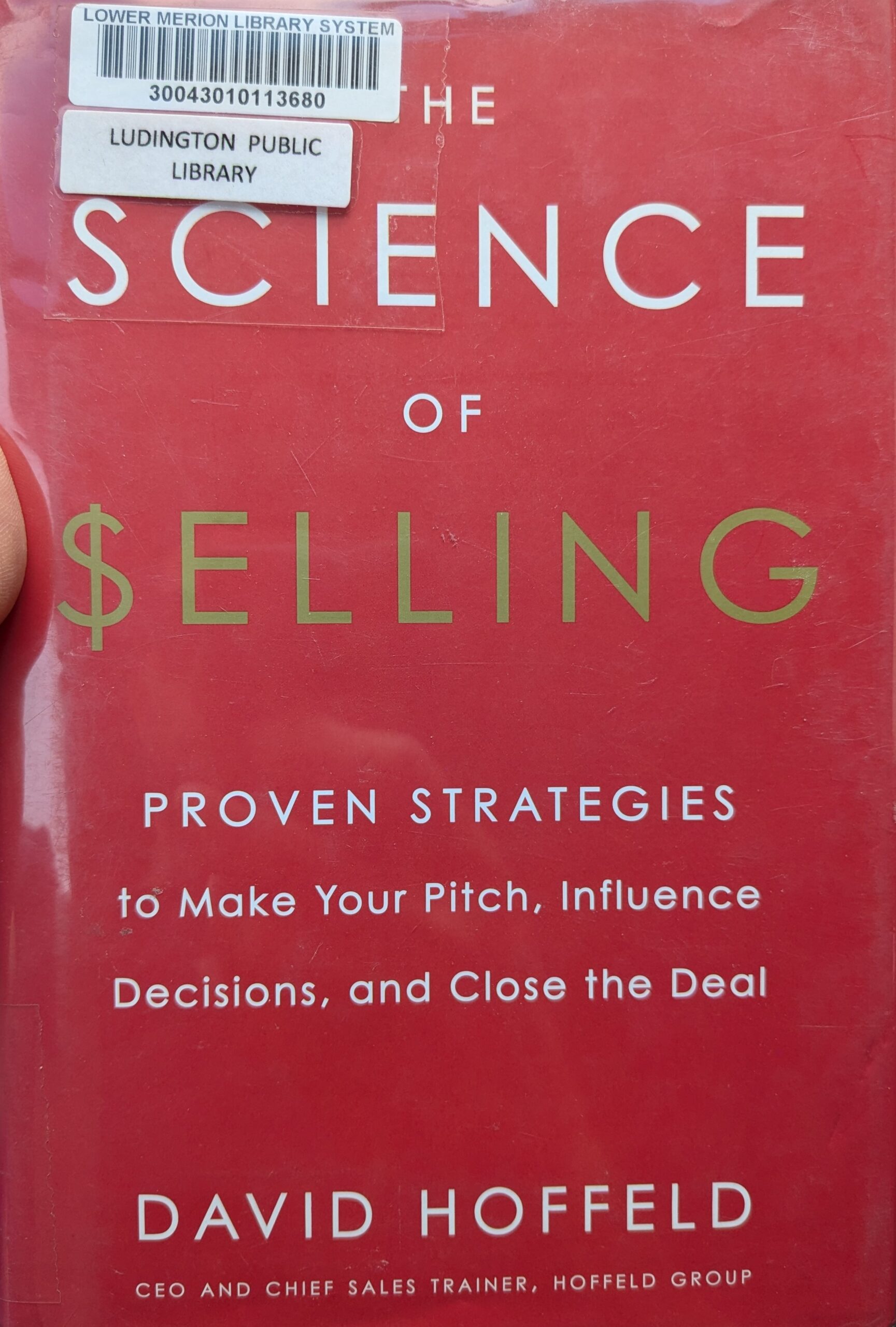
    I started reading a book a few months ago called The Science of Selling, by David Hoffeld. The author criticizes modern selling tactics as being born out of instinct instead of teachable skill. In response, he studied every research paper known to Man about the psychology and behavior of how people decide to buy. It’s a good book, and worth reading.

    The section pertinent to my challenge is on how to ask powerful questions. Hoffeld points out that we are typically taught to ask open ended questions, or questions that can’t be answered with a simple Yes or No. He then describes research that shows we typically don’t communicate in a logical progression, but rather tend to reveal information layer by layer, like an onion. So, he boiled it down to three successive layers of question to ask while hunting for primary buying motivations.

    1. Open up the topic to reveal thoughts, facts, behaviors, situations This is the layer that hunts for areas of friction or pressure. These are the typical open ended questions we’re taught to ask. Something along the lines of “In your opinion, what are the challenges faced by a growing company like yours?”

    2. The Elaboration Questions Here, you get the person to think through their opinions about what was revealed by the first layer of questioning. For example, “Why do you think it’s so hard to find qualified people for that specific role?”

    3. Desire for gain, Fear of loss Finally, get the person to express their desires or fears related to that problem. For example, “How much would you say it costs your company in terms of man-hours for each interview that leads to a non-hire?” Hoffeld calls these fears and desires the primary buying motivators, because they are the main reason the customer would be moved to trade money for solution.

    This third layer of questioning is also where you can gauge the actual dollar value of a solution. Logar from the Side Hustle Nation episode suggests that, once you know how much the client could save or make with a solution, a good value to charge for that solution is 10%. In other words, if your solution will save him $50,000, then your product is worth $5000. Ballpark.

    With these question guidelines, we have a map of how to get to the information we need from prospective clients. You and I are both creative enough to come up with a few potential solutions to whatever problem is revealed.

    Taking the First Steps

    With all these great ideas, I still haven’t made any calls. My goal in the next week or two is to make just one phone call. The bugbears in my way are fear of rejection, lack of time, and an internal critic that says “It’s never going to amount to anything.”

    But now that I’ve told you my plan, you will hold me to it, right? You might even want to take on the reconnaissance phase yourself, and get on the path to great fortune. I’ll follow up in a few weeks, and let you know how it’s going. If you’ve already made a few cold calls like this, leave your story in the comments below.

    If you enjoyed this post, please leave your email to get regular updates in your mailbox, and share the link with someone you know! Thanks for reading.