Tag: adhd

  • What is and How to Use Exposure Therapy

    What is and How to Use Exposure Therapy

    I’ve got two major diagnoses to deal with: ADHD-inattentive, and Anxiety. They both sprinkle generous heaps of caltrops on my daily path to extraordinary success.

    Closely connected to anxiety is Fear. This article is about how to deal with both.

    One form of anxiety that really stops my progress, is social anxiety. Here’s how it works. We live pretty close to a college bar. During big games or other college events, the line of kids with fake ids stretches down the block around the corner. They’re just kids to me. I have no problem interacting with college kids.

    But when I try to walk down the sidewalk next to this line of party, my knees buckle, I break out in cold sweat, my breath starts getting shallow. It takes everything I got to keep my body moving normally. I almost cry!

    My fears take over. “What if somebody says something to me”, “what if I’m dressed like a hobo?”, “What if…”, there’s always something that could happen that could embarrass me in front of all these people.

    In the end, who cares? For some reason, I do.

    But I’ve mostly gotten over this fear. The way I did it is through exposure therapy.

    In this article, I’ll explain what it is, how it works, and how you can design an exposure therapy strategy that will help you overcome your own fears, crippling or otherwise.

    What is Exposure Therapy?

    Exposure therapy is a strategy used by psychologists skilled in Cognitive Behavioral Therapy (CBT) to handle pretty much any fear or phobia their clients are trying to overcome. Practitioners of CBT believe that you don’t change underlying cognitive disorders by just talking about them. You start by changing actual behaviors. The new behavior drives the changes in the underlying condition.

    For example, let’s say you are afraid of snakes, like Indiana Jones. One glance at a snake generates massive, pants shitting fear, and an immediate urge to flee the scene to safety.

    The writers actually trapped Indy in a textbook forced-exposure scenario. In the opening of Raiders of the Lost Ark, when he hops into Jacques’s plane, he meets Reggie – the pet boa constrictor. Stuck in the cockpit with the snake, Indy can’t flee. He is forced to sit there, panic spiking, while the plane takes off. Because he can’t escape, his brain is eventually forced to realize that Reggie isn’t a threat compared to the poisoned darts behind them. That’s the core of exposure: staying put until the panic runs out of gas.

    It’s that assured survival that makes exposure therapy effective.

    The strategy is to put yourself into environments that you know will trigger that panic, handle it for a while, then exit. Once you exit, you reflect how you survived the interaction. You’re teaching your rat brain that you can willfully enter the threat zone, and be OK.

    As you structure those interactions to become riskier and riskier, you may not totally overcome the fear, but you do learn that you can do it.

    You grow your confidence.

    Design Your Own Exposure Strategy

    DISCLAIMER I am a writer sharing my personal experiences and research, not a licensed therapist or a medical professional. If you are dealing with severe anxiety, panic disorders, or trauma, please talk to a professional before trying to rewire your brain. Exposure therapy is a highly effective tool for everyday fears and social anxiety, but it is not a cure-all. Do not use this framework to jump off a roof, wrestle poisonous snakes, or try to navigate an active volcano. Know your limits, use common sense, and seek a qualified guide if you are dealing with the heavy stuff.

    I like to think about this as programming myself. I wrote a while back about how we are really at least three beings in one: Beast, Rider, and Marshall. The fear comes from that Beast, at which the Rider wheels the steed around and rides it to safety.

    We can instead wield the Marshall’s personality, and rewrite the commands executed by your Rider.

    What follows is called a Fear Ladder (or, clinically, an exposure hierarchy).

    1. Identify the Fear

    Vague fears cannot be targeted. You need to identify fears, and then identify the fears behind the fears, until you can’t go any further.

    For me, it’s any environment that screams “PARTY TIME” (surface fear). I’m afraid that I will get embarrassed and that it will matter (deeper fear). Really, I’m afraid that I don’t deserve love and will be abandoned (primary fear).

    For you, it may be something else. Maybe you’re really scared of spiders. Whatever, dig down. Use your Morning Pages to get to the root.

    1. Build the Fear Ladder

    Write down 10-15 scenarios related to your fear, and then rank them from 0 (completely relaxed) to 100 (blind panic).

    For example, in my case:

    Anxiety Score

    (0-100)

    Exposure Scenario
    Level 10 Asking the grocery store cashier how their day is going.
    Level 30 Asking a stranger on the street for the time or directions.
    Level 50 Making 5 minutes of small talk with another parent at a baseball game.
    Level 70 Attending a neighborhood block party for 30 minutes without a ‘shield’ person.
    Level 90 Sitting alone at a crowded bar and initiating a conversation.
    1. Identify and strip away “Safety Behaviors”

    This one is big, and people usually miss it.

    Safety Behaviors are things that we do to cushion our feelings during a scary situation, so we don’t actually have to face it. Common behaviors are: staring at a smartphone, mentally rehearsing every sentence before speaking, watching the TV, just concentrating really hard on something to pretend it’s important.

    To make exposure work, you have to eliminate these safety behaviors during the exercise.

    1. Execute the exposure!

    Start at the bottom of your Fear Ladder, and do the action.

    One thing I’ve been trying at this stage is to recognize when the anxiety starts to spike, when I start to feel the need to flee. At that moment, it helps to mentally holler “CHARGE!!!

    When you’ve gotten into position, don’t leave. The golden rule here is that you have to stay in the situation until your anxiety drops by half.

    If you leave the exercise while your anxiety is still spiking, you’re teaching your Rider that the only way to survive is by escaping. We need to stop reinforcing that belief.

    If you stick around and let the awkward feelings wash over you, eventually your brain will get bored and realize “I’m not dying”.

    1. Repeat

    Do that low level exposure over and over until it doesn’t spike your anxiety any more. Then, go to the next level of your fear ladder and do that exposure exercise.

    Keep going until that top rung of the ladder is yours!

    This process takes work, and it’s really easy to stop in the middle and think you’re cured. Or, think that you’re permanently screwed.

    Both of those are fictions! Keep going, and do the work.

    Bonus: Program Your Own Ladder with an LLM

    If you’re staring at a blank page struggling to break your fear down into 10 or 15 incremental steps, you can use an AI assistant (like ChatGPT, Claude, or Gemini) as a collaborative architect.

    The secret to getting a great clinical framework out of an LLM is providing strict constraints. If you just ask it for “an exposure ladder for social anxiety,” it will give you generic boilerplate. You need to give it a role, clear definitions, and an iterative process.

    Copy and paste this exact system prompt into your favorite LLM to map out your custom regimen:

    Act as an expert psychologist specializing in Cognitive Behavioral Therapy (CBT) and exposure therapy frameworks. 
    
    I want your help building a personalized "Fear Ladder" (exposure hierarchy) for a specific fear I want to conquer. Before generating the ladder, you must understand two things:
    1. My surface fear, deeper fear, and the situations that trigger me.
    2. The "safety behaviors" (crutches, distractions, avoidance tactics) I usually use to hide from this fear.
    
    Do not generate the entire ladder yet. First, ask me 2–3 targeted questions to get the context of my specific anxiety. 
    
    Once I answer, you will output a clean Markdown table with columns for:
    - Anxiety Score (0 to 100, graduated in increments of 10-20)
    - Exposure Scenario (Highly specific, real-world actions)
    - Safety Behaviors to Eliminate (The specific crutches I am forbidden from using during that step)
    
    Acknowledge that you understand, and ask your first questions.


    Why this prompt works:

    • The Interactivity Gate: By telling the AI not to write the ladder immediately, you force it to interview you. This ensures the final output is tailored to your actual life, not a generic textbook definition.
    • The Safety Behavior Constraint: Forcing the LLM to explicitly list which “crutches” you have to abandon at each rung removes your ability to cheat the system when it’s time to execute.

    Give it a spin with your own root fears and see how sharp of a tracking matrix it builds for you.

    If you’ve tried using your own exposure hierarchy, write about it in the comments. Who knows, someone with your same anxieties may read it and get inspired.

  • How I Used AI to Make Technology Disappear (and Saved My Son from “Screen Withdrawal”)

    How I Used AI to Make Technology Disappear (and Saved My Son from “Screen Withdrawal”)

    Mid-year 2025, my son became obsessed with Major League Baseball. He had started playing Little League the year before, and we had seen a couple of Phillies games, but suddenly he was hooked on the progress of the season.

    There was just one problem: my kid is a screen hunter.

    When he wakes up in the morning, he hunts for the TV remote. If he can’t find that, he hunts for the Nintendo Switch. Then the tablet, the computer, my phone, and my wife’s phone. You get the idea. He’s on the hunt.

    We’ve been trying to address this because once he gets on a screen, getting him off is nearly impossible. It usually leads to a “verbally violent” outburst-from him, not us-and he stays a bit of a jerk for a while after.

    My wife and I call it “screen withdrawal,” and with our two boys, it feels very real.

    The baseball scores became a flashpoint. I wanted him to follow the scores; it’s an innocent hobby, there’s math involved, and it’s the National Pastime. But I didn’t want him looking at a screen to get them.

    The “Screamsheet” Solution

    My first workaround was digging into the scores myself and dictating them to him, but that’s a hassle when you’re trying to get breakfast on the table and kids out the door for school.

    Then I tried supervised screen time, but the second I turned my back, he’d drift from baseball highlights into the typical “junk” on YouTube. The algorithms don’t care about your age; they only care about keeping you watching.

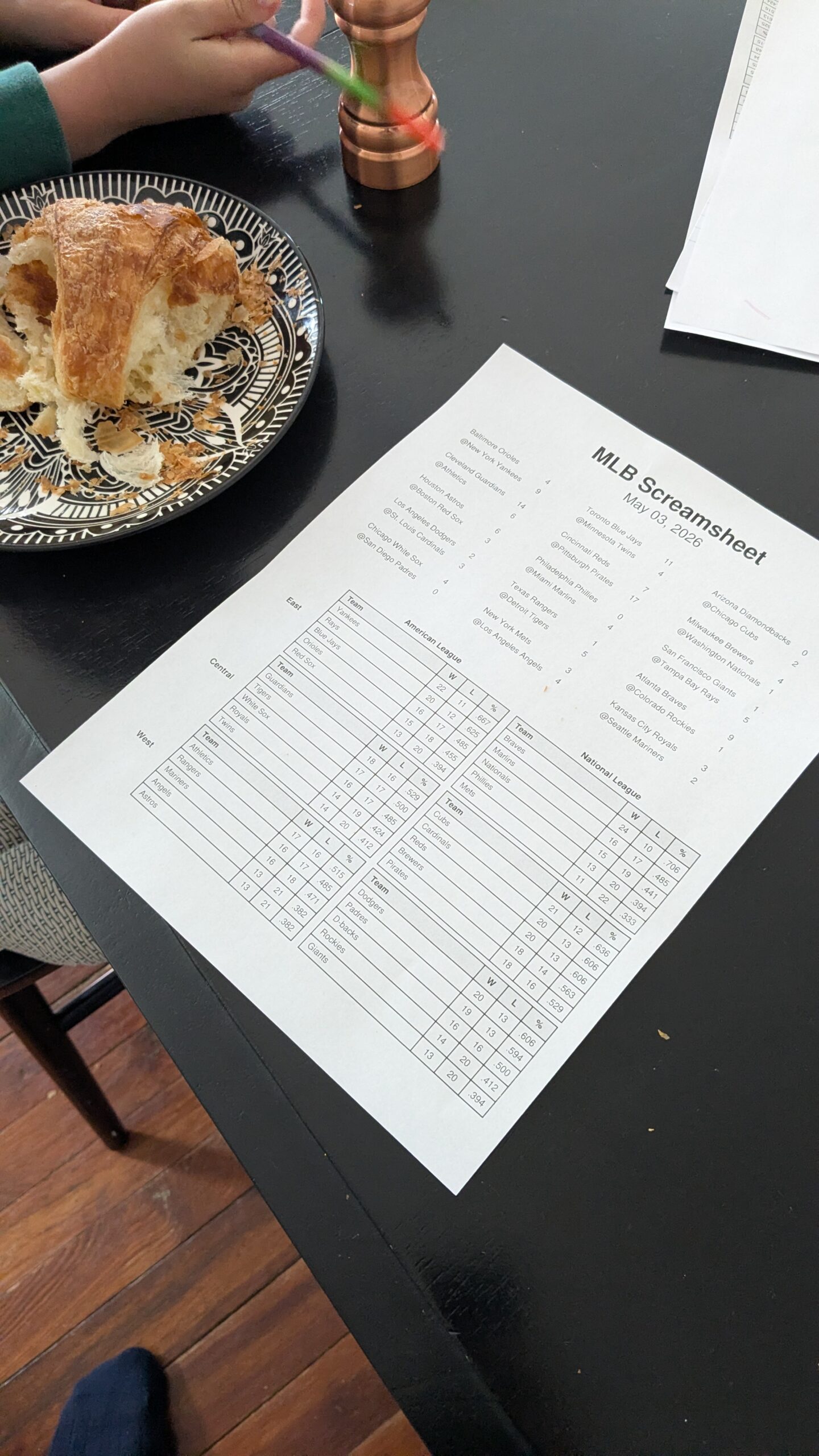
    Then I remembered something from my childhood. I used to be into cyberpunk role-playing games-not even playing them, just delving into the worlds they created. I remembered a futuristic item called a “Screamsheet.” The idea was basically a high-tech fax machine: you put in a buck, it prints out a sheet with the latest headlines, you read it, and you toss it away. I thought: Wouldn’t it be great to create a Screamsheet for baseball? A physical page that prints every morning, ready for my kid to read like his own little newspaper.

    Building with the “Vibe”

    I decided I wasn’t going to program this all by myself. I was going to get AI to do the heavy lifting. I fired up Gemini and told it what I wanted: a morning summary of yesterday’s games, who won, the scores, and a chart of the current standings.

    Gemini spit out the Python code. I stuck it in a GitHub repository and started running it. It uses an online API (MLB Stats) to pull the data, assembles it into tables, creates a nicely formatted PDF, and drops it into a folder.

    The last mile was the hardware. We have one Linux box in the basement connected to a printer. I used Gemini to help me write a simple Bash shell script and a “cron job” that tells the computer to run the program and print the file automatically at 6:00 AM.

    The Result: A Silver Bullet

    The first morning it worked, I heard the printer running at 6:00 AM on the dot. I ran downstairs, grabbed the sheet, and put it on the kitchen table. My son came down, saw it, and just started reading while eating his breakfast. He didn’t say a word, but he also didn’t hunt for a screen.

    Then he told me “Dad, the Brewers are the top team” (he likes poking at my Wisconsin heritage).

    But I didn’t care about the Brewers at that minute – Team Parents had won this game!

    Since then, I’ve embellished it. If the Phillies played, the back of the sheet now features a full box score and a “journalistic blow-by-blow” generated by the Grok API.

    I even modified the prompt to match my son’s morning mood: if the Phillies (or whatever team you pick as your favorite) lose, the AI is instructed to write the summary like a local fan who is absolutely fed up-just totally throwing the team under the bus and ready to chuck a cheesesteak at the wall. Matching his “energy” has actually helped my boy commiserate and get a kick out of the loss instead of just losing it himself.

    Expanding the Feed

    Once the season ended, I kept the habit going with MLB trade rumors so he could read about how teams were transforming in the off-season. Now, I’ve expanded the system to include:

    • NHL and NFL scores.
    • The Presidential Screamsheet: A morning scan of news sites and WhiteHouse.gov, summarized by AI into stories under 200 words.
    • The Sky Tonight: A front-page star chart with an LLM-generated “reenactment” of Star Hustler’s Jack Horkheimer describing the night sky, plus horoscopes for my wife and me.

    Making Technology Invisible

    The point of all this is that I’ve taken advanced technology – Large Language Models – and used them to make technology disappear. Instead of sifting through an infinite scroll of noise and being held hostage by an algorithm, we’re reading good old-fashioned paper. The computer is now an invisible aspect of our morning.

    This personal project actually mirrors a larger movement happening in my own community right now. My wife has been active in the Lower Merion School District board meetings, where a growing group of parents is pushing for a “Bell to Bell” phone ban and the right to opt-out of 1:1 tablet use in favor of Pencils Over Pixels.

    My goal is to use AI to make technology as invisible to my eyes as possible so I can regain my concentration and attention. I can force these tools to give me exactly what I want to see and hear, and nothing else.

    I’ve posted the link to the code below. It’s all on GitHub – feel free to fork it and make it your own. It includes architecture diagrams and READMEs so your own LLM can read the docs and help you extend it to whatever you’re interested in.

    If you have questions on the setup or suggestions for new sheets, drop a note in the comments!

    Screamsheet

  • Use AI To Get The Fire Blazing

    Use AI To Get The Fire Blazing

    Disclaimer: this post contains affiliate links. If you click on them and buy the products, I’ll get a cut of the profit. They’re good products!

    This post is pretty much going to be a list of ways I use AI in my general life, which I do every day. I’ve found these programs to dramatically help me overcome blocks, get things done, and make sense of my world.

    I remember when ChatGPT first stormed the ramparts back in 2022. I felt great apprehension, that they would steal my creativity and render myself just a stick of meat.

    However, when I first started creating this blog, I got hooked. I certainly wrote all the articles, but I used the AIs to get things over the goal line. Whenever I got stuck writing or looking for ideas, I would just paste my draft and my frustrations into Google Gemini, and it would IMMEDIATELY spit out ideas.

    In fact, the name Distracted Fortune came out of just such a brainstorming session. I told it who was the target audience (you, dear reader!), and what the intended story was, and then demanded 25 short titles. Over and over again. I don’t remember it ever coughing up exactly “Distracted Fortune”, but the ideas it did spit out led to the title.

    The main ways I use these programs is to generate ideas, research products, overcome blocks, stay on task, and of course, write programs. I’ll go over each in turn.

    The AI Toolbox

    There are a few AI chat bots you could turn to. I find they each have their strengths and weaknesses, their own personalities. Here’s how I choose:

    1. Google Gemini

    This is the generalist, my first stop. I have a few specific prompts stored in its memory so it can refer to specific aspects of my life and travails when answering questions. It can also search the web, save things in Google Keep, adjust or check my Google Calendar, and integrate with my Google Home smart devices.

    Also, full disclosure, I have a premium account here because I pay for Google Storage. So, you might not get as much mileage with Gemini as I do.

    1. Grok

    Grok is like my crazy conspiracy theorist buddy. It has realtime access to all of X (nee Twitter), so it’s my primary news source. I go here if I need a rundown on a specific story.

    1. Github Copilot

    This is my programming buddy. I have it integrated into my Visual Studio Code, so I can tell it what I want a program to do, and it will just write it all up for me. It’s also available directly on GitHub, where it can review my code repositories, create issues, and do other programmy things.

    1. ChatGPT

    I use this one mostly at work. It’s also a generalist, can search the web, and give me code snippets. However, I find it has the ability to think a little deeper than the other three. Really, I just use it as a different voice in the pack.

    Sometimes, if I don’t trust an answer from one of these, I will put the whole conversation into another. I recently reorganized my whole family finance review system, and had to shop the discussion back and forth to all four of these.

    Generate Ideas

    “Hey Program, give me a few ideas for a date with my wife next Friday, during the day.”

    Yes, I have a bit of a date palsy. But Gemini does not! Within moments, it will hunt through Maps to find locations open on the day and time within walking distance, see if they’re open, and see if any of the places have something interesting scheduled. Then, it will list them out, along with suggestions how to make each spot extra fun.

    You see, these programs don’t have emotions, so they don’t get hung up on the emotional weight of the ideas. They just get automatically generated.

    Research Products

    “Hey Program, I want a watch I can wear at night so I can see what time it is. Should be big enough so I can see the time without my glasses, track my sleep, and be cheap as hell. Give me three options.”

    Bam! Three options in three seconds. No more scouring product reviews and “here’s some random junk available on Amazon right now” sites. The LLMs will give a few leads right away, especially if you tell it a LOT about what you’re actually looking for. Remember, these programs have context windows that can hold around 100,000 words. They remember your entire conversation.

    Tell it what you’re looking for, criticize its first, second, third tries. You’ll eventually get to whatever you were looking for out of the billions of possibilities.

    (I ultimately got an Amazfit Band 7)

    Overcome Blocks

    I started writing this article about five times. Finally, I put my fullest draft into Gemini and told it I thought it just wasn’t going in the right direction, sounded too self deprecating, and needed to change. It suggested I cast AI not as a crutch, but more like “an exoskeleton” that accentuated my abilities. Then, it gave me a few ideas for an introduction.

    I didn’t actually use any of those introductions, but it got me moving on the current draft.

    If you’re ever having trouble starting something, just tell the LLM what’s going on, and you need some help. Sometimes, all you really need is a few novel ideas to get moving.

    Stay on Task

    Most LLMs have some kind of memory storage, where you can make it remember important details about you so you don’t have to repeat every time you return.

    Back when I was building my SigmaK annual filing program, I realized too late that I hadn’t pitched it to anybody yet, and I’d sunk a lot of time into it. After breaking down, gnashing my teeth, shaking my fist at the sky a few times, I came up with a new idea. I had Gemini help me come up with a memory it could store, which we call both “Prime Directive” and “Golden Rule”.

    Every three prompts, Gemini must warn me that I’m going down a research hole, and then ask me what person I will discuss the topic with. “No idea is finished until it’s tried on a real person.” It’s annoying, but it does get me to move and talk to people as a first step now.

    Write Programs

    My boys are into baseball. They’re also into screen time. Their parents are into NO screen time.

    After spending a few mornings prying various devices out of my oldest kid’s hands, I came up with an idea. His “foot in the door” was to explain he just wanted to check the MLB standings from the day before. I decided to write a program that would print out the standings on paper every morning at 6am.

    Out of that thought, the Screamsheet was born.

    Really, I had GitHub Copilot write the program for me. It’s since expanded from baseball scores to hockey scores, MLB news, and political news (for Dad). I even have the Grok API summarize games for me. You can see the code here.

    AI is a Life Lever

    The reason for this post isn’t to get you to use a new program. It’s to use a special kind of program to get more effective in the real world.

    I don’t talk to Gemini to keep talking to Gemini. I talk to Gemini, so I can be more present with my kids, talk more clearly with my wife, and have better control of where my money goes.

    Use these things as tools. These programs are what we always hoped search engines would be: a way to cut through the noise and find the signal.

    Now, time to put down your phone and go do something interesting.

    If you liked this article, please leave a comment below, share it with someone you know, and get on my email list!

  • Reviving a Dead Blog: My New Strategy

    Reviving a Dead Blog: My New Strategy

    It’s been a couple months since I published anything on here.

    I’m back.

    Here is the plan.

    The Web Log

    I’m not going to push for 1000-1500 word self-help guides anymore. Instead, I’m going back to the roots of the blog form.

    For now, I’ll shoot for 250-500 words instead, and talk about what I’ve been up to. Things I’ve tried, things I’m working on, failures I’m trying to learn from, and other subjects that end in prepositions.

    For example, I spent winter vacation in Stowe, Vermont, working on a product to sell to small hedge funds. It’s a report that compares annual SEC filings from companies to their prior-year filings, to identify any new or deprecated risks.

    I’m still working on it, and kind of shipped a version of one to a hedge fund guy. He never responded, and I put the kibosh on the project.

    Why?

    Because I’m committing to a different strategy now. Ship first, build second. I should have ham-fisted a report with my own eyeballs and fingers first, before trying to build a computer system to do it. Then, ship that and see if there’s any interest at all.

    If there’s no interest, why waste the time banging out code!?

    Mailing list

    Besides maintaining an exciting log of my weekly foibles and follies, I’ll send out a weekly email with my latest thoughts to you lucky subscribers. No more random links, no 1500 word manifesto. Just me, sharing what’s working and what’s not, as I build in public.

    So, put down your drink, enter your email address, and hit Subscribe.

    Thanks for reading. See you next week!

  • Article Review: Tim Beshara “Inattentive ADHD and Me”

    Article Review: Tim Beshara “Inattentive ADHD and Me”

    Disclaimer: this post contains affiliate links. If you click on them and buy the products, I’ll get a cut of the profit. I promise they’re good products!

    Author Tim Beshara wrote a great article a few months ago on what it’s like to be a high-functioning guy with ADHD-I. I read it first on ADDitude’s website, but it was first published on Medium.

    For review, ADHD-I is also called ADHD (Primarily Inattentive). This means that you have the same executive functioning problems as other people with ADHD, but you don’t have the hyperactivity. The main symptom is that you appear to get distracted easily.

    It reminds me of this legendary character in William Gibson’s book Count Zero named Wilson. The protagonist kid is just learning how to be a hotshot computer hacker, and when he messes up he says he “pulled a Wilson”. His mentor responds, “Wilson, I knew the guy.”

    Protagonist: “Was he dumb?”

    Mentor: “No, he was smart as hell. Just a complete f— up is all.”

    Beshara captures the feeling precisely. Below, I’ll reprint a few quotes that stuck out to me, and say why they did, but I suggest you read the original article. Some issues you, dear reader, face each day may be due to this disorder.

    What Stuck Out

    1. “[E]ven if I’ve reminded myself several times I need to put my lunch in my bag before I walk out the door for work, the thought will simply not enter my mind at all.”

    You don’t even remember that you need to remember something. It’s only since getting on meds that I realized my awful memory may have something to do with ADHD. The need to remember something short term can couple with the fear of forgetting, and drive me into a real panic attack.

    1. “You get judged by your friends, colleagues, teachers, partners and relatives as being weak in character or lazy. And you don’t know if they are right. Eventually you believe them.”

    This is something dangerous to both close relationships as well as job security. I got serious about my ADHD at the prompting of my wife. After the first few years with her, I began to think that maybe I really did want to hurt her by not doing important things, or by doing important things half-assed. Nope. It’s typical ADHD-I.

    1. “People diagnosed with ADHD later on in life, like I was, wear the scars of a lifetime of judgment from failures you could never explain.”

    Beshara begins his journey by visiting a psychiatrist to get diagnosed for a mood disorder, only to find that the mood disorder is a result of his ADHD.

    One good effect I’ve seen in myself since being diagnosed, is my interest in helping others afflicted with this silent knee-capper. For example, I’m very conscious now of building habits to defeat the effects brought on by ADHD. Since I’m so conscious of this, I am eager to help others build the same habits, so they don’t have to go through half their life wondering why they suck so bad.

    As the existence of Beshara’s report demonstrates, he feels the same way.

    Read Beshara’s article!

    Please go read Beshara’s article, and share it with your friends. It’s good for us to know what events and self-conceptions were caused by ADHD-I, and it’s also good for our loved ones to know what we’re going through.

    If you liked this article, please leave a comment below, share it with someone you know, and get on my email list!

  • Put Another Link on the Chain!

    Put Another Link on the Chain!

    Disclaimer: this post contains affiliate links. If you click on them and buy the products, I’ll get a cut of the profit. But I promise I’ll only link to products I think you’ll like!

    A few weeks ago, I was asked to write an article on the Moon, and to focus on the Chinese sample returns. Day turned into week. Week turned into two weeks. And BOOM! I broke my chain of success.

    The Chain is a concept I first heard about from Jerry Seinfeld. I swear I heard him talk about it, but all I can find now is a story, where a young comic asked Jerry what was the secret to great comedy. Jerry said “Tell a lot of jokes. Write at least one joke every day. Draw a big red X every day you write a joke, and don’t miss a day. Don’t break the chain.”

    The idea here is that, after identifying some habit you want, you mark it on a calendar every day you do it. For me, my goal was to write an article for this blog once a week. When you focus on building that chain of successes, you are carving for yourself a consistent habit for long-term personal success.

    Atomic Habits

    Another guy who talks about this is James Clear, of Atomic Habits fame. He looks at these chain links as little micro-encouragements, micro-rewards. Each time you put another link on the chain, you get a little hit of dopamine that reinforces your identity. “This is what people like me do!”

    The other strategy Clear adds is that, if you DO break the chain, get right back on that horse. If you skip a link, don’t skip two.

    Now here is where my problem really lies. Once I miss a link, I miss the next one. And the next one. And, before I know it, my chain is long gone.

    Then comes the guilt and the inner critic. “Of course you broke the chain. It’s because you suck.” I think what actually happens here is that I start a new chain that reinforces my identity as a chump.

    The solution is really easy – just do the habit again and restart the chain. But, that’s easier said then done.

    The Chain and ADHD

    For those of us with ADHD, we tend to spiral and wallow. We constantly listen to that inner critic, and wind up agreeing with it. It’s like when a song gets stuck in your head. That song can play over a thousand times in there, maybe without you noticing it.

    The inner critic does that too, but it’s not just annoying, like that song; the inner critic reinforces an awful identity.

    The only way to end the song, and the inner critic, is to stop what you’re doing and confront that internal parasite. With the song, you can consciously stop the music, or think of a different tune.

    It’s a little more difficult with the inner critic. With the critic, it’s useful to challenge what he’s saying.

    “You’ll never start that habit, you suck!” Not true, I did keep that chain going, just had a little setback.

    “You’re no writer, you suck!” No, a person becomes what he does. If I want to be a writer, I just need to write every day, which I did for a while.

    “You’re a glutton, and you’ll never change. You suck, fat ass!” No, I did slip up and missed my salad yesterday, but I was doing fine for a while.

    “You’re just a fat weakling! Get over it, you suck!” Not true. I just missed a few days at the gym. I can get back on this horse, you imaginary critic parasite.

    After confronting the inner critic with real evidence for a bit, turn him off. Go put another link in your chain.

    Get into the chain business

    The real topic here is, all us distracted people want to get wealthy, but that’s impossible without focus. The chain helps us create a discrete continuity over a long period, of small actions that build toward larger goals.

    In the words of Seinfeld: “No one’s really that great. You know who’s great? The people that just put tremendous amount of hours into it. It’s a game of tonnage.”

    I believe that if you give the Chain a try, it will become a key to your success.

    So how do you start?

    1. Find your focus

    This is the tough part. Pick something you want to do every day, something not too big. “I’ll read for 2 hours every day” probably won’t happen. But “I’ll read for 10 minutes every day” has a chance.

    For another example, “I’ll go to the gym every day” is probably not going to happen. You’ll stop after like two days. But, “I’ll put on my running shoes every day” takes less than a minute. With those shoes on, you’re much more likely to actually go for the run.

    And if you don’t go for the run, you can still put an X in your calendar.

    1. Get a calendar

    This can be a big wall calendar, or something DIY like a row of boxes drawn on a piece of paper, with dates written over them. The main thing is, you need something that can bear a visual record of your successes, something you can mark up.

    If you just have to have an app on your phone, try Habitica. It has pretty good reviews, and can do more than just track the chain.

    1. Be compassionate

    If you miss a day, don’t be too hard on yourself. Even if you miss a week, don’t let that boring, poor inner critic take over. Just try to put another X on the calendar today. The more you do it, the more enjoyable it gets.

    Remember, consistency is the key. Give the Chain a try, and watch yourself blow past your goals.

    This article is evidence that I put an X on my calendar today.

    If you liked this article, please leave a comment below, share it with someone you know, and get on my email list!

  • Cold Calls: Your Secret Weapon for Growth

    Cold Calls: Your Secret Weapon for Growth

    Once upon a time, I worked with an organization that had to raise funds. The two biggest parts of the job were talking to people at street corners to gather contact information by selling literature, and then calling those people back afterward. The point was to either get them to donate money, or come to meetings, or both.

    But, oh, those calls. I could sit and stare at that phone for hours and not make a single call. I would play procrastination games like organizing my contact sheets in the perfect order in which to make the calls. Or, spend hours scripting out the perfect briefing. Or, go take a two hour dump while reading a book.

    You may be asking, who cares about cold calls? Here’s the problem – I want to launch a successful business. This means I need a product to sell, and a market in which to sell it. In order to come up with a product, I need to know what problems need to be solved.

    So, for a given customer base, how do you find the problems that your creative genius can solve?

    That’s where cold calls come in.

    In this post, I’m going to describe how cold calls fit into my current business plan. Let’s call this the “reconnaissance phase” of entrepreneurship. I’ll also give some practical advice on how to carry out this phase of research.

    The goal here is twofold: 1. By telling you my plan, I will burden myself with the social pressure to carry it out, and 2. Maybe you will find some of these ideas useful, and use them to go make yourself a fortune.

    Solutions Need Problems!

    I don’t right now have a product, or any idea of a clear market demand. So, where do I find a pool of customers, and a product that solves a problem for those customers?

    Like you, I listen to a bunch of podcasts. Recently, I’ve been spending some time with two podcasts on side hustles: Side Hustle School and Side Hustle Nation. One podcast on Side Hustle Nation caught my eye. It’s about this Australian guy named John Logar who makes cold calls to company bigwigs, and sells them software that he doesn’t make. He hunts down companies in markets experiencing growth, and calls decision makers in those companies. When he gets one on the horn, he sweet talks them into divulging areas of friction facing the company. When he finds one that could be solved with software, he hires out a few freelancers to build the software, and boom, he’s sold a product!

    It’s probably more difficult than that. But the main idea is actionable – to find a real problem, talk to people to find their problems.

    One industry I found that is growing in the USA, is mining and resource development. It turns out, I have a master’s in Geology, which means I don’t know anything about mining or resource development, but I think I do! So, my reconnaissance phase involves finding companies taking part in the boom, finding the decision makers at those companies, and then hustling them to cough up their problems, so I can sell them the solutions.

    It couldn’t fail!

    Now, what if I actually get some dude on the horn willing to talk to a random for 60 seconds. What do I say? For the record, I’m the exact opposite of a crisp salesman who can talk to anyone about anything. My most comfortable state of being is holed up in my house talking to nobody.

    But, progress is not made without taking personal risks.

    The Questions

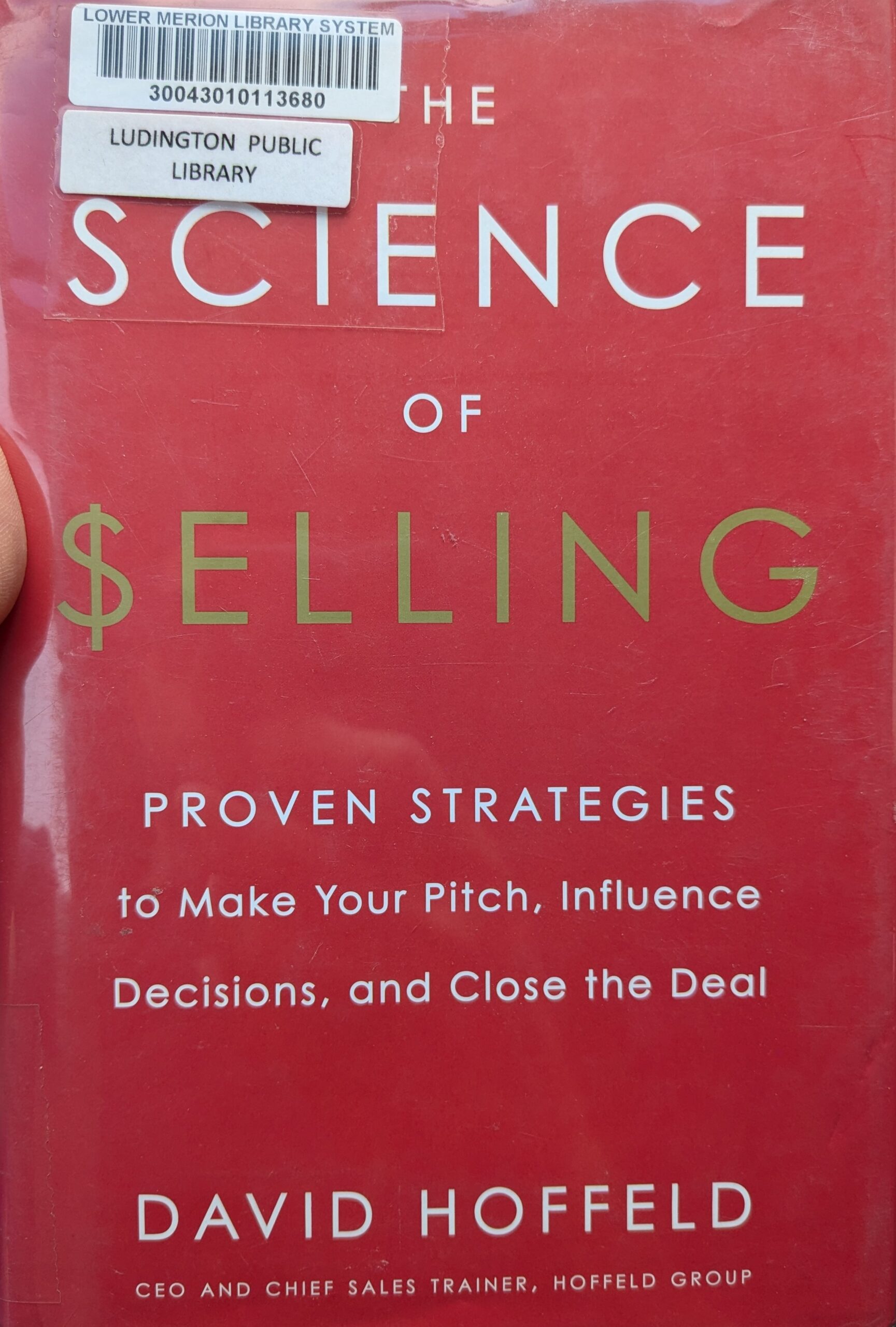
    I started reading a book a few months ago called The Science of Selling, by David Hoffeld. The author criticizes modern selling tactics as being born out of instinct instead of teachable skill. In response, he studied every research paper known to Man about the psychology and behavior of how people decide to buy. It’s a good book, and worth reading.

    The section pertinent to my challenge is on how to ask powerful questions. Hoffeld points out that we are typically taught to ask open ended questions, or questions that can’t be answered with a simple Yes or No. He then describes research that shows we typically don’t communicate in a logical progression, but rather tend to reveal information layer by layer, like an onion. So, he boiled it down to three successive layers of question to ask while hunting for primary buying motivations.

    1. Open up the topic to reveal thoughts, facts, behaviors, situations This is the layer that hunts for areas of friction or pressure. These are the typical open ended questions we’re taught to ask. Something along the lines of “In your opinion, what are the challenges faced by a growing company like yours?”

    2. The Elaboration Questions Here, you get the person to think through their opinions about what was revealed by the first layer of questioning. For example, “Why do you think it’s so hard to find qualified people for that specific role?”

    3. Desire for gain, Fear of loss Finally, get the person to express their desires or fears related to that problem. For example, “How much would you say it costs your company in terms of man-hours for each interview that leads to a non-hire?” Hoffeld calls these fears and desires the primary buying motivators, because they are the main reason the customer would be moved to trade money for solution.

    This third layer of questioning is also where you can gauge the actual dollar value of a solution. Logar from the Side Hustle Nation episode suggests that, once you know how much the client could save or make with a solution, a good value to charge for that solution is 10%. In other words, if your solution will save him $50,000, then your product is worth $5000. Ballpark.

    With these question guidelines, we have a map of how to get to the information we need from prospective clients. You and I are both creative enough to come up with a few potential solutions to whatever problem is revealed.

    Taking the First Steps

    With all these great ideas, I still haven’t made any calls. My goal in the next week or two is to make just one phone call. The bugbears in my way are fear of rejection, lack of time, and an internal critic that says “It’s never going to amount to anything.”

    But now that I’ve told you my plan, you will hold me to it, right? You might even want to take on the reconnaissance phase yourself, and get on the path to great fortune. I’ll follow up in a few weeks, and let you know how it’s going. If you’ve already made a few cold calls like this, leave your story in the comments below.

    If you enjoyed this post, please leave your email to get regular updates in your mailbox, and share the link with someone you know! Thanks for reading.